After the first awakening: Reaching the other shore

大道無門      The Great Way is gateless,
千差有路      Approached by a thousand ways
透得此關      Once past this checkpoint
乾坤獨歩      You stride through the universe
– The Gateless Gate (a collection of koans)

“From now on it is not necessary for you to study the Buddha-doctrine and to investigate to the limit the ancient and modern cases. It’s just a matter of eating when hungry and sleeping when tired.” – Gaofeng Yung

“Let him who seeks continue seeking until he finds;
when he finds, he will become troubled;
when he becomes troubled, he will be astonished;
and he will rule over the All.” – Gospel of Thomas (Lambdin)

“He who seeks will not give up until he finds;
and having found, he will marvel;
and having marveled, he will reign;
and having reigned, he will rest.” – Gospel of the Hebrews

“Don’t read the sutras, practice meditation; don’t sweep the floor, practice meditation; don’t plant the tea seeds, practice meditation; don’t ride a horse, practice meditation.” – The Priest of Shinju-an

A man cannot attain to this birth except by withdrawing his senses from all things. And that requires a mighty effort to drive back the powers of the soul and inhibit their functioning. This must be done with force; without force it cannot be done. As Christ said, “The kingdom of heaven suffers violence, and the violent seize it.” (Matt. 11 : 12 ) – Meister Eckhart, Sermon Three (Walshe)

When thus the Bodhisattva, discarding all effortful works (sarvdbhogavigata), attains to the effortless state of consciousness, he enters upon the eighth stage known as Acala, the Immovable. – Suzuki (1929, p. 225)

Purgation

There are as many paths to enlightenment as there are seekers; each one must travel his or her own path, depending on no one. Enlightenment comes down to a decision, made in an instant of thought, to let go of the self. This only possible after one has let go of all attachments to the world. As Lester Levenson said, “When the ego is zero, God is all.” Madame Guyon said, “The less there is of the self, the more there is of God.” Meister Eckhart said, “You must know, too, that to be empty of all creatures is to be full of God, and to be full of all creatures is to be empty of God.”

We must school ourselves in abandoning till we keep nothing back. All turbulence and unrest comes from self-will, whether we know it or not. We should place ourselves with all we have in a pure renunciation of will and desire, into the good and precious will of God, together with everything that we may will or desire in any form. – Meister Eckhart (Vol. III, p. 48)

If you are not releasing, see Letting go of the ego and Letting go of the mind. One must continue to let go of the ego until complete enlightenment is achieved. If you take notice of any person or event, if you recollect any person or event, there is an ego-attachment that you need to let go of.

Dreams tell us about deeply buried feelings and desires. Begin releasing immediately when you wake up from a dream. If you have a dream of enlightenment, release the ego-desire for enlightenment.

The process of purgation is nearly complete when the world seems dreamlike— mayopama.  You have already had realizations that people and things don’t exist, but they aren’t nonexistent either: meditatively you are entering the form realm. The initial euphoria you felt when you had your awakening may have subsided: “The fourth jhana similarly lacks happiness, and possesses just one-pointedness and equanimity” (Buddhist Meditation). Lord Alfred Tennyson wrote, “There is no joy but calm!” (The Lotos-Eaters)

Fear and hope are alike beneath it. There is something low even in hope. In the hour of vision, there is nothing that can be called gratitude, nor properly joy. The soul raised over passion beholds identity and eternal causation, perceives the self-existence of Truth and Right, and calms itself with knowing that all things go well. – Ralph Waldo Emerson (Self-Reliance).

Identity with what you are

“There’s neither a higher self nor a lower self. There’s only you, identifying with your limitless being or identifying with your limited being.” – Lester Levenson

From this point on you must focus only on achieving identity with what you really are—the one Self—and forget about all people and all things.  You may have begun your journey by asking your “higher Self” for help’; gradually your perspective should shift, so that you are that Self. You should begin to see your ego-self as no more than a series of repetitious thoughts, like an old record album playing the same old songs. You should start to identify with an “I” which encompasses everyone and everything. As Huang-Po said, “When you come to have a realization in one thought it is no other than this: that you are from the start the Buddha himself and no other.”

And yet, although innumerable beings have thus been led to Nirvana, not one being has been led to Nirvana.” And why? If in a Bodhisattva there should arise knowledge of a being, he could not be called a Bodhisattva. And why? He is not to be called a Bodhisattva in whom arises knowledge of a self, nor in whom arises knowledge of a being or knowledge of a living soul or knowledge of a man. – The Diamond Sutra

Detach yourself from all things in order to find all things

Sometimes I say, if the soul is to know God, she must forget herself and lose herself: for if she were aware of herself, she would not be aware of God: but she finds herself again in God. By the act of knowing God, she knows herself and in Him all things from which she has severed herself. To the extent that she has abandoned them, she knows herself totally. If I am truly to know goodness, I must know it there where it is goodness in itself, not where goodness is divided. If I am truly to know being, I must know it where being subsists in itself, undivided: that is, in God. There she knows total being. As I have perchance said before, all humanity does not exist in one man, for a single man is not all men. But there the soul knows all humanity and all things at their highest, for she knows in accordance with being. – Meister Eckhart (Walshe, Vol. II, p. 168)

We must become so alone, so utterly alone, that we withdraw into our innermost self. It is a way of bitter suffering. But then our solitude is overcome. We are no longer alone, for we find that our innermost self is the spirit, that it is God, the indivisible. And suddenly we find ourselves in the midst of the world, yet undisturbed by its multiplicity, for in our innermost soul we know ourselves to be one with all being. – Herman Hesse

Skillful means

  1. Become nobody in this world. The craving for love and approval is the single greatest hindrance to enlightenment, followed by the craving for control. Lester said, “Self-realization is the temporary separation from the world, only to become more closely and more intimately united with it by becoming one with it.”
  2. Detachment is key to to Self-realization. This is achieved by letting go of all attachments with their feelings of want, fear, anger and grief, and finally, by observing the voice in your head as if it were a voice overheard from another room.
  3. Seek all of your happiness within; keep your attention focused within, on the source of creation, and off of the created, which is without. A Japanese master named Kanzan was said to have walked the entire length of the Great Eastern Road twenty times without once looking up to notice Mount Fuji as he passed beneath it (Wild Ivy, p. 25). Meditate on “All dharmas are unworthy of attachment.”
  4. Do nothing. Read “Lester Levenson: Be Not the Doer.”
    “Homeward is the Tao’s course, Effortlessness is the Tao’s force.” (The Tao Te Ching)
  5. Always practice non-dual thinking: there is no person, no thing, no event out there that is not you. The highest state is to experience everything and everyone as “I”. “There is nothing out there but your own consciousness” (Lester Levenson, Love is absolutely necessary).
  6. Do not contemplate teaching. This is a great hindrance to liberation.
  7. Cultivate self-confidence by letting go of self-doubt. (The Perfection of Faith)

Renounce the renouncer

Let go of your desire for enlightenment. All beings are you. The sages and masters are all you, wearing different costumes, or robes. Just as your life and death have no effect on the world, your attainment of enlightenment will have no effect whatsoever on the world.

Lin-chi asks over and over, “What is it that you lack?” Another way to put it is: “Who is it that has a feeling of lacking?” The feeling of lacking, of wanting, is the ego, and it must be let go of.

The last thing one lets go of is the mind itself (see Letting go of the mind). As thoughts arise, observe them as if they were voices from another room which do not concern you. Who is speaking? Where do these thoughts arise from? Be mindful that there is no self from which they can arise. Thoughts are only repetitive patterns, or habits, formed over many lifetimes. They are not you.

* * *

Hung-Jen, Fifth Ch’an Patriarch:

When doing sitting after realization, the impression is like that of being located on a solitary, tall mountain in the midst of a vast field. You are sitting on exposed ground at the top of the mountain and gazing off into the distance on all four sides. It is limitless. When doing sitting, completely let go of body and mind to fill up the world and abide in the Buddha realm The pure Dharma-body is limitless; the impression is also like this. (Broughton, p. 110)

Meister Eckhart:

I have read many writings of pagan masters, and of the prophets, and of the Old and New Testaments, and have sought earnestly and with all diligence to discover which is the best and highest virtue whereby a man may chiefly and most firmly join himself to God, and whereby a man may become by grace what God is by nature, and whereby a may come closest to his image when he was in God, wherein there was no difference between him and God, before God made creatures. After a thorough study of these writings I find, as well as my reason can testify or perceive, that only pure detachment surpasses all things, for all virtues have some regard to creatures, but detachment is free of all creatures. (Vol. III, “On Detachment“)

“As long as the least of creatures absorbs your attention, you will see nothing of God, however small that creature may be. . . . The soul must step beyond or leap past creatures if it is to know God.” (“Into the Godhead”)

“What is the poverty of the inner man? That lies in three things. The first is utter detachment from all creatures, in time and in eternity. The second is determined humility of the inner and outer man. The third is a diligent devotion and a continual raising of the mind to God.” (Vol. III, p. 140)

Hakuin

[A]t all times test to see whether you have lost it or have not lost it [the Tao]. This is the true practice of the sages of the past and of today. Tzu Ssu has said: “Do not deviate from the Tao even to the smallest degree. What can be deviated from cannot be called the Tao.” In the Li-jen chapter of the Analects we read: “In moments of haste he cleaves to it [the virtue of the Tao]; in seasons of danger he cleaves to it.” This teaches that not for a moment must one lose it. This Tao may be called the True Tao of the Doctrine of the Mean. . . . Placing the essential between the two states, the active and the passive, and being in a position to be able to move in any direction, with the true principle of pure, undiluted, undistracted meditation before your eyes, attain a state of mind in which, even though surrounded by crowds of people, it is as if you were alone in a field extending tens of thousands of miles. You must from time to time reach that state of understanding described by old P’ang, in which you are “with both your ears deaf; with both your eyes blind.” This is known as the time when the true great doubt stands before your very eyes. And if at this time you struggle forward without losing any ground, it will be as though a sheet of ice has cracked, as though a tower of jade has fallen, and you will experience a great feeling of joy that for forty years you have never seen or felt before. (Orategama)

Bodhidharma:

17. If your mind values one thing, it will surely despise another. If your mind affirms anything, it must negate something. If your mind takes one thing to be good, then other things are bad. If your mind has more affection for one person, it despises others. The mind does not abide in forms, nor does it abide in formlessness. It does not abide in abiding, nor does it abide in non-abiding. If your mind abides anywhere, it cannot avoid being bound. If your mind functions anywhere, that is bondage. If your mind values things (dharmas), things will bind you. If your mind values one thing, other things are inferior. When you try to grasp the meaning of the sutras and treatises you should not value understanding. If there are parts that you understand, then your mind is attached to something. If the mind is attached to anything, that is bondage. The sutra says: “It is not through inferior, average or superior things that one attains Nirvana.” Even though the mind has entered delusion, do not push delusion away. Instead, when something arises from the mind, rely on the Teaching to gaze at the place from which it arises. If the mind discriminates, rely on the Teaching to gaze at the place of the discrimination. Whether greed, anger or ignorance arise, rely on the Teaching to gaze at the place from which they arise. To see that there is no place from which these can arise is to cultivate the Way. If there is anything arising from the mind, then investigate it, and relying on the Teaching, clean house! (Bodhidharma’s Method For Quieting the Mind)

21. Question: What is transcending the limits of the norms?

Answer: The spontaneously peaceful mind does not realize the understanding of the Mahayana or the Hinayana, does not raise the mind of enlightenment, even to the point of not wishing for the omniscience of a buddha, does not honor the person who is accomplished in samadhi, does not disdain the person who is attached and craving; he does not even wish for enlightenment. If one does not grasp for understanding and does not seek wisdom, he will avoid the delusions and confusions of the Dharma masters and meditation masters. If one can preserve mind and erect will, entertain no wish to be a worthy or a sage, not seek liberation, fear neither the cycle of birth and death nor the hells, and with no-mind directly perform his duties, then for the first time he will bring to perfection a dull mind of norms. If one is to witness all the transformations of the worthies and sages due to their supernormal powers through hundreds of thousands of eons without the arising of envy, then one should avoid the deceptions and delusions of others.

Another question: How does one produce the mind that transcends the limits of the norms?

Answer: When you do not produce the mind of the ordinary man, arhat or bodhisattva, and do not even produce a buddha-mind or any mind at all, then for the first time you can be said to have transcended the limits of the norms. If you desire that no mind at all should arise, that no understanding or delusion should arise, then for the first time you can be said to have transcended everything. (Bodhidharma’s Method of Quieting the Mind)

Madame Guyon:

The soul, being turned in the direction of God, has a great facility for remaining converted to Him. The longer it is converted, the nearer it approaches to God and attaches itself to Him; and the nearer it approaches to God, the more it becomes necessarily drawn from the creature, which is opposed to God. But this cannot be done by a violent effort of the creature; all that it can do is to remain turned in the direction of God in a perpetual adherence.

God has an attracting virtue, which draws the soul more strongly towards Himself; and in attracting it, He purifies it.

We should be indifferent to all things, whether mundane or spiritual, for the body or the soul; leaving the past in forgetfulness, the future to providence, and giving the present to God.

The Lankavatara Sutra:

These and others, Mahamati, are the deep-seated attachments cherished by the ignorant and simple-minded to their discriminations. Tenaciously attaching themselves to these, the ignorant and simple-minded go on ever discriminating like the silk-worms who, with their own thread of discrimination and attachment, envelop not only themselves but others and are entranced with the thread; and thus they are ever tenaciously attached to the notions of existence and non-existence. Mahamati, here there are no traces of deep-seated attachment or detachment. All things are to be seen as abiding in oneness (viviktadharma) where there is no evolving of discrimination. Mahamati, the Bodhisattva-Mahasattva should have his abode where he can see all things from the viewpoint of oneness. (Suzuki, 1932, p. 162)

Meister Eckhart:

When I preach, I usually speak of detachment and say that a man should be empty of self and all things; and secondly, that he should be re-formed in the simple [undifferentiated] good that God is; and thirdly, that he should consider the great aristocracy which God has set up in the soul, such that by means of it man may wonderfully attain to God; and fourthly, of the purity of the divine nature. (Treatises introducing The Talks of Instruction, Blakney, p. 1)

Huang-Po’s Sermon (Huangbo)

This Mind is the Source, the Buddha absolutely pure in its nature, and is present in every one of us. All sentient beings, however mean and degraded, are not in this particular respect different from Buddhas and Bodhisattvas—they are all of one substance. Only because of their false imaginings (parikalpita) and false discriminations do sentient beings create their karma and reap its result, while their Buddha-essence itself is not affected by it. The Essence is empty and allows everything to pass through. It is quiet and at rest; it is illuminating; it is peaceful and productive of bliss.

When you have within yourself a deep insight into this you immediately realize that all that you need is there in perfection, in abundance, and nothing at all is wanting in you. You may have most earnestly and diligently disciplined yourself for aeons and passed through all the stages of bodhisattvahood, but when you come to have a realization in one thought it is no other than this: that you are from the start the Buddha himself and no other. The realization has not added anything to you beyond this truth. When you look back and survey all of the disciplinary measures you have gone through, you only find that they have been no more than so many idle doings in a dream. Therefore, it is told by the Tathagata that he had attained nothing when he had enlightenment, and that if he had really attained anything, Buddha Dipankara would never have testified to it. (Suzuki, 1935, p. 81) (https://inscribedonthebelievingmind.blog/2019/02/22/79/)

Hakuin

For penetrating to the depths of one’s own true self-nature, and for attaining a vitality valid on all occasions, nothing can surpass meditation in the midst of activity. The Zen Master Ta-hui has said that meditation in the midst of activity is immeasurably superior to the quietistic approach. Po-shan has said that if one does not attain to this meditation within activity, one’s practice is like trying to cross a mountain ridge as narrow as a sheep’s skull with a hundred-and-twenty pounds load on one’s back.

This is why Myōchō has said:

Watch the horses competing at the Kamo racegrounds;
Back and forth they run—yet this is sitting in meditation.

The Priest of Shinju-an has explained it in this way: “Don’t read the sutras, practice meditation; don’t sweep the floor, practice meditation; don’t plant the tea seeds, practice meditation; don’t ride a horse, practice meditation.” This is the attitude of the men of old to true Zen study.

In the middle ages when the Zen Sect flourished, samurai and high officials whose minds were dedicated to the true meditation would, when they had a day off from their official duties, mount their horses and, accompanied by seven or eight robust soldiers, gallop about places crowded with people. Their purpose was to test the quality and validity of their meditation in the midst of activity.

In the past Ninagawa Shinuemon gained a great awakening while involved in a fight. Ota Dokan composed poems while held down by an opponent on the field of battle. My old teacher Shoju, at a time when his village was beset by an enormous pack of wolves, sat for seven nights in different graveyards. Although the wolves were sniffing at his neck and ears, he did this to test the power of true meditation, continuous and without interruption. (Orategama)


“How Bizarre,” OMC (Otara Millionaire’s Club), 1996

Chan Master Dahui Gao of Jingshan

Even if you don’t obtain thorough awakening in the present life, when this life comes to an end, you certainly won’t be at the mercy of bad karma. When you raise your head in a future birth, you will certainly be within prajna. It will be ready-made enjoyment. This has already been determined—it’s nothing you should be worried about. (Broughton, 1999, p. 76)

* * *

Blakney, Raymond B. (1941). Meister Eckhart: A Modern Translation. New York: Harper & Row. (Internet Archive)

Broughton, Jeffrey L. (1999). The Bodhidharma Anthology: The Earliest Records of Zen. University of California Press.

Broughton, Jeffrey L. (2015). The Chan Whip Anthology. New York: Oxford University Press.

Conze, Edward (1975). The Large Sutra on Perfect Wisdom. University of California Press. (download)

Erich Fromm, D. T. Suzuki, et al. (1960). Zen Buddhism and Psychoanalysis. New York: Harper Colophon Books.

Guyon, J. M. B. de La Mot. (1875). A Short Method of Prayer. London: Sampson Low, Marston, Low & Searle. https://faculty.gordon.edu/hu/bi/ted_hildebrandt/spiritualformation/texts/guyon_shortmethodofprayer.pdf

Yampolsky, Philip B. (1971). The Zen Master Hakuin: Selected Writings. New York: Columbia University Press. (https://terebess.hu/zen/Orategama.pdf)

Levenson, Lester (1993). Keys to the Ultimate Freedom: Thoughts and Talks on Personal Transformation. Phoenix, Arizona: Sedona Institute. (keys-to-the-ultimate-freedom) ISBN 0-915721-03-1

Levenson, Lester (1998). The Ultimate Truth. Sherman Oaks, California: Lawrence Crane Enterprises, Inc.

Suzuki, Daisetz Teitaro (1949). Essays in Zen Buddhism (First Series). New York: Grove Press.

Suzuki, Daisetz Teitaro (1953). Essays in Zen Buddhism (Second Series). London: Rider and Company.

Suzuki, D. T. (1988). Studies in the Lankavatara Sutra. New Delhi: Munshiram Manoharlal Publishers (first published in 1929).

Suzuki, D. T. (1932). The Lankavatara Sutra: A Mahayana Text (Based upon the Sanskrit edition of Bunyu Nanjo, 1923). London. (http://lirs.ru/do/lanka_eng/lanka-nondiacritical.htm)

Suzuki, D. T. (1957). Mysticism: Christian and Buddhist. London and New York: Routledge Classics. https://terebess.hu/zen/mesterek/d-t-suzuki-mysticism-christian-and-buddhist.pdf

Suzuki, D. T. (1935). Manual of Zen Buddhism.

Waddell, Norman (2001). Wild Ivy: The Spiritual Autobiography of Zen Master Hakuin. Shambhala Publications.

M. O’C. Walshe (1987). Meister Eckhart: Sermons & Treatises Volume I. UK, Element Books Limited.

M. O’C. Walshe (1987). Meister Eckhart: Sermons & Treatises Volume III. UK, Element Books Limited.
Meister Eckhart on Acceptance

Let no man say when he is tempted: I am tempted by God. For God cannot be tempted with evil, neither tempteth he any man; but every man is tempted when he is drawn away by his own desire and enticed. Then when desire hath conceived, it bringeth forth sin; and sin, when it is accomplished, bringeth forth death. Do not err, my beloved brethren. Every good gift and every perfect gift is from above, and cometh down from the Father of lights, with whom is no variation, nor shadow of turning (as a sundial) . – James (brother of Jesus) 1:13

Sermon Forty

St. James says in his epistle: “Every good gift and every perfection comes from above, from the Father of lights”. Now you must know that for people who resign themselves to God and diligently seek to do His will alone, whatever God sends them will be the best. As God lives, be sure that it must be the very best, and there could never be any better way. Though some other way may seem better to you, yet it would not be so good for you: God wills this way and no other, and so this way is bound to be the best for you. Sickness or poverty, hunger or thirst—whatever God sends you or does not send you, what He grants you or withholds, that is the best for you. Even should you lack fervour and inwardness—whatever you have or lack, be minded to honour God in all things, and then whatever He sends you will be best.

Now you might say, ‘How do I know whether it is God’s will or not?’ Be sure, if it were not God’s will it would not be. You have neither sickness nor anything else unless God wills it. And so, knowing it is God’s will, you should so rejoice in it and be content that pain would be no pain to you. Even in the extremity of pain, to feel any pain or affliction would be altogether wrong, for you should accept it from God as the best of all, for it is bound to be the best for you, for God’s being depends on His willing the best. Let me then will it too, and nothing should please me better. If there were someone I tried hard to please and who I knew for certain liked me better in a grey coat than in any other, however good, assuredly that coat would delight and please me too more than any other, however good. If I wanted to please anybody, whatever I knew that he liked, of word and deeds, I would do that and that alone. So now, judge for yourselves [the measure] of your love! If you loved God, you could rejoice in nothing more than in that which pleases Him best and that His will is done in us. However great may seem the pain or distress, unless you have an equal delight in it, it is wrong.

The day Therese of Lisieux was canonized, Therese Neumann heard her voice. Softly and dis­tinctly, the saint said to her, “Therese, do you not want to become well?
Therese answered, ”Anything is all right with me: to be healthy, to remain sick, to die, whatever is the will of God.”
The voice continued, “Therese, would it not cause joy to you if you received some relief of your suffering, at least to be able to sit up and walk again?”
Therese answered, “Anything that comes from God causes joy in me.”
Again the voice said: “Therese, I shall obtain for you a small joy. You shall now be able to sit up and to walk. (Mystics of the Church)

One thing I am wont to say and it is a fact: that we daily cry in our pater noster, ‘Lord thy will be done!’ yet when His will is done we are angry and discontented with it. But whatever He did should please us best, and those who do take it as being for the best ever remain in perfect peace. But sometimes you think and say, Oh, it would be better if it had turned out differently, or, If it had not been so, things might have been better. So long as you think this way, you will never find peace: you should take everything as being for the best. This is the first meaning of our text.

But there is another meaning, and mark it well! He says, Every gift. Only the very best and the very highest are true gifts in the truest sense. God gives nothing so gladly as great gifts. Once in this very place I said God likes forgiving big sins more than small ones. The bigger they are, the more gladly and quickly He forgives them. So it is with the graces, gifts, and virtues: the greater they are, the more gladly He bestows them, for His nature depends on giving great gifts. And so, the better the things, the more he bestows them.

I said once that, properly expressed, matter must come out of a person, bringing its form with it. It cannot get into you from without; no, it must issue from the inner man. Its true life is in the soul’s inmost recess. There all things are present to you, alive and active, and are at their best and highest. Why are you unaware of this? Because you are not at home there.

Sermon Forty Three

Now you might want to ask, How do I know if it is God’s will? I reply, If it were not God’s will for a single instant, it would not be; it must always be His will. Now if you really enjoyed the taste of God’s will, you would be just as if you were in heaven, whatever happened or did not happen to you.

They are rightly served who want anything other than God’s will, for they are always in sorrow and distress. They often suffer violence and oppression and are always in trouble. And that is j ust as it should be, for they act as if they were selling God, as Judas did (i.e. Judas sought to profit from his relationship with Jesus). They love God for the sake of something else that is not God, and if they get something they love, they do not bother about God. Whether it is contemplation or rapture or whatever you welcome, whatever is created is not God.

Scripture says, “The world was made by Him, and what was made knew Him not” (cf. John 1:10 ). If anyone should think that to gain a thousand worlds plus God were any more than to gain God alone, he would not know God or have the slightest idea of God and would be an ordinary stupid person. Therefore, a man should heed nothing but God. Whoever seeks for anything by God, as I have said before, does not know what he is looking for.

It has been written that a virtue is no virtue unless it comes from God or through God or in God: one of these things must always be. If it were otherwise, it would not be a virtue; for whatever one seeks outside of God is too small. Virtue is God, or [being] without any other thing in God.

Now you might say, ‘Tell us, sir, what is that? How can we be without any other thing in God by striving and aiming for nothing but God? How can we be so poor and give up all things like that? What you say is very hard, that we should desire no reward!’

Be assured, God will not fail to give us everything. Even if He had sworn not to, He still could not refrain from giving to us; it is far more necessary for Him to give than for us to receive. But we should not seek it, for  the less we seek or desire it, the more God gives. In this way God intends only that we may be the richer and receive the more.

God wishes alone to please the soul, and will brook no rival. God will endure no competition, and does not wish us to strive for or desire anything but Himself.

M. O’C. Walshe (1987). Meister Eckhart: Sermons and Treatises Vol I & II. UK: Element Books Limited.

The Perfection of Patience

Ksanti (kshanti): Patience, acceptance; to suffer or allow things to happen with perfect equanimity. In its highest perfection it means to welcome all events, good or evil, with the knowledge that they only happen to help us to grow, but have no inherent reality.

God is all and God is perfect; therefore, anything that we see as imperfect is within us. – Lester Levenson

Said Ummon to his disciples, “I do not ask you to say anything about what has happened before today, the fifteenth of the month, but say something about after today, the fifteenth of the month.” Because no monk could reply, Ummon answered himself and said, “Every day is a good day!”  (Suzuki, 1950, p. 56)

If you view something that is right as right, then there is something that is wrong. If you view something that is wrong as right, then there is nothing that is wrong. – The Ta-ch’eng Ju-tao An-hsin fa

Be very charitable; when one of your eyes sees what is not right, shut it and then open the other one! Change everything into good. – Saint Mariam of Jesus Crucified (the Flying Nun)

Be a passerby. – Yeshua (Gospel of Thomas)

Without a breath of censure or criticism, he surveyed the world with eyes long familiar with the Primal Purity. His body, mind, speech, and actions were effortlessly harmonized with his soul’s simplicity. – Yogananda

God gives to all things alike, and as they all proceed from God they are alike. . . . A flea, to the extent that it is in God, ranks above the highest angel in his own right. Thus in God all things are the same and are God himself. – Meister Eckhart (Walshe, Vol. II, Sermon Fifty Seven)

If you truly walk the Way,
You are blind to the faults of the world.
If you judge others’ faults,
Your fault-finding itself is wrong.
Others’ faults I do not judge;
For my faults I blame only myself. – Hui-neng (BTTS)

Bodhidharma:

Those who know that coming and going are not under the control of the self know that that which the ego takes as real are illusory phenomena that cannot be grasped. If one stops resisting the illusion, one becomes unlimited. If one stops resisting changes, then one is not disturbed by anything that happens.

* * *

The sage has patience with things and does not have patience with himself and with him there is no grasping and rejecting, disliking or liking. The stupid one has patience with himself and does not have patience with things, and with him there is grasping and rejecting, disliking and liking. If you can empty your mind, be unhurried and free and completely forget the world, this is having patience with things and going along with the times, which is easy. Opposing, resisting and changing things is difficult. If something wills to come, let it come and do not resist it; if it wills to depart, let it go and do not chase after it. Whatever you have done is past and not to be regretted. That which you have not yet done (or that which has not yet happened), let go of it and do not think of it. This is to be a practitioner of the Way. Having patience, one leaves the world to its own devices, and gain and loss do not arise from the self. If you have patience and do not oppose, if you let go and do not resist, where and when will you not roam in the remote? (Bodhidharma’s Method for Quieting the Mind)

Meister Eckhart:

Meister Eckhart said to a poor man, ‘God give you good morning, brother.’
‘Keep it for yourself, sir, I have never had a bad one.’
He said, ‘How is that, brother?’
‘Because whatever God has sent me to suffer, I have suffered gladly for His sake and have considered myself unworthy of Him, and so I have never been sad or troubled.’
He asked, ‘Where did you first find God ?’
‘When I left all creatures behind, then I found God.’
He said, ‘Where did you leave God, brother?’
‘In every pure, clean heart.’
He said, ‘What kind of a man are you, brother?’
‘I am a king.’
He asked, ‘Of what?’
‘Of my flesh, for whatever my spirit desired from God, my flesh was always more nimble and quick to perform and endure than my spirit was to receive.’
He said, ‘A king must have a kingdom. What is your realm, brother?’
‘In my soul.’
He said, ‘In what way, brother?’
‘When I have closed the doors of my five senses and desire God with all my heart, I find God in my soul, as radiant and joyous as He is eternal life.’
He said, ‘You must be a saint. Who made you one, brother?’
‘Sitting still and raising my thoughts aloft and uniting with God that has drawn me up to heaven, for I could find no rest in anything that was less than God. Now I have found Him, I have rest and joy in Him eternally, and that surpasses all temporal kingdoms. There is no outward work so perfect, but it hinders the inner life.’ (Walshe, 2009, pp. 580-581)

The Mahaprajnaparamita Sutra:

Furthermore, a Bodhisattva stands firm in the perfection of patience. He instigates, exhorts, leads beings to patience in the following way. Upon taking the vow of enlightenment he puts on the armour thus: “If all beings were to hit me with sticks, clods, fists, or swords, not a single thought of anger should arise in me, and also should I lead all beings to such patience!”

It is as if a clever magician or magician’s apprentice had conjured up a great crowd of people. If they all hit him with sticks, clods, fists, or swords, he would bear towards them not even a single thought of anger. And if he were to lead these magically created beings to such patience, no being at all would have been led to it, however many he had led to it. The same is true of the Bodhisattva. And why? For such is the true nature of things that in fact they are illusory. (Conze, 1975, p. 139)

The Buddha:

Addressing the assembly the Bodhisattva said, “Dharma has many aspects, but in essence it is based on compassion. If one has the same compassion for others as one has for oneself, how could they be swayed by harmful thoughts much less engage in harmful actions? Compassion gives rise to the other virtues and leads to happiness. No anger can arise while the mind remains calm. In brief, compassion is dharma. Therefor treat others with compassion as you would toward yourself.” (https://www.jewelheart.org/jataka-tales/)

Jataka Tales – Anger is the Real Enemy

The Buddha was once born into a prosperous and noble brahmin family. As a Boddhisatva for numerous lifetimes, he had become accustomed to wisdom and renunciation. He therefore did not enjoy the life of a householder.

He decided to set such a life aside and become a renunciate in the forest. His wife, who loved him very much, was determined to accompany him on this path. He tried to dissuade her, telling her of the difficulties faced by a homeless ascetic.  But she could not be turned aside and so went with him as they wandered off into the lonely forest, like two geese that pair for life.

One day, a local king happened upon them in their forest abode. Struck by the wife’s radiant beauty, the king was determined to have her for his own.  But the king was fearful of the power of an ascetic’s curse.  He thought to test the Boddhisatva to see if his fears were grounded. If he were a true renunciate, he would show no sign of anger or attachment.  If he did show such signs, there would be no powers to fear.

“What would you do if someone tried to carry off your wife from this lonely place?” the king asked.

The Boddhisatva replied, “If anyone were to act against me here, he will never escape me while I live.”

The king thought that if this ascetic shows such attachment and hostility, he surely cannot have the magic powers of a true renunciate.  And so the king ordered his men to carry off the wife. At this, the Boddhisatva showed not the slightest sign of distress.

“You claimed to vanquish whoever acted against you, yet here you sit without lifting a finger,” said the king.

“The one who acted against me here has not escaped me,” replied the Boddhisatva. “Listen, great king.  There is a demon that causes untold harm wherever it finds refuge. Its name is anger.  It is the enemy within who turns men to evil. Knowing this, who would not vow to vanquish it?  This I have done.  Can you say the same?”

Hearing the words of the Boddhisatva, the king’s mind was pacified.  He fell at the great man’s feet and begged forgiveness. With a word, the wife was returned and the king became the Bodhisattva’s servant.

King Kali cuts off the Buddha’s ears, nose, hands and feet

In a previous existence, when the Buddha was a bodhisattva, he dwelt in a certain mountain. Kaliraja, or King Kalinga, went on a hunting trip to this mountain, bringing along his queen and concubines. While the king was off hunting, the women found the Buddha and stayed to listen to him teach. The king came upon the scene and accused the Buddha of harboring passions. When the Buddha denied knowledge (samjna) of any passions the king cut off first his ears, then his nose, then his hands and feet in order to test him. Every part of his body grew back, which proved that the Buddha had not experienced any passions. (This story is mentioned in the Diamond Sutra, and the original story is in Cp. 14 of the Dharma Lotus Flower Sutra – http://www.cttbusa.org/dfs14/dfs14.asp.html)

Lester Levenson: When we want to change the world, it is the ego playing God

Q: I have no interest in politics, or all these things which at one time seemed so important.
Lester: You are right. The higher you go the more you see the perfection and therefore the less you see the problems. The more one sees problems, the lower one is. What you’re talking about is problems.
Q: So, I should just do everything with a desire to help, and that is love.
Lester: Yes, just feel love–you don’t necessarily have to do anything. Love, and your thoughts are positive. Thought is far more powerful than action. It’s the basis of and effects action; it’s the initiator. It comes before it and determines action. A realized being sitting in a cave somewhere all by himself is doing more good for the world than organizations of action. He is aiding everyone, his help being subconsciously received by all.

The right way is letting go and letting God, and then everything falls into line perfectly, no effort. But when I have to do it, it’s not God; it’s me, the ego, wanting to do, to change things, correct this world and so forth.


Conze, Edward (1975). The Large Sutra on Perfect Wisdom. University of California Press. (download)

Jorgensen, John A. (1979). The Earliest Text of Ch’an Buddhism: The Long Scroll. The Australian National University. (download)

Levenson, Lester (1993). Keys to the Ultimate Freedom. (keys-to-the-ultimate-freedom)

Suzuki, D. T. (1950). Living By Zen. New York: Samuel Weiser, Inc.

M. O’C. Walshe (1987). Meister Eckhart: Sermons and Treatises Volume II. UK: Element Books Limited.

Walshe, Maurice O’C. (2009). The Complete Mystical Works of Meister Eckhart. New York: The Crossroad Publishing Company. (download)

Useful resources for the practice of acceptance:

Ten practices to attain your first awakening

Every creature seeks to become like God. If there were no search for God, the heavens themselves would not be revolving. If God were not in everything, nature would not function nor would desire be in anything. – Meister Eckhart

Starting out

The Song of Angya describes the proper attitude of the young man who has left his home to become a monk. However, it isn’t necessary to leave home if you mentally leave everything behind. Therefore, before you begin your program, put your affairs in order as if you had three months to live.

Whatever you have done is past and not to be regretted. That which you have not yet done, let go of it and do not think about it. This is to be a practitioner of the Way. Having patience, one leaves the world to its own devices, and gain and loss do not arise from the self. – Bodhidharma’s Method of Quieting the Mind

The Perfections (Paramitas)

Knowledge comes through likeness. – Meister Eckhart

But he turned and said to Peter, ‘Get behind me, Satan! You are an obstacle in my path, because you are thinking not as God thinks but as human beings do.’ (Matthew 16:23)

Be you therefore perfect, even as your Father who is in heaven is perfect. (Matt. 5:48)

Self-realization is attained through the perfection of practices aimed at achieving as much identity with the Self, or God, as possible. The first list of practices is the Eightfold Path, which is the fourth Truth of the Four Noble Truths. Each of the eight paths was preceded by the word samyak, meaning perfected or accomplished.

The Pali canon (Theravada School) lists ten perfections, or paramitas:

Giving (Dana)
Morality (Sila)
Renunciation (Nekkhamma)
Wisdom, insight (Prajna)
Zeal (Viraya)
Patience, acceptance—to suffer ills without complaint (Ksanti)
Truthfulness
Resolve, determination (Adhitthana)
Love or compassion (Metta or Karuna)
Equanimity, dispassion, detachment (Upekkha)

The Mahayana school includes a perfection not included on this list: dhyana, or meditation.  Missing from both the Theravada and Mahayana lists is Right View, which is the first perfection of the Eightfold Path.  This is most likely because meditating and listening to talks about the laws of reality, known as Dharma talks, are features of monastic life.  However, most people have never listened to a Dharma talk or meditated, so I have included them in my list of practices, along with others, such as gratitude or thankfulness, that have proven to be very effective.

Ten practices for attaining an awakening:

Right View
Surrender
Desiring happiness for others
Forgiveness
Gratitude
Envisioning success
Mindfulness meditation
Loving everyone
Letting go of the ego
Acceptance

There must not be any negative thought in the mind. “Will it be possible for me to succeed?”—such a question must not arise in the mind, and whenever there is such a question, it means you will not be successful in your mission. Your thinking should always be positive: “Yes, I must be successful.” There must not be any question regarding your success. Lord Shiva said, “The first factor for attaining success is the firm determination that I must be successful.” (Shrii Shrii Anandamurti)

1. Right View (Before beginning your program)

“There are two causes, two conditions for the arising of Right View: the testimony of another and proper reflection.”  If you don’t believe that the world and everyone in it are illusions, this realization can be shattering.  However, if you are prepared, if you know what to expect, you will merely slip into the experience of seeing the world as dream-like.

• Listen to Deepak Chopra’s “The Secret of Healing” every day for ten to fifteen minutes.
• Read Lester Levenson’s teaching on The Self.

Recommended:

• Robert Lanka’s book, Biocentrism
Dharma: the True Reality
• Dolores Cannon (2013): Between Death and Life. Ozark Mountain Publishing.
• The Only Planet of Choice (download pdf)
The Lankavatara Sutra: Introduction

Practices 2-6 are performed beginning with week one

2. Surrender

Every morning before you get up and every evening just before going to sleep, surrender control over your life to a greater power.  For the reasoning behind this, read The question of will.

3. Praying that others may be happy

Every morning and evening, after surrendering control over your life, pray that others may find happiness.  One version of this prayer is: “Just as I wish to be happy and free from suffering, so may all others.”  Another version is, “May all beings be happy and free from suffering.” (https://www.accesstoinsight.org/lib/authors/nyanaponika/wheel006.html

4. Forgiveness

Every morning and evening, after praying for others to find happiness, forgive others for the mistakes they have made in their ignorance.  Then forgive yourself for the mistakes you have made in your ignorance.  If you can’t forgive yourself, try Larry Crane’s guided release on regrets, at this page: https://www.releasetechnique.com/audios/.

“Once in this very place I said God likes forgiving big sins more than small ones; the bigger they are, the more gladly and quickly He forgives them.” – Meister Eckhart (Walshe Vol. I, Sermon Forty)

“That which has been is now; and that which is to be has already been; and God required that which is past to happen.” (Eccl. 3:15)

5. Gratitude

Every morning and evening, after you have practiced forgiveness, name out loud a few things you are grateful for.  Then name something that you wouldn’t ordinarily consider good, such as losing your job, and be grateful for that, too.  (See Meister Eckhart on Acceptance)

“Morning Has Broken,” lyrics written in 1931 by Eleanor Farjeon and set to the Gaelic tune, Bunessan; performed by Orla Fallon

6. Envisioning success

At the end of your morning exercises, spend a few moments envisioning yourself feeling joyful at the end of the day because you have had an awakening.  Then don’t think about success or failure for the rest of the day.

• One-time exercise: Watch this interview of one of the first six graduates of the Finder’s Course: https://youtu.be/v7bXukRfYmU.

To sum up morning and evening exercises, every morning when waking up

1. Surrender control over your life to a higher power
2. Pray that others may be happy and free of suffering
3. Forgive others and yourself
4. Count your blessings
5. Envision success

Just before going to sleep, do all of the above except number five, envisioning success.  After a few days you will find that you can get through these five practices quickly.

7. Mindfulness meditation (Beginning of week two of your program)

Mindfulness is paying attention on purpose non-judgmentally in the present moment as if your life depended on it. – Jon Kabat Zinn

Find a mindfulness technique that works for you. Mindfulness is key to self-realization, because the ego is never in the present moment—it is always dwelling on the past or future. You need to practice sitting meditation for at least one hour every day, because the transformations of your consciousness begin to occur after the first 40-45 minutes.

For one method, see The Four Foundations of Mindfulness. Another method is taught by Eckhart Tolle. Or you can practice each one of the following exercises for two to three days, and then move on to the next one.

• Start by counting your breaths (five in, five out) until you have mastered it—a few days.
• Without counting, observe your breathing, mentally saying “gone” at the very end of each inhalation, and again at the end of each exhalation. Do this for a few days.
• Focus on the sensation of the breath entering and exiting just the opening of the nostrils. Mentally say “gone” each time the sensation of the breath flowing in and out of the opening ceases. Do this for another few days.
• Focus on the sensations of the breath inside of the nose and the sinuses. Mentally say “gone” each time the sensation ceases. Do this for a few days.
• Focus on the sensation of the breath as it touches the skin beneath the nostrils (above the lip). Say “gone” when a sensation ceases.
• Focus on the sensations felt on the skin on the outside of the nose, noting when each sensation begins and saying “gone” when it ceases. (tingle, itch, cool air)
• Focus on the sensations of the rest of the face, again mentally saying “gone” when they cease.
• Focus on sensations on the crown of the head. Beginning with a square inch at the very top, wait until you feel a sensation. Then slowly proceed downward, square-inch by square-inch, in concentric rings. This is only for the crown of the head.
• Scan every square inch of your body beginning with the top of the head and moving down in concentric rings, inch by inch. Stay on each section until you feel a sensation then quickly move on. (It is fine to cheat by pinching or tapping the spot.) If you don’t finish the entire body in an hour, pick up where you left off the next day.
• Scan the entire body in a slow, fluid motion starting from the top of the head and moving down to the toes.
• Scan the entire body from the top of the head to the toes, but this time feel the sensations both inside and outside. (By this time you should be able to feel an energetic sensation at will.)

Note: The mind has two modes: Default and Task. The default mode is when the mind wanders. When you notice that the mind has wandered, that’s perfectly normal; simply return to the task. In Buddhism this practice is called non-dwelling or non-attachment. Don’t dwell on the idle thought. Instead, as soon as you notice that the mind has wandered, return to the task. Imagine you are a large tree branch floating down a river to the ocean, and don’t get entangled in the riverbank—just return to the middle of the river.

8. Cultivating love for everyone (Beginning of week four)

This practice is indispensable.  I was in an awakening course with someone who thought she could skip this: she refused to love a priest who had offended her.  She didn’t have an awakening during the course, so even though she thought she was punishing the priest, she only hurt herself.

First read Lester Levenson’s Love is absolutely necessary.

Exercise:

Make a list of the people you have known, beginning with the people you dislike the most.  Every day, set aside twenty or thirty minutes.  Go down this list and release your negative feelings about each person.  Then replace them with love.  (See Letting Go of the Ego for instructions.)  Do this exercise until you feel only love for everyone on the list.  If it helps, try to see people you dislike as little children, as actors playing a role, or simply backwards souls who don’t know any better.

Human love is what we think love is. Divine love is a constant, persistent acceptance of every being in the universe, fully, wholly, totally as the other being is, and loving them because they are the way they are. Divine love is allowing the other one to be the way the other one wants to be.

Divine love is seeing everyone equally. I think that is the test of how divine our love is: is it the same for every person we meet every day? Is our love for those who are opposing us as strong as our love is for those who are supporting us? Divine love is unconditional, and is for everyone alike. – Lester Levenson (https://youtu.be/vLOEgK-8EdQ)

Just as a thing made of gold ever has the nature of gold, so also a being born of Brahman has always the nature of Brahman. – Adi Shankara

Intelligence, knowledge, freedom from doubt and delusion, forgiveness, truthfulness, control of the senses, control of the mind, happiness and distress, birth, death, fear, fearlessness, nonviolence, equanimity, satisfaction, austerity, charity, fame and infamy—all these various qualities of living beings are created by Me alone. – Bhagavad Gita, Cp. 10

From the beginning our nature is pure. – Hui-neng

9. Letting go of the ego (Beginning of week four)

Painful memories

We repress bad memories in the subconscious mind like junk we have shoved into the attic. They serve no purpose, but only make us miserable and block us from experiencing the joy of living right now. What makes memories seem like real things are the strong feelings associated with them. To let go of a bad memory, allow the feeling to come into your consciousness and observe it until it goes away on its own. Without the feeling, the memory loses all of its power.

See Letting go of the ego for the Release Technique taught by Lester Levenson, and let go of all of your bad memories one by one.

Negative feelings

Again, see Letting go of the ego for the Release Technique. Once you master this technique, release negative feelings whenever you have a emotional reaction to anything.

How to see the ego? Every time there is a reaction to anyone or anything that reaction is ego-motivated. Look within for the ego motivation, and when you see it, let go of it. Each time an ego motivation is seen, the ego is weakened. To see ego motivation is to feel it, not just see it intellectually. The more something hurts, the more involved the ego is. – Lester Levenson

10. Acceptance (Beginning of week five)

There is acceptance of events and acceptance of people. Accept every event and every person exactly as they are right now without judgment. Try to see the perfection in everything.

“If you consider right to be right, there is something that is not right. If you consider wrong to be right, there is nothing that is not right.” – Bodhidharma

Things have no inherent qualities: they simply are. Whatever you perceive is a reflection of your own feelings. Therefore if you see something as imperfect, look for the imperfection within your mind: it is some desire or fear you are holding on to, such as wanting approval or fearing disapproval, wanting control or fearing a lack of control, wanting superiority or fearing inferiority. Use your reaction to identify and let go of the desire or fear that caused you to judge something out in the world as good or bad. (See the post Practicing Acceptance.)

I saw that the source of all this energy, of all intelligence, was basically harmonious, and that harmony was the law of the universe. – Lester Levenson (2001)

Cat Stevens: “Moonshadow”

A final word

Earth is a university and karma is our teacher.  Your life span was determined before you were born, so don’t be on guard against death.  You need to see yourself as a student and view every event as a lesson that was planned just for you and you alone.  Never attempt to change anyone or anything, but instead be grateful for everything that comes your way.  You were pre-destined to leave that job or drop out of school: there’s no way you could have avoided it.  Give bad guys your own acting award for Best Villain and move on.

* * *

The purpose of life and living is to make us realize the real wondrous and unlimited being that we are, that we have turned away from this infinity, and that we must now return home to that abode that was always awaiting us, always beckoning us to come back home. – Lester Levenson (Purpose)

* * *

Every man is where he is by the law of his being; [his] thoughts have brought him there, and in the arrangement of his life there is no element of chance, but all is the result of a law which cannot err. As a progressive and evolving being, man is where he is that he may learn [so] that he may grow; and as he learns the spiritual lesson which any circumstance contains for him, it passes away and gives place to other circumstances. – James Allen (“As a Man Thinketh”; 1903)

* * *

If the soul were able to know God wholly as the angels do, she would never have entered the body. If she could know God without the world, the world would not have been made for her sake. The world was created on her account for training . . . – Meister Eckhart (Walshe, Sermon Fifty-Two)

* * *

For at the first, Wisdom will walk with him by crooked ways, and bring fear and dread upon him, and torment him with her discipline, until she may trust his soul and try him by her laws.
Then will she return unto him the straight way, and comfort him, and show him her secrets. – Ecclesiasticus


[End of Ten Practices]

* * *

PRACTICAL METHODS THAT MAY BE USED DAILY

Lester Levenson

Square all with love.

Accept full responsibility for whatever happens to you. Your thinking is the cause, what happens is the effect.

Keep your focus on the real, which is changeless.

Attain the desireless state.

Attain the place where no one and no thing can disturb you.

Be a witness; be not the doer.

Consciousness is perfect, and when one sees that, one only sees perfection.

Do not try to correct a problem. Behold the real perfection underlying everything.

There’s nothing out there but your consciousness.

Only that which is within can be seen without. When we see imperfection without, we should look within.

See your Self in everyone and everything.

Develop a constant feeling of gratitude.

Grant others their beingness.

Daily, let go of the ego.

Take no thought for the ego, only for your Self.

Let the ego go its way and know that it is not the real you, your Self. Just keep knowing that you are not it. Eventually, it not being recognized, it will recede!

Practice loving those who oppose you; be grateful to them for providing you with an opportunity for growth.

Reactions or disturbing thoughts are gifts. Seize them as opportunities for growth by seeking their source and letting go of more of the ego.

Introspection brings up the subconscious and makes it conscious, allowing us to change it.

Focus on the positive, eliminate the negative.

We are here and now a fully realized being telling ourselves that we are not, saying, “I need this,” “I need that,” “I am limited by this,” “I am limited by that.” All we need to do is to stop feeling that we are limited and start being the unlimited Being that we really are. (Lester Levenson, 1998)

* * *

Dwoskin, Hale and Levenson, Lester (2001).  Happiness is Free. Sedona, Arizona: Sedona Training Associates.

Levenson, Lester (1998).  The Ultimate Truth. Sherman Oaks, California: Lawrence Crane Enterprises, Inc. (https://www.scribd.com/doc/17260101/Lester-Levenson-Ultimate-Truth-Part-1-2-3-52-Pages)


The Four Foundations of Mindfulness

A guide to the Mahasatipatthana Sutta

The Buddha taught that the practice of mindfulness (P. – sati or S. – smrti) has four foundations: concentration on the body (kayasati), concentration on feelings or sensations (vedanasati), concentration on mental processes (cittasati), and concentration on the phenomenal (dhammasati). This guide is a brief summary taken from the work of Bhikku Ayalano, an expert on the Satipatthana.

FIRST FOUNDATION: MINDFULNESS OF THE BODY

The First Foundation of Mindfulness is mindfulness of the body. This foundation is broken up into six sections: breath, posture, clear comprehension, the reality of the body, the elements, and the nine cemetery contemplations.

1. Mindfulness of the Breath

“When practicing mindfulness of breathing, attention should be focused between the nostrils and the upper lip, where the current of air can be felt. The meditator’s attention should not leave this focal point whence the inhalations and exhalations can be easily felt and observed. The meditator may become aware of the breath’s route through the body but he should not pay attention to it. At the beginning of the practice, the meditator should concentrate only on inhalations and exhalations and should not fall into any reflections about them. It is only at a later stage that he should apply himself to the arousing of knowledge and other states connected with the concentration.

“When counting, the meditator should first count when the inhalation or exhalation is completed, not when it begins. So taking the in-breath first, he counts mentally ‘one’ when that inhalation is complete, then he counts ‘two’ when the exhalation is complete, ‘three’ after the next inhalation, and so on up to ten, and then again from one to ten, and so he should continue.

“After some practice in counting at the completion of a breath, breathing may becoming faster. The breaths, however, should not be made longer or shorter intentionally. The meditator has to be just mindful of their occurrence as they come and go. Now he may try counting ‘one’ when he begins to inhale or exhale, counting up to five or ten, and then again from one to five or ten. If one takes both the inhalation and exhalation as ‘one’, it is better to count up to five.

“Counting should be employed until one can dispense with it in following the sequence of breaths successively. Counting is merely a device to assist in excluding stray thoughts. It is, as it were, a guideline or railing for supporting mindfulness until it can do without such help. There may be those who will feel the counting more as a complication than a help, and they may well omit it, attending directly to the flow of the breathing by way of “connecting the successive breaths.”

CONNECTING

“After the counting has been discarded, the meditator should now continue his practice by way of connecting (anubandhana); that is, by following mindfully the inhalations and exhalations without recourse to counting, and yet without a break in attentiveness. Here too, the breaths should not be followed beyond the nostrils where the breath enters and leaves. The meditator must strive to be aware of the whole breath in its entire duration and without missing one single phase, but his attention must not leave the place of contact, the nostrils, or that point above the upper lip where the current of air touches.

“While thus following the inhalations and exhalations, they become fainter and fainter, and at times it is not easy to remain aware of that subtle sensation of touch caused by the breath. Keener mindfulness is required to keep track of the breaths then. But if the meditator perseveres, one day he will feel a different sensation, a feeling of ease and happiness, and occasionally there appears before his mental eye something like a luminous star or a similar sign, which indicates that one approaches the stage of access concentration. Steadying the newly acquired sign, one may cultivate full mental absorption (jhana or dhyana), or at least the preliminary concentration as a basis for practicing insight.” (https://www.accesstoinsight.org/lib/authors/nyanasatta/wheel019.html)

2. MINDFULNESS OF POSTURES

In the Satipatthana Sutta, the Buddha directs his monks to maintain their concentration in any posture.

3. CLEAR COMPREHENSION

Clear comprehension is defined as comprehension of the purpose, suitability and utility of the activity, and comprehension of the reality of the body. We are to maintain clear comprehension while we are engaged in any activity: going forwards and backwards, looking straight ahead and looking to the side, bending and stretching, getting dressed, eating and drinking, urinating and excreting, walking and standing, sitting, sleeping, waking, and speaking.

COMPREHENSION OF PURPOSE

Is the purpose of an activity a skillful means? (e.g., giving, meditation)

COMPREHENSION OF SUITABILITY

Is the activity suited to the purpose? (i.e. Is walking suitable for meditation?)

COMPREHENSION OF UTILITY

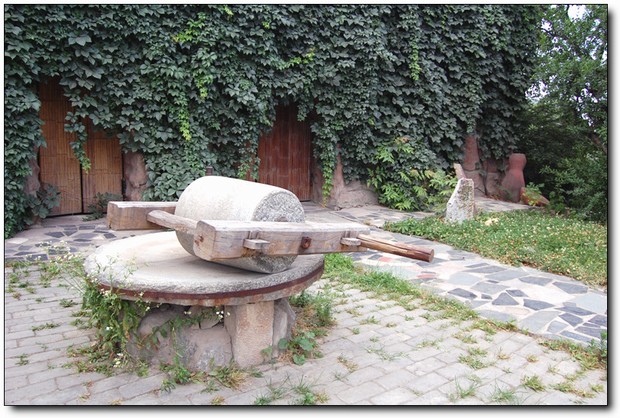
Is the activity effective for the practice of mindfulness? (e.g., Hui-neng treading round and round the rice mill for eight months)

ancient rice mill China

COMPREHENSION OF THE REALITY OF THE BODY

This is contemplation of the body as impermanent, devoid of self-nature, and being the source of suffering.

4. MINDFULNESS OF THE REALITY OF THE BODY

Sometimes called “Contemplation of the repulsiveness of the body,” this is not unlike opening a sack of provisions and taking stock of the contents. “Just so, monks, a monk reflects on this very body enveloped by the skin and full of manifold impurity . . .” Bhikku Ayalano has simplified the contents from 32 (see end note) to three: skin, flesh and bones, while in Ch’an the body is simply referred to as a sack of shit.

5. MINDFULNESS OF THE FOUR ELEMENTS

Contemplating the body as composed of earth, air, fire and water.

6. THE CEMETERY CONTEMPLATIONS

Contemplating the body in various stages of decomposition.

    1. the festering (decomposition) of the body (by maggots, etc.)
    2. the body being eaten by animals
    3. a skeleton with sinews, flesh and blood
    4. a skeleton with sinews, smeared with blood
    5. a skeleton with sinews only
    6. a clean skeleton
    7. loose bones bleached by the sun
    8. one-year-old bones lying in a pile
    9. bones crumbling into the earth

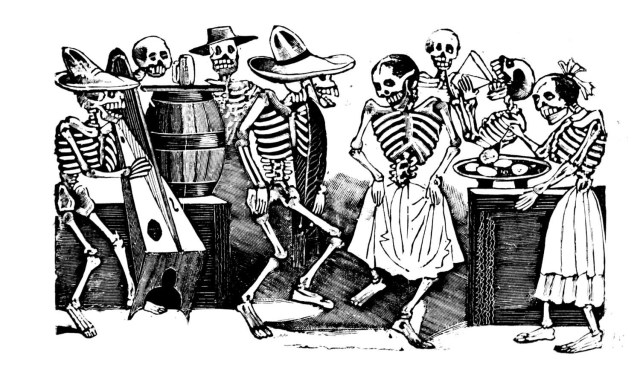
Jarabe en Ultratumba 2

Jose Guadalupe Posada: “Dance Beyond the Grave”

Second Foundation of Mindfulness: Feelings and Sensations (Vedana)

The first part of this contemplation is being aware of a sensation and noting whether it is pleasant, unpleasant, or neutral. Sensations have no inherent quality: they are only unpleasant when we link them to the fear of death or the fear of being all alone.

The second part is to note whether the experience is bodily or mental. Physical pain is only painful because it arouses fear. At the same time, fear often provokes physical pain or discomfort.

Finally, we are to note whether the experience is “worldly” or “unworldly.” Worldly experiences are anything related to the six sense-gates (hearing, smelling, tasting, touching, seeing, thinking). An unworldly experience is related to the higher realms—the form and formless realms.

Third Foundation of Mindfulness: Contemplating states of consciousness

The Satipatthana Sutta reads as follows:

Herein, monks, a monk knows the state of consciousness where there is craving as being covetous; the state of consciousness where there is hatred as being hateful . . . the state of consciousness where there is indolence as being indolent; the state of consciousness where there is distraction as being distracted . . . the concentrated state of consciousness as being the concentrated state; the unfocused state of consciousness as being the unfocused state; etc.

Fourth Foundation: Mindfulness of phenomena (dharmas)

The Fourth Foundation of Mindfulness is often translated as mindfulness of dharmas, or the realm of senses and desire, and counterposing this realm to the state of awakening.

Investigating dharmas consists of studying five lists: the hindrances, the aggregates, the internal and external sense-bases, the seven perfections, and the Four Noble Truths. Here is a simple breakdown of the lists:

The Five Hindrances – sense-desire, ill-will, sloth and torpor, restlessness and worry, doubt

The Five Aggregates [skandha] – form, feelings, knowledge of differences good and bad, expectations, consciousness.

The Six Sense-Bases – eye and appearances, ear and sound, nose and odor, tongue and flavor, body and sensation, mind and thought

The Seven Perfections – investigation, zeal, joy, mindfulness, tranquility, samadhi, perfect equanimity

The Four Noble Truths – Suffering, The Cause of Suffering, The Cessation of Suffering, the Noble Eightfold Path

Practicing the Four Foundations of Mindfulness

When practicing with the satipatthana, it is important to remember that our task is just to contemplate these things. In mindfulness practice we allow feelings to come up into our awareness and let go of them. We observe our judgments of good and bad, right and wrong, and let go of them. The objective is to observe everything with equanimity and detachment.

Bhikku Analayo (2004). Satipatthana: The Direct Path to Realization. Cambridge, UK: Windhorse Publications. (Exploring_Satipatthana)

Bhikku Analayo (2018). Mindfulness: A Practical Guide to Awakening. Cambridge, UK: Windhorse Publications. (Windhorse Publications)

Guided meditation of Exploring Four Satipatthanas (40 min.):

1. The thirty-two parts of the body are: hair of the head, hair of the body, nails, teeth, skin, flesh, sinews, bones, marrow, kidneys, heart, liver, membranes, spleen, lungs, bowels, intestines, gorge, dung, bile, phlegm, pus, blood, sweat, fat, tears, grease, snot, spittle, oil-of-the-joints, urine, and brain. Bhikku Analayo has simplified this list to ‘skin, flesh and bones.’

Lester Levenson: Meditation

The greatest thing we have to do, and the most difficult, is to drop the mind.  It’s a junkyard full of refuse from ages past; refuse of thoughts of limitations—“I am a limited body,” “I have troubles.”  All thoughts contain limitation.  We pile them up in the thing we call mind.  Mind is nothing but the total accumulation of all these thoughts, so mind is nothing but a junkyard of limitation.

All right, so how do we get rid of the mind?  By quieting it.  When we quiet the mind, we discover our infinity.  The more we see our limitlessness, the more we recognize that junkyard called mind and the more we let go of it, until we go so far that we drop the whole remaining mind at one time.

Before that, however, we keep [confronting] the thoughts as they come up.  As the thoughts come up, we let go, let go, let go, until we let go of enough of them so that the Self that we are is obvious.  Then it takes over and takes us all the way.  The greatest thing is quieting the mind, which is eliminating thought, which is eliminating the mind.

Meditation is necessary.  This is the major point I’m stressing—meditation.  Learn how to meditate.  The deeper one goes, the more one discovers the innate joys to which there are no limits.  No matter how joyful you get, you can always go further.  If you were a thousand times more joyful than you are now, you could still go on and on and on in joy.   Joy is unlimited, because we’re infinite.  But the major thing to accomplish is the ability to control the mind, to meditate, to drop into peace at will.  A man can control a whole nation, but if he cannot control his own mind, what kind of control has he got?  He is a victim of his own mind.  Rather than being in free control over his thoughts, he is an effect of them; he is actually pushed around by past habits.  He is no master.  Only he who can control his mind is a master—a master not only of himself, but of anything and everything he does.  Meditation is the way.
* *
Meditation does not have to be formal to be meditation: it can be any time one gets quiet and seeks.  Some of us find it is easier to meditate when it isn’t formal, because sometimes we unconsciously have an aversion to formal meditation.  However, we should work to drop the aversion.
* *
Meditate to get into the practice and habit of meditation.  We should meditate as much as we possibly can.  Meditation is getting the mind one-pointed in the direction of who and what we are.  It’s taking the mind away from the worldly things and focusing it on the direction that we’re in.  The more we do it, the more we like it, and the more we like it, the more we do it, until it becomes a thing that goes on effortlessly all the time.  No matter what you’re doing, that meditation continues in the background.  Then you are really moving.
* *
Meditation is extremely difficult at first, but it gets easier as time goes on.  Then one day you’ll say, “This is great!  This is what I want!”  Then you do it all the time.  Then you’re really on the spiritual path.
* *
Meditation has to get to the point where it is the most important thing.  The longer you can meditate, the deeper you can go.  However, even a little meditation will go a long way, especially if it is concentrated.
* *
There is only one way to get to the high state, and that is by quieting the mind.  The method of quieting the mind is meditation.  It’s very difficult; the moment you sit down and want to quiet the mind, up pop the thoughts.  Well, as thoughts pop up, release the feelings behind the thoughts; eventually you will reach a state where your mind is quiet.  Then you begin to like meditation because it’s a deeper experience of your real Self.
* *
Release thoughts as they come into mind.  This is done by allowing the negative feeling behind the thought into your awareness and focusing only on the feeling.  Do this over and over until the feeling is gone for good.
* *
Whatever you let go of is gone forever.  But even though you’ve let go of one thought, one idea, there still remains a multitude of thoughts, and so another one comes up.  Letting go of one limiting thought doesn’t undo all the subconscious thoughts.  What remains must be let go of by dropping a tendency or predisposition; this way you drop all the thoughts that arise from it. (See Letting go of the mind)
* *
We get to see the perfection by looking in the direction where the perfection is.  Now, the perfection isn’t out there—we know that.  The perfection is in here where we are, where the “I” of us is.  So first, we have to direct our attention inwardly.  We should pose a question and hold it until the answer comes.  When the answer does come, you know, and you know that you know.  And to get the answer to “What am I?”  it is necessary to still the noise of the mind, to still the thoughts.  The thoughts are the noise.  The thoughts are concepts of limitation, and there are so many of them that they’re constantly bombarding us, one after another all the time.  Keep on releasing the feelings behind the thoughts until the perfection is obvious.
* *
Meditation is putting your mind on the way to find God.  Look within for the kingdom of God.
* *
To go inward is the doorway to the infinite.  To go outward is the doorway to limitation.
* *
Internalize your attention.  All externalized attention is wasted.
* *
What you do to yourself, being your own doing, can only be undone by you.
* *
Meditating to get the mind quiet is good.  Meditating to let go of ego-wants is better.  Meditating on “What am I?” is best.
* *
Meditation should be on: “What am I?”  “What is God?”  “What is the world?”  “What’s my relationship to the world?”  “What is the substance of this world?” ” What is infinity?”  “What is intelligence ?”  “Where is this world?”  Or on some of the statements you’ve heard, like: “I’m not in the world but the world is in me.”  Question, and ask: “How come?”  Try to see it. T ry to see the meaning behind these statements of truth.
* *
Everything that everyone is looking for through work is far better gotten through meditation.  Meditation will get you what you want sooner than working in the world for it.
* *
With meditation, you will discover that you’ve covered up your unlimited Self with your limited ego.
* *
Meditation is the road to omnipresence.
* *
Meditation really should be communing with your Self.
* *
You’ll see your Self to the degree that your mind is quiet.
* *
The way to get rid of the ego is to get the mind so quiet that you can see what you are.  Then you know that you are not the ego, and you drop it.
* *
Spiritual things are spiritually discerned.  Spiritual knowledge does not come down to a lower level—we have to raise ourselves up to it.  We raise ourselves through meditation.  Meditation should be used to get higher understanding by raising ourselves up to where higher understanding is.
* *
Meditation is wonderful.  Things happen in meditation that never could happen while you are talking or active.
* *
Meditate until it becomes constant, i.e., until it continues in back of the mind regardless of what you are doing.
* *
You’ll reach a point where you’ll like meditation better than anything else, because you’ll reach a point where you’re being very much your real Self.  That is the greatest of all joy, which before you thought was to be found in the world, in other people.  You’ll see others as nothing but your very own Self; you’ll see that.  And the joy will be direct and constant all the time.
* *
The answer won’t come from reasoning; it will come from quiet meditation.  Some day, some time, it will come.  It will just present itself to you, in its simplicity, and you’ll say, “Oh!”
* *
The quieter we are, the more we are the Self.  When meditation becomes constant, all the time, even though we are outwardly active, we go through life and work automatically, all the time remaining in our real Self.
* *
Just look at what you are instead of what you are not.  When you discover what you are, you simultaneously discover what you are not and you drop it.
* *
Seeing that you’re not the ego, you’re letting go of big chunks of ego.
* *
The depth to which you go in meditation determines how much you wipe out the ego.  Depth of meditation is the degree of quieting the mind.
* *
Getting the good feeling is good. The higher you go the better the feeling is. But when you look for the good feeling as the end, then that is the end of growth. Growing is more than dropping into the good feeling of the Self; it is dropping the non-self, the ego.
* *
When you get full realization, you’re in the meditative state all the time.  Actually, meditation is the natural state.
* *
Constant meditation is a constant remembering of God, the Self.
* *
Dwell upon your Self.  Turn the mind back upon the mind to discover what the mind is, and then go beyond the mind and dwell in your Self.
* *
We must learn to quiet the mind so that when we sit down, we let go of the world.  Only then do we really begin to move at high levels on this spiritual path.  We must learn to let go of thoughts, all thoughts.  The way is through meditation, right meditation: quieting the mind, stilling the thoughts, and finally, eliminating all thoughts.
* *
In group meditation people support each other; but the very best meditation is when you are by yourself and you need no support.  Then you are not confined to any time period.  You might stay with it five, ten, even twenty-four hours.  And this should happen.  When you get to like it so much that you stay up all night continuing it, it has become more interesting than sleep—then you’ve got the momentum going.  Then you’ll get to see and be you’re real Self.
* *
A way to dominate the mind is to drop into the Self.  You reach a place where it’s so delightful you just don’t want to do anything but remain in it. It gets to be very easy.  Once you get to the point where it’s easy, then just continue it.  Stay with it until you go all the way.  By the constancy of it, each day, you get quieter and quieter, and then the Self, because you see it, keeps burning away the ego, which further quiets the mind.
* *
Meditation at first is holding the thoughts on God, Self, to the exclusion of other thoughts.  When one is realized, meditation is the awareness, not of anything by anyone, but only the current of awareness of awareness; where there is no otherness and no action, yet there is full use of the mental and physical faculties.
* *
At the end of the road of meditation you discover your grand and glorious Self!
* *

This chapter was compiled from various sessions.

Levenson, Lester (1993).  Keys to the Ultimate Freedom: Thoughts and Talks on Personal Transformation. Phoenix, Arizona: Sedona Institute. ISBN 0-915721-03-1 (pp. 291-302)

Lester Levenson: Understanding the Top State

No one can do anything to us; no one can do anything for us. Some day you’ll see this, that we in our consciousness determine everything that happens to us.

I thought maybe a summary of what we’ve been through, where we are going, and what there is at the end might be a good idea for the last talk of this series. I really don’t know how we started, at what point, but the way I like to look at it is that everyone is seeking happiness, full and complete, with no taint of sorrow. That that happiness is our very own basic natural nature, which I call the Self with a capital ‘S’. And because it’s our basic natural nature, everyone seeks happiness. And in the end we see that Happiness with a capital ‘H’, God with a capital ‘G’, turns out to be the same thing.

If I am fully transported into the divine essence, then God, and all that He has, is mine. That is when I have true joy, when neither pain nor sorrow can take it from me, for then I am installed in the divine essence, where sorrow has no place. – Meister Eckhart, Sermon Seven

The mistake we all make is that we look for this happiness in people and in things, and it is not in people or things. The happiness or the pleasure that we feel is the eliminating of the pain of the desire for something. This desire is an original lack, which we assume. Being infinite beings, we never had any lack. We assume this lack, we create a desire for it, and when the desire is fulfilled, our thoughts are stilled and our nature, the Self, shines forth.

Someone comes along and says, “Attention: you have spent many lifetimes looking in the wrong direction! Stop looking without and look within! Only there will you find that which you have spent lifetime after lifetime seeking!” And then you meet someone like Lester who tells you, “Seek your very own Self—therein lies your complete happiness. Stop looking for happiness in people and things. There you merely relieve the pain of the desire for something, and this relief you call pleasure. But the pleasure is short-lived because the desire is not eliminated. It’s still there, and therefore the pain of it continues to gnaw at you.”

Now the starting point is you. You must take the way toward discovering you, and only you can do it. Accept nothing unless you can prove it yourself. Prove it and it is yours. Prove it, and then you can use it.

The uniqueness of this science—and it is a science; someday you’ll see it is the science of all sciences—is that this is a subjective science. We have to seek it within. We can’t put it out on a table in front of us and examine it. We can only examine it within our own mind, or better, within our own being. Also, the intellect is of no avail to us. The intellect can get us in the right direction to find it. The right direction is turning within, stilling the mind and experiencing this truth, this knowledge, and only by experience can we get to know it.

Methods are many, but the very highest is the method that everyone uses in the final end, and that method is finding the answer to “What am I?” This quest should be kept up all the time, not only in meditation, but during the day. While we’re working, no matter what we’re doing, in the back of our mind we can always keep that question posed: “What am I?” until the answer makes itself obvious to us.

Now, any answer the mind can give us must necessarily not be it because the mind is an instrument of limitation. All thoughts are qualified; all thoughts are limited. So any answer the mind gives cannot be right. The way the answer comes is simply by our casting off the blindness that we have imposed upon ourselves by assuming thoughts that we are a thinking mind-body. When the thoughts are quiet, the limitless Being is obvious. It’s self-evident. It’s there all the time. It’s just covered over by thought concepts, every one of which is limited.

So, the way is to pose the question “What am I?” and quietly await the answer. Other thoughts will come in, and the biggest difficulty is quieting these thoughts. When other thoughts come in, if we pose the question, “To whom are these thoughts directed?” the answer naturally is, “To me.” Then, “What am I?” puts us right back on the track again. That way we can continuously keep our attention on “What am I?”

In addition to posing this question until we get the answer, it is good practice in our daily life to be not the doer, be not the agent. Just be the witness. Acquire the attitude of “It is not I, but the Father who works through me.” This is the main conduct of life that we should strive for. The more we become the witness in life, the more we become detached from the body, and the more we are our real Self.

So, there are two things I’m suggesting: one is the quest “What am I?” and the second is, in life itself be not the doer: be the witness. Let things happen; allow life to be. That’s the way we are in the top state, and the best behavior in life is that which is characteristic of the top state.

Knowledge comes through likeness. – Meister Eckhart

There are many other things which I’m sure you are aware of: humility, goodness, kindness, honesty, etc. All these things help, but the greatest aid is to be not the doer but be the witness.

Now, when the Self of us presents itself to us, it’s a tremendous experience! It’s a very difficult one to contain. We feel as though we’re going to burst, because we recognize our omnipotence, omniscience, and omnipresence. But just seeing it once doesn’t establish us in that state. However, once you experience it, you’ll never let go until you reestablish it. You’ll continue to try, and you should continue to try, to get back into that state. The next time, it’ll last a bit longer, the third time still longer, until finally we are in it twenty-four hours a day.

When we attain this top state, we are not zombies, but we are all-knowing and everywhere present. Everything falls perfectly into line. We move in the world just like anyone else moves, but the difference is that we see the world entirely differently from the way everyone else sees it. We see our body and every other body equally as our Self; likewise, every animal and every thing as our Self. Seeing everything as “I” gives us that singular oneness throughout the universe which is called God, or the Self. We watch our body moving through life like an automaton; we let it go its way. And since we are not really that body, nothing that happens to that body can affect us. Even if it were crushed, it wouldn’t mean much to us because we fully know that we are not that body. We know our eternal Beingness and we remain that!

I left prison without feeling I was going out, and without being able to reflect on my deliverance. Yesterday morning I was thinking, But who are you? What are you doing? What are you thinking? Are you alive, that you take no interest in what touches you as if it did not touch you? I am greatly astonished at it, and I have to apply myself to know if I have a being, a life, a subsistence. I do not find it. On the outside I am like another; but it seems to me I am like a machine that speaks and walks by springs and that has no life or subsistence in what it does. This is not at all apparent on the outside. I act, I speak like another, in a manner more free and expansive, which embarrasses no one and pleases others, without knowing either what I do or what I say, or why I do it or say it, or what causes me to say it. – Madame Guyon (James, p. 238)

So, one who has attained the top state is difficult to distinguish from anyone else. He’ll go through the same motions of life and whatever he was doing before, he might continue to do. But his outlook on life is entirely different: he is completely ego-less. He has no concern for his own body. He is interested in others and not in himself. He is interested in all humanity. Whatever he does has absolutely no ego motivation. His body will continue to live its normal span and usually goes out, in the eyes of the unknowing, the same way most bodies go out, via so-called death and coffin, but the one who was originally connected with that body never sees any of this death. He sees this entire world and body as an illusion that was created mentally, just as we create scenes, cities and worlds in our night dreams. When we awaken, we realize there never was such a thing, and in the same way, when we a awaken from this waking state we see that the whole thing was a dream and never really was. That the only thing that ever was, was my Being, the absolute Reality, being all beingness, infinite, all-perfect, all-knowing, all-powerful, omnipresent.

It is like a sleeping man dreaming of a country that seems to be filled with all sorts of men, women, elephants, horses, vehicles, pedestrians, villages, towns, hamlets, cows, buffaloes, mansions, woods, mountains, rivers and lakes, and who moves about in that city until he is awakened. As he lies half-awake, he recalls the city of his dreams and reviews his experiences there. What do you think, Mahamati? Is this person to be regarded as wise, who is recollecting the various unrealities he has seen in his dream?

Said Mahamati: Indeed not, Blessed One.

The Blessed One continued: In the same way the ignorant and simpleminded do not recognise that things seen, which are only of the mind itself, are like a dream, and are bound by the notions of self-ness and otherness, of being and nonbeing. Mahamati, it is like a painter’s canvas on which there is no valley or hill as imagined by the ignorant. (Lankavatara Sutra, p. 92)

So, to reiterate, the main two points that I wanted to bring out today were that firstly, the very highest method is the quest “What am I?” As we pose this question in quietness, when other thoughts come in, ask, “To whom are these thoughts directed?” The answer is “To me.” “Well, what am I?” and we’re right back on the track again, until we get the total answer. And, secondly, the way in life is to be the witness, to be not the doer. I believe that sums up what I’ve been trying to get across up until now. Any questions on this?

Q: To not be the doer, don’t you plan? Don’t you do everything normally?

Lester: No, the right way is not to plan. Let it happen. Let go and you’ll be guided intuitively. Instead of planning with thought, you’ll do the exactly right thing, perfectly at the right moment, from moment to moment. I’m talking from a higher level now, the perfect state, where everything is in absolute harmony every moment. There you never think, and at every moment you know from within just the right thing to do. You’re guided intuitively each and every moment and everything falls perfectly into line. Now, if you’re not there, of course you have to think; you have to plan.

Q: Well, in practice then, in the beginning, it’s probably a combination of the two where things go very easily, and then there’s a hump in which you have to plan.

Lester: Definitely yes! In the top state you do by knowing; you just know from moment to moment. One feels “I know it!” That’s just the way it feels and there’s no thinking to it, only “I know it!”

Q: I know from my own experience, I slip back and lay out a plan, but sometimes that plan comes very easily and quickly to me and sometimes I have to struggle like the devil to work it out, step by step and I don’t know what’s going to happen. Other times I just lay out a plan and I know what’s going to happen and I have no difficulty with it.

Lester: The word “know” as you use it is the key. You know how that word feels when you say “I know it!” There’s no doubt, not one iota of doubt there. And it happens. That’s the key. That’s the realm of knowingness. Make that all the time. Keep working for it until it comes and stays.

The quickness with which we attain this is determined by the intensity of the desire for it. The more we desire this top state the sooner it comes. Everyone makes it eventually. I’m convinced the majority of people on earth today will probably take millions of years, but any one of us who is consciously seeking the way out can do it this lifetime.

The so-called grace of God is always there also. All those who have made the top grade before us are radiating the consciousness of perfection to us. We have tremendous grace being actually pushed our way all the time. However, they have no right to impose themselves and they don’t. We have to open ourselves to it in order to receive it. We need this grace because of the state of affairs today: man is relatively low. We are very strongly convinced that we are a limited body and by long habit we are trying to hold on to it. So it’s not easy to let go of this body, and because of that we need the grace of the great ones who, in our eyes, have passed on, but in their eyes they’re still here. When we recognize that they are still here, we can see them and talk to them the way we talk to each other. If we accept them partially, we can talk to them in a dream or a vision. The way we meet with them is determined by our acceptance of them. If any one of us believed that he could go down to a restaurant and have a snack with Jesus, the way you believe you could do it with me, if you had that much acceptance then you could do it.

Now, some of us know that he came into this room. He gave a sign proportionate to our degree of acceptance. If he were suddenly to appear in a physical body in the room, it would be too much for most of us to accept and therefore he doesn’t. But the way he comes to us is determined by our acceptance of him. He gave signs to some here and some did not recognize that he did; however, most of us did.

The point I’m trying to make now is that we should open ourselves to the help of the great masters. Jesus and the great ones want each and every one of us to know our perfection. They can’t force it upon us, but their hand is always extended. It’s good to keep this in mind; then we open ourselves more to the help.

Q: How do you request and receive this help?

Lester: You have to be accepting of Jesus as being alive, just as much as we are, and capable of meeting with you, the way we meet with you; then it can happen. You have to be open to it. The help is always being sent to you.

Q: Are there words to say, thoughts to carry?

Lester: Yes. But I can’t give them to you; that’s up to you. See, I give you the general principle, acceptance of him the way he is. However, he can appear as a very humble human being in form. Being omnipresent, at any moment he can appear to anyone and speak with him.

Q: Would you define humility?

Lester: Yes. The greatest humility is through surrender. Not I but Thou. It is not I, but the Father who worketh through me. Everything I do is God’s work. I am not the doer. It is surrender of the ego, the ego being a sense of separate individuality.

Q: If you surrender yourself as an individual, how about the other person? I think we mentioned before that I recognize the other person as myself and I treat him as though we are the same. Who is this other person?

Lester: From where you stand now, the other person should not concern you. The only thing that should concern us is what we do. For me, it matters not what your attitude is toward me—you could hate me with every cell in your body. But my attitude toward you is of the utmost importance. While you’re hating me I should love you fully and completely. Then you’ll understand the answer to your question and you will see only the One. When you separate yourself and then ask what’s up here in the One, it just doesn’t fit.

When we love, and only love, we are using the most formidable power in the universe. No one and no thing can harm us. We can never ever be hurt or unhappy if we would only just love without any hate. You can never be hurt when you love in the sense that the love is full, complete, divine love. It’s just love with not one bit of hate in it. It requires turning the other cheek, loving your enemy. That’s the kind of love it takes.

Q: Love is understanding?

Lester: When you love fully you understand the other one fully. Love is understanding. It’s identifying with the other one, being the other one. Coming down a step, it’s wanting the other one to have what the other one wants, loving the other one the way the other one is.

Q: Then who is our enemy?

Lester: In reality we have only one enemy and that’s ourselves. No one can do anything to us, no one can do anything for us. Someday you’ll see this, that we in our consciousness determine everything that happens to us.

Q: Then it is our idea of ourselves which is incorrect?

Lester: Right. And that could be made better!

Q: When you say understanding, do you mean understanding in a logical sense, or do you mean acceptance of them without question of the reason why they’re doing things, good or bad, just acceptance of whatever they are in their entirety?

Lester: It’s acceptance in their entirety. But the real understanding requires knowledge of what the universe and the world are. When we see someone doing wrong, we have to know that this is a God-being, misguided. He’s looking for God in the wrong place. That’s the understanding.

Q: Which in his mind would be happiness, right?

Lester: Yes. He’s looking for happiness the way he sees it. Even a Hitler, in his mind, is doing right, and therefore should not be hated, but should be loved, wanting him to be what his real basic nature is. Now this doesn’t mean approving of his program. But whether we approve or not of his program, loving and hating are different things than not approving of his program. So we love everyone, see them as misguided beings, forgive them for they know not what they do. They’re like children, misguided. Attain the highest state of loving everyone equally, as Christ did.

This session was recorded in Los Angeles on July 12, 1965. (https://youtu.be/iIokyVYNyZg)

Levenson, Lester (1993). Keys to the Ultimate Freedom: Thoughts and Talks on Personal Transformation. Sedona Institute (p. 116).  (http://www.freespiritualebooks.com/keys-to-the-ultimate-freedom.html) (download)

James, Nancy C. (2011) The Complete Madame Guyon. Brewster, Massachusetts: Paraclete Press.

Suzuki, D. T. (1932). The-Lankavatara-Sutra: A Mahayana Text. Translated for the first time from the original Sanskrit. (http://lirs.ru/do/lanka_eng/lanka-nondiacritical.htm)

Walshe, Maurice O’C. (2009). The Complete Mystical Works of Meister Eckhart. New York: The Crossroad Publishing Company. (download pdf)

Lester Levenson: Conscious creation

The prime obstacle that we meet is the subconscious mind. It is full of thoughts of limitations that propel us every day, automatically. And we have made these habits of subconscious thoughts so strong that even when we recognize the direction we would like to go in, the subconscious thoughts keep directing us for quite some time—even lifetimes—until we finally succeed in overcoming them. We overcome them with thoughts of what we really want to do in life, and in that way become master over the mind, controlling the thoughts until only the thoughts we want determine our behavior.  Then we’re in a position where we can do something about the mind and we start to transcend the mind. We rise above it and we drop it. We let it go.  And when we do that we find ourselves this pure, infinite, limitless, totally free being that we naturally are.  And then happiness is complete.

The direction is to go within, seeking and meditating to quiet the mind enough so that we can see the infinite being that we are. The major steps are first, becoming aware of the fact that we are master over matter—and matter includes the body.  Then, the second major step is becoming master over mind. And when we become really masterful over mind, we are able to, and we do, let go of mind and operate in the realm of omniscience, in the realm of knowingness.  Then we are fully aware of’ the infinite being that we are, and are in the ultimate happiness.

We should start with the first step, consciously controlling matter.  Whether we are aware of it or not, everyone is controlling matter all the time.  Whether one wants to be a demonstrator or not, he is.  It is impossible to not be a creator all the time; everyone is creating every day.  We’re not aware of it because we just don’t look at it.  Every thought—every single thought—materializes in the physical world.  It is impossible to have a thought that will not materialize, except that we reverse it.  If we say the opposite right after we have a thought, with equal strength, we just neutralize it.  But any thought not reversed or neutralized will materialize in the future, if not immediately.  So, this thing of demonstration that we’re all trying so hard to do, we’re doing all the time, unaware of the fact that we’re doing it.  All we need to do is to consciously direct it, and that we call demonstration.

I said once that, properly expressed, a matter must come out of a person, bringing its form with it. It cannot get into you from without; no, it must issue from the inner man. Its true life is in the soul’s inmost recess. There all things are present to you, alive and active, and are at their best and highest. Why are you unaware of this? Because you are not at home there. – Meister Eckhart, Sermon Forty

Everything that everyone has in life is a demonstration.  It couldn’t come into your experience had you not had a thought of it at some time prior.  If you want to know what your sum-total thinking is, it’s exactly determined by what’s around you, what you have.  That’s your demonstration.  If you like it, you may hold it; if you don’t, start changing your thinking.  Concentrate it in a direction that you really want until those thoughts become predominant, and whatever those thoughts are will materialize in the world.

And when you begin to demonstrate consciously—small things—you may then realize that the only reason why they’re small is because you don’t dare to think big, that the exact same rule or principle applies to demonstrating a penny that applies to demonstrating a billion dollars.  The mind sets the size.  Anyone who can demonstrate a dollar can demonstrate a million dollars. Become aware of the way you’re demonstrating the one-dollar bill and just put six zeros after it next time.  Take on the consciousness of the million, rather than the one-dollar bill.

This relates to what I have been saying: that there’s no difference between the spiritual and the material when you see it, the material being just an out-projecting of our minds into what we call the universe and the world, and many bodies.  And when we see that it’s just an out-projecting of our mind, it’s just a picture out there that we have created, we can very easily change it, instantly.

So, to repeat, everyone is demonstrating, creating, every moment that he or she is thinking.  You have no choice.  You are a creator so long as you have a mind and think.  To get beyond creation, we must go beyond the mind.  And just behind the mind is the realm of all knowingness, where there’s no need for creation.  There’s a higher state than creation.  It’s the state of is-ness or beingness, sometimes called awareness, beingness, consciousness.  That’s just behind the mind.  That’s beyond creation.  The mind finds it very difficult to imagine what it’s like beyond creation, because the mind is involved primarily in creation, in creating.  It’s the creating instrument of the the universe and everything that happens in the world, in the universe.  So, if you take this thing called mind, which is only a creator, and try to imagine what it is like beyond creation, it’s impossible.  The mind will never know God, because you have to go just above the mind to know God, to know the infinite being that we are, to know what it’s like beyond creation.  The final state is beyond creation.  The ultimate state is the changeless state.  In creation everything is constantly changing.  Therefore, in creation the ultimate truth is not there.

So, to demonstrate what one wants, one needs to become aware of the fact that all we need to do is to think only of the things we want.  And that is all that we would get, if we would do just that.  Only think of the things you want, and that’s what you’ll be getting all the time, because the mind is only creative.  Also, take credit for all the things you create that you don’t like.  Just say, “Well, look what I did!”  Because when you become aware that you’ve created things you don’t like, you’re still in the position of creator.  And if you don’t like it, all you have to do is turn it upside-down and you’ll like it.

A concentrated thought will materialize anything

Now I’ll come down a step.  The mental consciousness of a thing in its is-ness [i.e. the belief that you already have it] will also very quickly bring something into your experience.  If I have a Cadillac in my mind, and I’m driving, it’s mine, it’s mine now, and I accept this thought, it is an absolute fact that this Cadillac will come into my experience.  Because these are laws of nature, natural laws of the mind.  See, the mind is only creative, so everything created is created through the mind.  Everything that’s created that we like, we call good; everything that’s created that we don’t like, we call bad.  But there isn’t a being who is not a creator, who isn’t creating all the time.  So, when you’re asking, How can I create $5,000, what you are really asking is, How can I create more of materiality?  I say, by using your process of creation that you have been using on a smaller scale, and just daring to think bigger, in larger amounts—that’s all.  Everyone creates, but they create with a conviction that they can only create a tiny amount, just make a living, or just make a half-living, or just enough to survive by, and so it is.  So, the consciousness of anything you want, in the is-ness of it, in the the acceptance of it, makes it so.  “Believe that you have already received it” is the way the Bible puts it.

Anything you want, hold it in your mind as though it’s yours now, and if you do just that, it has to be.  And when I say, “if you do just that,” don’t allow thoughts to the contrary.  Any doubt, any thought to the contrary, just undoes it.  So it’s necessary to rid oneself of doubts.

Q: How does one eliminate reoccurring conditions in one’s life?
Lester: By constantly working to undo it; looking for the subconscious thoughts that are causing it and dropping them.
Q: It’s my thoughts; I don’t look at anything but my own thinking.
Lester: Yes. Now there’s another way, a better way. If you can’t pull up the subconscious thoughts, you can now put in a conscious thought with strong will—so strongly that it overrides all the prior unconscious thoughts. This is possible. This is called using willpower. You can will it. And if you will it strongly enough, it’ll override all the subconscious thoughts. When you’re feeling high, that’s when you have your greatest will.

Q: How do you connect our effort, trying to create that which we might desire with the statements: “Seek ye first the kingdom of God and all good things will be added unto you” and “Think not of what you shall eat and where you shall sleep?”
Lester: Well, it fits in. “Seek ye first the kingdom of God.“ God is the essence of our very beingness. If we seek that and discover it, we find the secret of everything. So, “Seek ye first the kingdom of God,” go within, discover who and what you are; then you have the secret to everything, not only to creating but to everything. But you see, that’s been part of several years of what we have been going through as a group: how to go within and discover this infinite being that we are, which is the God part of us. And when this infinite being is discovered, everything is known: how to create, and more than that, how to un-create. And still more important, how to get beyond creating and uncreating, which is the ultimate state. Then you will not think of what you shall eat and where you shall sleep. Did I connect it for you?

Q: Until you reach the higher state, I wonder if it isn’t possible to get caught up in still trying to create before you become aware of the higher state?
Lester: Yes, I say that you are caught up in trying to create. You now have no choice whether to be a creator—you are that all the time. You should now consciously create only the things you want and stop creating the things you don’t want. One of the grossest errors we make is to try to create in the future: I will have this, I will get that; and when we do that, it keeps it in the future. This is the greatest stumbling block for most people. When you create something, it has to be seen in present time, in its is-ness, now. It is mine now.

Levenson, Lester (1993). Keys to the Ultimate Freedom: Thoughts and Talks on Personal Transformation. Phoenix, Arizona: Sedona Institute (Session 9: “Mastering Mind and Matter”)

Also posted to YouTube here: https://youtu.be/bWY76XU3aAk

Dolores Cannon:

But this shows you too how powerful your mind is; because everything you see, everything that’s around you, everything in your life, you’re creating and putting there to live your world. So that means you can create anything. Nothing is impossible: you can change your life; you can have anything in your life at all. They told me one of the biggest lessons you come to Earth to learn is how to manipulate energy. You can’t get out of the Earth school and graduate until you learn how to manipulate energy. What does that mean? Create. You have to learn to create. Because this is how powerful your mind is: you can create anything. So that means every time you go anywhere, even go back to your house, it is re-created every time you go into it.

Lester Levenson: As you see the world, so are you

Mind is the master power that moulds and makes
And man is mind, and evermore he takes
The tool of thought, and shaping what he wills
Brings forth a thousand joys, a thousand ills
He thinks in secret, and it comes to pass
Environment is but his looking-glass

– James Allen, “As a Man Thinketh” (1903)

THE BASIC GOAL (1993)

Let’s now take a look at this so-called apparency, the world. The world is only an illusion that we created mentally. It is not external, but in reality within us, within our mind. Someday you’ll discover that you created this entire universe that you see. The method of creating is by first creating what we call a mind. We create our mind, which is nothing but a composite of all our thoughts, conscious and subconscious, and the thoughts create the material world. Every little thing that happens to each and every one of us is created in our thinking. We mentally set up a thing called time, which makes it even more difficult to see things because we think now and things happen years later, but the only creator there is, is the mind—your mind. Is God a creator? Yes, because you are. Thou art that! You set up a mind, and through the mind you create.

As you see the world, so are you

Recorded on June 14, 1966

As you see the world out there, so are you. The ego part of us rebels against it, but this can be used every day, all day, for checking ourselves to to see what our consciousness is. It is impossible to see something out there that is not in our mind. There’s nothing out there but our own consciousness. A master, a perfected being, sees only perfection.

So, if we would take this key and check ourselves during the day—on all the negative thoughts especially—and start looking within to discover the source of this, we will see that these thoughts are right in us. They are our thoughts. That power that we thought was out there is right in here.

Because we are in a state of the world that is relatively a low state, most of us have far more negative thinking because we accept negativity. Therefore, we can undo that negativity by facing it. By first learning how to discover this negativity. By seeing that if we see it out there, it’s right within us—otherwise we couldn’t see it—and then using it to let go of it.

Now using it to let go of it is the most important thing. So we look out there, and anything and everything we see that is not just right, we turn inward, and we look for this very thing within ourselves. And if we look honestly, we’ll discover that that thought was right within us, that that concept is our concept. That it doesn’t apply to what’s outside of us—that it applies right to us. And when we see it, we automatically let go of it, because we are seeking truth, we are seeking happiness, and it’s ridiculous to hold on to things that keep us miserable. So the first key was: “As you see the world, so are you.” Since happiness and sorrow is probably the thing that we are most concerned with every day, happiness and sorrow can be used as a means of growth. (Creating All You Desire)

Levenson, Lester (1993). Keys to the Ultimate Freedom: Thoughts and Talks on Personal Transformation. Sedona Institute. (http://www.freespiritualebooks.com/keys-to-the-ultimate-freedom.html)

The Mind Mirror

Recorded on May 31, 1966

Now why do we, who are more with this subject than others, why is it that we don’t have the joy all the time with no sorrow? Why, after having been with this subject and following the great masters, why can’t we get that thing we are looking for? What is wrong? Well, I believe if you’ll look into it, you will discover that there’s only one thing wrong, only one thing: our wanting this growth is not as strong as our wanting this world, as our wanting ego-approval. Therefore I try to be as practical as can be by presenting you with methods that you can use every day to grow by. There is no moment in life that cannot be used as an opportunity for growth.

There is no moment in life that cannot be used as an opportunity for growth.

Now, the only growth—and I’m underlining this word, only—the only growth is letting go of ego. When the ego is zero, God is all. If we are not finding enough of God, or enough of happiness, it is only because we are holding on to our ego-desires. So I think at each meeting I’ll present one particular method that we can use in everyday life to help us let go of our ego. And I think today I would like to say this: “As you see the world, so are you.” Now this is similar to: “As a man believes in his heart, so is he,” which is correct. But I say this is a much more advanced way of looking at it: “As you see the world, so are you.”

Now, every day when we wake up and open our eyes, we start looking at the world. We meet people. And as we see those people, so are we. It is impossible to see a fault in anyone else that we don’t have in ourselves. If the fault is not in us, it’s impossible to see it out there in anyone else. It’s almost the same as, in order to understand Greek, you must know Greek. Anything we understand out there, we know within. So, every time we see something out there that we do not like, a person who is doing something that we don’t like, and it bothers us, it is only because that very same thing is in us.

Now, this is a powerful method of growth, because most of us, unfortunately, see things that are wrong in this world. When a master looks at the world he sees nothing but perfection. We should try to get the same viewpoint. If we will hold on to just this one thing, there will be a tremendous growth. Every time you see something wrong in someone, look for it in yourself. And when you see it, let go of it. Keep letting go. And every time you let go of it, you’re letting go of a bit of ego.

The whole thing is very simple: “Thou art That” here and now. Remove the covering of the ego. Let go of the ego. And when the ego is completely gone, the only thing left is the infinite Self. Where the ego rises not, there is the Self.

When the ego is completely gone, the only thing left is the infinite Self.

So, in everyday life, as we meet people, situations, every time we see something we don’t like, we should turn within. See it within ourselves and let go of it. Now this will not clear us in one day or one week because there’s an awful lot to be cleared. We have developed through many lifetimes ego-attachments and desires, and they don’t disappear in one or two days.

When we start letting go of the ego, it appears sometimes as though the ego is getting stronger and stronger, and bigger and bigger. That’s not true; it will never get any bigger than it is right now. What happens is that as we let go of it, more of it presents itself to us. We are looking at it more, and it appears sometimes as though the ego is getting bigger. Actually we are just facing up to more of it that was there all the time. Looking away from ego does not dissolve it: it just remains there until the time comes that we are forced to let go of it.

So, daily, right through the entire day, if we will just look at the world and realize that we are seeing it through our own eyes, through our own consciousness, through our own understanding, that what we see out there is nothing but ourselves, this can effect a rapid positive growth that will show results immediately. The first week, you will feel better. And as you keep doing this you’ll get lighter and lighter and lighter. Happiness will become more and more and more. Sorrow will become less and less.

But the main warning I give you is: don’t expect it overnight. And if the ego appears to loom up larger it’s only because you’re facing it, whereas before you were looking away from it.

Nancy just asked, “Well, how do you do it?” Well, you see someone out there who’s trying to be the life of the party, the number-one, and you don’t like it. If we don’t like the other one trying to be the number-one, it’s only because we want to be the number-one. All right, so what do we do? You have to go within and look for it, and stay with it until you see it. If you will go within, meditate on it, quiet your mind, the answer will always come. You will see: “Why, yes. I, too, want to be the number-one. And I was resentful because the other one was trying to be the number-one.” And then when you see you want to be the number-one, say to yourself: “This I must let go of,” with a wish to let go. And just by the wish to let go, you are letting go of a bit of ego.

There are no better lessons than those we get from our family. You’ll find family the best means of growing. And the main reason for that is that we choose our parents. And we choose parents who have similar characteristics to our own. And so there’s always a to-and-fro between parent and child because of this. The parents are telling the children what to do and the children are fighting right back—forward and back, forward and back, all the time. Most of the time the parent and child are together there’s a constant to-and-fro on the thing we’re talking about. Because we have it in ourselves, we see it in our parent, or we see it in our child, and they see it in us. Which causes quite a lot of friction. Now there can be the opposite relationship, too, where we can have an ego-lift if our parent has the things that we like. The parent and child are together on something that they both agree on, then there’s an elation, a support of the ego going on all the time. That’s possible also.

Now, ego, the same way it goes down on rebuff, goes up on praise. So we should look for it in two ways. Now, remember, anything that can be lifted by words of praise can be as quickly dropped by the opposite words. And the state that we want to attain to is one of equanimity, where we are always happy. Where our happiness does not depend on people and things outside of ourselves. The real Happiness, with a capital H, is our natural state, and is independent of people of things. Any time it’s dependent upon anything outside of ourselves it’s an ego-pleasure, which must necessarily have an ego-pain after it. And yet all joy that we feel in this world is only the feeling of the Self, more or less. Even though we attribute it to someone or something outside, that feeling of joy that we feel is nothing but the Self. And so I say, all joy has its source in the Self, and all misery that we feel has its source in the ego. And there’s another way of letting go of ego: every time we feel unhappy, look for the ego-motivation. There’s something we want, and we’re frustrated and we’re unhappy. Seek the ego-source: when you see it, you’ll automatically let of of it and you’ll feel happy again.

All joy has its source in the Self, and all misery that we feel has its source in the ego.

Another way of saying it is: “There’s nothing out there but our consciousness.” Whatever we see wrong out there, the mote is in our eye. A master sees nothing but perfection, in you, in everyone and in everything. If he says otherwise, he’s just talking for the benefit of the hearer, in order to communicate.

There is only the truth: the absolute, eternal, infinite, unlimited joy, omniscience, omnipresence, all-glorious. That’s all there is in truth. Anything other than that is the falsity, the appearance, the delusion, the maya. So what you ask is, “Well, isn’t this maya true?” So the only thing I can say is, “No, it isn’t.” See the truth and you’ll see that everything is absolutely perfect. Everyone is trying to return the the full Self, to let go of their ego. Some of us make errors in that direction. By going further into an ego-direction we get more and more apparently in trouble—and it’s all an apparency—until the apparency gets so difficult that we start looking in the other direction. If you want to know light, don’t look at the darkness. If you want to know truth, good, don’t see evil.

Ego is the sense of separation from the All. Before we got ourselves into this apparent delusion, we were that infinite being that we are now seeking. Through some quirk in beingness, we decided to play a game, really a game of limitation: we decided to be just a little limited. Now, in order to be that way, we had to move away from the All—the All is unlimited. And so we drew a wide circle around us. We were nearly unlimited at that moment. And then we wanted to play with the feeling of becoming unlimited again. But when we started in that direction we fell into a trap. In the game of limitation, instead of going back to the unlimited, we went further and drew a less-wide circle around ourselves, and became more limited and tried to get out of that. We kept doing that. And the main divisions of it are, first, we were what is called a causal body. We created a body to be separate in. And in the causal body it’s the realm of ideation to us now, the realm of ideas. And in that causal body, the moment we had an idea, it was completely fulfilled. It’s almost like hurting yourself and stopping and saying, “Gee, that feels good.” We create a little separation and it feels good to go toward the All each time.

So, we first created the causal body. And the moment we had a idea, a thought, a wish, it was immediately fulfilled. Then we tried playing more limited through an astral body, which to those of us who are now in the physical is a heavenly life. In the astral body, whatever you think is immediately effected. We’re not limited by time there.

Then we moved from the astral into the physical, which is the slowest, the most dense realm possible to any being in the universe. This is the lowest state possible—the physical. There’s only one possibility of going lower, and that’s lower in the physical. But the physical state is the lowest state. This is the deadest state that’s possible unto us. When you know this you’ll never fear death, because death feels like a wonderful freeing. It’s a tremendous experience—after you do it, not before! (laughter) Because before, we think we are nothing but this body, and when this body goes, we go. And even the pain of death is not nearly as much as the pain you suffer through life. You have migraine headaches, and diseases, and mental agonies with families, and heartbreaks in love—that’s more severe than dying at death. Because dying at death generally is just a pain for a moment, and then this tremendous feeling of freedom.

So, we came down to this most limited and densest state called the physical. And now all of us are on the way back. And there’s no question about that. We’re in a period of the world that is relatively low in vibration, very difficult, very physical, and those of us who are on the path are definitely on the way out. Because if we can get the right direction in this morass of living as it is today, it’s because we started on this a long time ago, and we’re continuing it in spite of the world, so to speak.

And we can go from the physical, we can graduate, get our wings, and fly off into the astral. And you can spend far more millennia in the astral than you do here because it’s an easier way of life. And then we can graduate into the causal. But if you understand what the ego is, you can go all the way from the lowest realm that we are in now, back to the highest, by eliminating the ego-sense. When we lose all of our ego-sense we are fully realized. We go all the way. We return to being the All. The opportunity to do this exists more in this realm than in any other realm, because it is so difficult that the incentive is greatest in this realm. As life gets easier, the incentive to grow gets less. But when you think you are not going to eat, and the whole world is going to collapse on you and so forth, and you have a sick body and all these troubles, you have a tremendous incentive to get out of that. And the incentive being so much stronger in this realm, it’s possible to transcend all the realms and go right back to the One, or the All.

So, this sense of egoity is very basic, and very important. It’s the start of all trouble, and letting go of it is the elimination of all trouble. It’s the sense of not being the All, of not being that God which we are. And if you’re not the All, there’s something missing and you’re trying to get it. First a hundred dollars, then a thousand, then a million, and a billion, then the Earth, then the moon, then the solar system, then the galaxy—until you wake up the the fact that everything you’re trying to get, you are. And once you see that, there’s nothing to be gotten anymore: you are It. It’s really a joke when you see the overall picture of how people struggle to get tiny bits of what they are.

So, every time you see something wrong in the world, look upon it as a mirror, and that’s all it is. It’s reflecting to you your consciousness. And if you accept this, you can use it to undo your ego. There’s nothing out there but our consciousness. If you ever want to know what your consciousness is, just take a check on what is around you and what you see and what you go through every day in life. That’s your consciousness.

This is the danger in reading newspapers, listening to the radio. The world in general has a very negative consciousness. If you go with it, it moves you in that direction. Now if someone tells you that that’s escape, it’s not. Any time you acknowledge anything in the world, you’re supporting it. If you acknowledge war and death and misery, you’re supporting it; that’s the mental thoughts you’re sending out. You see, we all send out thoughts. Every time we have a thought, we think it’s a secret little thing within ourselves. It goes out to the universe. So, the masters support the world; they counterbalance all the apparent negativity by just sitting in a cave and sending out the good whole thoughts, constructive thoughts, thoughts of oneness. So, the only way we can give real help to the entire world is by helping ourselves. The more positive our consciousness is, the more we send that out to everyone.

END

Lester Levenson: The Self

Practising the deep practice of the perfection of wisdom, the Bodhisattva Noble Avalokiteśvara examined the five skandhas and saw them to be empty of self-nature. – Heart Sutra

If at this moment you identify with your Self, you are infinite. That part of you that really is, your Beingness, is eternal. It’s the “I” that you really are. – Lester Levenson

Talking Heads: “Once in a Lifetime”

Sept. 28, 1964

All right, now I’ll go back one step and talk about this so-called apparency called the world. The world is only an illusion that we created. Some day you’ll discover that you created this entire universe. The method of creating is by first creating what we call a mind. We create our mind, which is nothing but a composite of all our thoughts, and thoughts create the material world. Every little thing that happens to each and every one of us is created in our thinking. We set up a thing called time, which makes it even more difficult to see things, because we think now, and things might happen years later; but the only creator there is, is the mind—your mind. Is God a creator? Yes, because you are. Thou art That. You set up a mind, and a mind creates.

It is good to discover that everything happening is caused by our thinking; everything that happens to us is created in our own thought. It’s a stepping-stone toward realizing that we are the creators. First you discover that you created your trouble, then you discover that you can create good things, then you discover that you can create anything you desire.

After you’ve discovered that there’s nothing that you cannot create, you’re still unhappy, the reason being that you have separated yourself from the One. So then you try to control the mind. You have already gained control over matter. You control the mind in ways such as, if you have pain you don’t feel it; if it’s cold outside you feel warm; if it’s hot you feel comfortable. This can be done mentally. This is in the line of getting mental control. When the mind is really controlled, then you’ll eliminate the mind. When the mind is eliminated there’s nothing left over but the infinite Self that you are.

So we start by becoming masters over matter, then we become masters over mind, and then we become masters.

So, if there are any problems that remain, they only remain because you are holding onto them. The moment you let go of them they are gone! If you tell me that isn’t so for you, that isn’t true. The truth is you’re still holding on to the problem, telling me that it doesn’t work. Now, trying to get rid of a problem is holding on to it. Anything we try to get rid of we are holding in mind and therefore sustaining that problem. So the only way to correct a problem is to let go of it. See not the problem—see only what you want. If you would, from this moment on, see only what you want, that is all that you would get—what you want. But you hold in mind the things you do not want, very strongly. You struggle to eliminate the things you don’t want, thereby sustaining them. [Don’t see any event as a problem, but see it as a gift from God and be grateful for it. – Ed]

You should have only one desire: a desire for complete liberation, complete realization. Any other desire will keep you in trouble. We should try to let go of all desires; we should not try to fulfill any desires. Every time we fulfill a desire, we strengthen that desire rather than weaken it, which I believe is obvious to all of us—that we never satiate desires. The more we try to satisfy them, the more we want of them. So it’s better to not satisfy desires, and by doing so the mind gets quieter. When the mind is quieter, we have a better chance to see the truth. When we see the truth, we scorch the desire. And this is the better way, actually the only really effectual way of getting rid of desire. When you see the truth, desires are scorched. Because a desire is trying to be your own real Self through some indirect means—through some person, through some thing. When you see this, you let go of these silly desires, because why struggle through indirect means to be that which you are? The indirect means cannot make you what you are, so it’s fruitless and extremely frustrating. Therefore we have this frustrated world. They’re all trying to satisfy desires and it’s absolutely impossible to do it. And they go on and on, lifetime in, lifetime out, until we recognize that desires are our enemy.

Desire is an admission of lack. If I am the infinite One, I desire nothing—I am the All. We must get back to that state by behaving as one would in that state. The greatest behavior that we can perform is living as a fully realized being would live. Try to attain the state of desirelessness. Try to attain the state of dispassion—no attachments, no aversions. Try to attain the state of equanimity, the feeling of equal-mindedness toward everything, everyone. Acting this way will push us toward being that way. By eliminating the effects out there we help to eliminate the thought [i.e., the cause].

Lester Levenson – The Ultimate Goal part 2

This subject cannot be learned intellectually, it cannot be learned through the mind because it’s perceived just behind the mind. We can use the mind to gradually undo the limitations enough so that we can get behind the mind by getting it quieter. If it were possible to get this subject through the mind intellectually, all we would need to do is to read the books on it and we would have it. But it doesn’t work that way. We have to very concentratedly dwell upon our Self that is just behind the mind. Turn the mind back upon the mind to discover what the mind is, and then go beyond the mind to the Self. So to get this subject, each one must experience it, realize it, make it real by going to the place just behind the mind and perceiving it there.

Now the very highest state is simply Beingness, and if we could only be, just be, we could see our infinity. We would see that there are no limitations. We would see that we are the All. We would be in a perfectly satiated, permanent, changeless state. And it is not a nothingness, it is not a boredom, it is an all-ness, an everything-ness, a total satiation that is eternal. You will never, never lose your individuality. The word “I” as you use it to mean your individuality will never ever leave you—it expands. What happens as you remember what you are is that you’ll begin to see that others are you, that you are me, that you are now and always have been gloriously infinite. (Keys to the Ultimate Freedom, 1993)

SESSION 34: THE SELF (YOUR SELF)

The Self, which is only your real Self, is the real “I” of you: knowing this, you know all there is to know.

Knowing your Self is being your Self.

The ultimate goal of every being in the universe is total freedom, and that is when you are only your Self.

The only reason why you are not aware of your Self is simply because you want to be only a single body in the world.

Everyone will someday wake up to the fact that he is the Self.

To see your Self, you have to quiet the mind enough. When the mind is being stimulated by the thousands of thoughts in the subconscious, there’s little chance of seeing your Self. The thousands of thoughts culminate in tendencies. Drop a tendency and you eliminate the thousands of thoughts underlying it.

The only things preventing you from being your Self are your mental habits called tendencies or predispositions. Will them out!

If you discover that the source of the tendencies or predispositions is the ego, your ego, you drop them then and there.

When the mind gets free enough, then the Self of you takes over and you are from then on Self-propelled.

To be the ego requires much effort, and it is the effort we feel in life. It requires no effort to be your Self!

The effort that you think you exert to try to be your Self is actually the effort of trying to break free of the hold of the ego while still holding on to it.

Your effort to be the ego, and at the same time to not be the ego, doubles the effort.

All the effort you’re involved in is effort to be an ego and to break free of being an ego. Do you see what the problem is? It is your constant effort. You must become effortless.

The only reason why anyone isn’t aware of the Self is because he wants something less. If one wanted the Self instead of wanting the world, he would soon have it.

When you find more joy within yourself than in anything else, then you’re really moving in the right direction. If you find any joy in external things you’re in the wrong direction. Enjoying any thing is wrong; seek joy within. Be joy. You don’t need any thing to enjoy if you are all-joyous. If we are enjoying any thing we are in duality. If I enjoy this, there’s “I” and “this.” If there’s Self alone, and Self is all there is, there can’t be any “I” and “this.” The basic truth is that you are all joy. Enjoying something external will impose an extreme limitation upon your natural state of all-joy. To enjoy something external, you’re pretending that there is something other than you. So, I repeat, we should never enjoy any thing. Seek joy only within, and then the natural state of infinite joy is discovered.

There is really only one happiness; it is being our very own Self. The happier we are, the more we are dwelling in our Self.

Every time you’re high you’re only being your Self, and it feels terrific.

Living in your Self is living in ecstasies; worldly desires is living in miseries.

Everyone every moment is experiencing his Self and every moment saying otherwise.

It’s only without thought that you can be the Self.

Discovering and being your Self is either easy or impossible. Finding the Self is the easiest thing in the universe when you do it. When you don’t do it, when you continuously keep looking away from it, you can never see it. And then it is the most difficult thing in the universe.

31. Question: It said that the Great Way is very easy to find and easy to follow, yet no one in the world is capable of finding it and following it.
Answer: These words are true. Being above the world, unmoved, letting go, indifferent to it, not doing a single thing, is called following the Way. Not seeing a single thing is called seeing the Way. Not knowing a single thing is called cultivating the Way. Not practising a single thing is called practising the Way. Thus it is said to be easy to enter and easy to follow. (Bodhidharma’s Method for Quieting the Mind)

Being your Self is easy. Being an ego is difficult.

When you realize what you are, it’s the dropping of what you are not that is the growth. Each time you see what you are, you should drop that which you are not.

Everyone is seeking the Self, calling It by different names.

Anyone who is seeking happiness is seeking the Self. There are two kinds of people in the world: those who are consciously seeking God, happiness, the Self, and those who are unconsciously seeking them.

In the consciousness of materialism (mammon) there is no God (Self).

You cannot see God in the world until you see God in yourself.

God is all and God is perfect; therefore, anything that we see as imperfect is within us.

If you see separation, you see not the Self.

When the world is real it is heavy. When the Self is real the world is light.

When our false identity as a body-mind disappears, our real identity as Self appears.

We are the Self now. All that we have to do is to let go of the idea that we are not.

The Self is God. The ego is the devil.

God (your Self) is infinitely individual and individually infinite.

The most beautiful is God.

There is something far more beautiful than nature, it is the Source of nature, the ultimate beauty: God.

No matter how much trouble man can get himself into, God is more resourceful in getting him out of it.

When we behave like God we have God-like powers.

God (Self) can materialize anything instantly.

The All that is God is not every little thing; it is the singular same essence behind all the little things.

God and good are sometimes used synonymously. Because everyone wants good, they make God good. God is above good and bad. However, good leads us to God.

If God is all, that leaves no room for the devil.

In Reality there is only God (your Self).

It is better to think of Self rather than God because you generally think of God as other than you, and you generally think of Self as you.

There’s no such thing as an external called God. There is a God but it is the internal Beingness of everyone.

Everything that is, is the Self, has its is-ness, its beingness, in your Self, God.

God is this world, the way this world is, and not the appearances that we see.

God, truth, the Self, is changeless. If God knew change, it wouldn’t be changeless. There is no action in God. God knows nothing of this world as we see it. God is only the changeless Beingness behind the world.

Everyone experiences his Self every moment of his life.

My Self is the nearest of the near and the dearest of the dear.

Look to the Self for everything!

If you want to get more comforts, know your Self.

The only answer to all problems is knowing your Self.

We will never be completely satisfied until we are completely being the Self.

To discover your Self is the reason why you came into this world.

Everyone is seeking his Self in his every act.

The ultimate happiness is the Self. All other happiness is only a bit of the Self.

When you know that the only joy there is, is of the Self, you take it directly and in its fullness rather than meagerly, as you formerly took it.

The only one you need to help you know your Self is yourself.

This feeling of needing someone else in order to find your Self is ridiculous. It hinders you from being your Self.

Everyone is actually the Self expressing the Self as extreme limitation, identifying as a limited body-mind. When you say “I” and add nothing to it, that’s it.

When you are not identifying with the ego, you are the Self.

The only direct knowledge is of the Self. All other knowledge, needing something external to ourselves, is indirect.

If at this moment you identify with your Self, you are infinite.

That part of you that really is, your Beingness, is eternal. It’s the “I” that you really are.

The little self, the ego, is nothing but the innate infinite Self assuming that It is limited. There are no two selves, one higher, the other lower, no two “I’s”. There is only one Self. It is perfect and always will be perfect, even though you make the false assumption that It is imperfect and limited. You are now, always were, and always will be your Self.

Although one always experiences his Self, he usually needs to be directed to it before he becomes aware of it.

It is the Self that is the source of the ego, the source of everything.

You are every moment the unlimited Self, every moment saying “I am limited.” When you drop into the Self you stop saying “I am a limited body-mind.”

Look only at the Self; then the ego is eliminated.

When you dwell in your Self you have no desire to be liberated. It is only when you are in the ego that you desire liberation.

The Self is not aware of the ego and the ego is not aware of the Self.

When I, infinite Being, feel like a body, it is I, infinite Being, imagining I am feeling like a body.

When the Self is real, the body is not real, and vice versa.

Identify with your body and the extreme limitations of a body are yours. Identify with your Self and you are all things, all knowledge and power, with no limits.

There isn’t anyone who couldn’t materialize anything right now if he or she would just let go of identifying as the limited body.

If you will discover your Self you’ll see that the body and mind are your servants.

Obtain and maintain direct experience of the Self. It is easier to obtain than to maintain direct experience.

Every time you say “I” it’s everything, all the power in the universe. Every time you add something to “I” you pull “I” down into limitation.

When you see the perfection, you see the other one as the other one really is, which is the real thing, the perfect Self.

There’s not a higher Self and a lower Self. There’s only you, identifying with your limitless Beingness or identifying with your limited being.

You’re never satisfied until you go all the way.

There’s only one thing that satisfies fully and eternally and that’s total awareness of your Self.

Everyone is aware of a selfhood. It is the Self, being wrongly identified as only a body and mind.

If you would just be aware only, you would be your Self. If you would only just be, you would be your Self.

This infinite glorious Being that we are, being absolutely perfect, can never change. It’s always there.

The greatest of all teachers is your Self.

Look to your Self until you see It completely.

All Beingness is God, your Self.

In the Self there is no one who has, no having, no thing had. There is no doer, doing or deed. There’s no knower, knowing or thing known. There’s only Being, being all Beingness.

Act as though you are the Self: this will lead you to seeing It.

The reality of you is perfect, all joyous, all glorious, all happy.

The higher you go, the more you realize your Self and the more you treat others as your own Self.

Being the Self is being selfless. In that state you are interested only in serving others, serving them as your Self.

The Self is absolute, profound, indescribable peace.

The only requisite for the realization of the Self, your Self, is stillness.

When one realizes his Self, all his actions and possessions are not perceived as his. He has given up ‘me and mine’. Everything is the Self.

When you experience the Self, you can’t describe It. Anything you can say about it isn’t it. It is the state of only being. There’s no action there; there’s no form there. It’s is-ness, and that’s all that it is. You can’t use it, you can’t know it, you can only be it. When you’re there, there’s only one, you, and that’s all there is.

Anything but the Self is wholly imagination. The ego is only an apparent actor in the imaginary story script you wrote. Thou art That, here and now. Do not delude yourself. Drop your illusory limitation.

The Self is quiescence, perfect awareness with perfect stillness.
He who seeks God will not find God in duality.
There is no human, God being All.
There is no time, no becoming.
There is no creating in total perfection.
Only God beholds God, there being nothing else.
Only God loves God, God being all.
Be still and know that you are God!

There is only God, nothing else. If there is only God, then I am That. At the end of the road we discover that there is only “I,” all alone.

You are the Self saying otherwise, but that doesn’t make it so. No matter how much you say otherwise, you are that infinite Being right now.

You can’t become your Self, you are it!

Every time you say “I,” that’s the Self, if you would only stop there!

The word “I” with nothing added to it is your Self. When you just say “I,” that feeling of “I” is the Self. But when you say “I am something,” that isn’t It. But just pure “I” and only “I” is It. When that is all you see and all you know, that’s God, your Self. That’s why God is closer than flesh! Just hold on to the word “I” only “I, I, I, I.” Try it when you are alone. Just “I, I” and not “I am a body,” but “I, I, I, I” — that feeling of being. Hold That; experience It; be It! It is your Godhead, your Self!

When man seeks and discovers the seeker, he discovers that in the Self
God is not being something—God is beingness
God is not conscious of anything—God is consciousness
God does not enjoy anything—God is joy
God does not love anything or anyone—God is love

In man
His beingness is God
His consciousness is God
His joy is God
His love is God

(Session recorded in Los Angeles, August 31, 1969)

Levenson, Lester (1993). Keys to the Ultimate Freedom: Thoughts and Talks on Personal Transformation. Phoenix, Arizona: Sedona Institute. (http://www.freespiritualebooks.com/keys-to-the-ultimate-freedom.html)

Levenson, Lester (1998). The Ultimate Truth. Sherman Oaks, California: Lawrence Crane Enterprises, Inc.