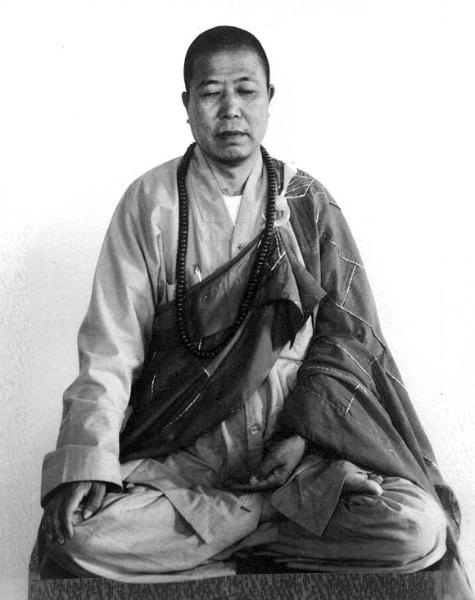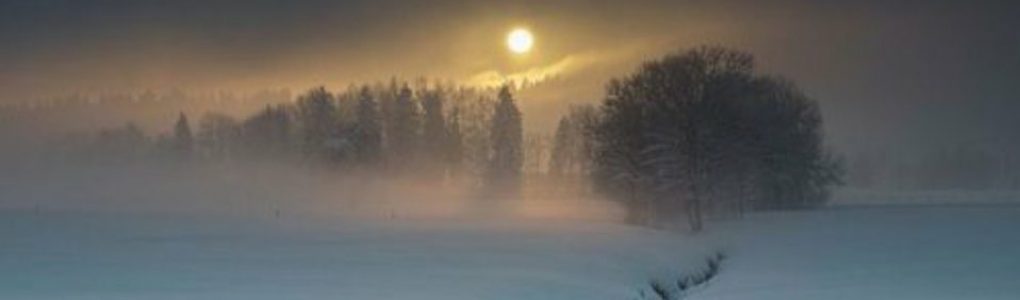
The world seen through the eyes of a master

I see the lilies in the field, their brightness, their colour and all their leaves. But I do not see their fragrance. Why? Because the fragrance is within me. But what I say is within me and I speak it forth from me. All created things are savoured by my outer man as creations, like wine and bread and meat. But my inner man savours things not as creations but as God’s gift; and my inmost man savours them not as God’s gift, but as eternity. – Meister Eckhart (Sermon Fifty Six, Walshe, Vol. II, p. 81)

The divine eye is center everywhere, circumference nowhere. . . . If “escapism” be a need of man, cramped in his narrow personality, can any escape compare with the majesty of omnipresence? – Yogananda

Now the very highest state is simply beingness, and if we could only be, just be, we could see our infinity. We would see that there are no limitations. We would see that we are the all. We would be in a perfectly satiated, permanent, changeless state. And it is not a nothingness, it is not a boredom; it is an allness, an everythingness, a total satiation that is eternal.

You will never, never lose your individuality. The word “I” as you use it to mean your individuality will never ever leave you: it expands. What happens as you remember what you are is that you’ll begin to see that others are you, that you are me, that you are now and always have been gloriously infinite. – Lester Levenson, “The Basic Goal”

Session 26: “Worldliness and Spirituality”

What is the difference between the divine and the worldly, the spiritual and the material? Is there a difference? Is there a difference between being spiritual and being in the world? There is a tendency for us to separate the two: that is a gross error. There is no difference between the spiritual and the material when we look at it from the viewpoint of truth.

The difference is in our outlook, in the way we see the world. It’s the way you look at it, that’s all. You may look at it from the ego point of view, or you may look at it from the Self. A realized person sees the world only as an out-projection of himself; therefore, it really is his creation. And as an out-projection, it’s like a cinema screen out there with this whole universe projected on it and which, at will, could be changed or withdrawn.

I alone bring all creatures out of their reason into my reason, so that they are one with me. – Meister Eckhart (Walshe Vol. II, Sermon Fifty Six, p. 81)

To the one who doesn’t see the truth, this cinema, this moving picture, seems not self-created and as such, one makes himself subject to it and becomes a slave to it.

A master is very much in the world. A master has his feet firmly planted on the earth, but he sees the basic substance just behind the apparent world as his very own Self. And when he does that, everything is in harmony, everything is perfect. It is not a matter of separating one from the other or having one or the other: it’s merely seeing the truth of the world. When one does, one is Self-realized; when one doesn’t, one is forever shadowboxing with his self-created world of opposition. Both see the world. The master sees the truth just behind it, and there’s nothing but harmony. The unrealized one sees separation and opposition and there’s much disharmony. The unrealized person sees it as a thing running him; the realized person sees it as his own projection, and therefore he can run it and it cannot run him. Being a master over it, he resides, ever the same, in peace and tranquility, and lives in complete ease all the time.

We must, in our everyday lives, be in that state of tranquility, and until we can be in that state while [involved] in the details of daily living we haven’t reached the top. So there are no two categories, the world and spirit: it’s all one and the same. It’s just a matter of the way we look at it. We should strive to get to the place where no one and no thing can perturb us. When you get to that state, you are at the top. You are in the world and nothing and no one can disturb you in the slightest. Develop this. Make this a practice. Make this your way of life. Do not react to people; do not become angry, [envious], hateful and so forth. Remain ever the same, ever the same. No matter what happens, no matter what goes on, you really are ever the same, serene and poised.

Q: But Lester, when I look at the world I see differentiation.

Lester: Any time we see any difference, or a difference between the spiritual and the worldly, it’s because we don’t have enough understanding of the spiritual as yet. We are separating. The highest state is when we are in the world and in spirit at one and the same time, and there is no difference. When we’re there, we don’t see it as world and spirit: we see it as one and the same thing. We see a oneness; we see it all as our very own Self. Or, if we want, we see the whole world as being within us, as a dream is within us in sleep. No matter what happens in the dream, we remain the same. We see absolutely no difference in anything. There’s a singular oneness throughout everything. Nothing changes. Ever-the-same is our feeling.

This can be used as a yardstick to know how far we are on the path. Is everything ever the same? Do things really not change? It is a little shocking when we start examining it from this point of view. How far am I on the path toward seeing the sameness, the oneness, the no-otherness, the nothing-but-God, God in all, the God in everyone? When you accomplish that non-duality, you lose the feeling of separation, of “I”. If you want to recognize the apparent others, you use the word “we”. But more than that, you would rather talk about yourself in third person—that is the feeling a master has, and he talks that way. Certain masters will not speak of themselves by name; they’ll speak of themselves in the third person as their disciples do. For instance, if everyone called me what Ken jokingly calls me, I would talk about Father Divine. Instead of saying “I”, “me” or “Lester” I would talk about him (pointing to himself), Father Divine. That’s just the way you feel when you’re in the state when all is one and all is the same. You don’t identify yourself with just your body. I’ve been emphasizing this point because quite a few were asking questions and talking about the two, the world and spirit, not knowing that in truth they are one.

Q: There is no difference?

Lester: Right. It’s one and the same, when you see it aright. If you see it through illusion, if you see it wrongly. You’ll see separation, you’ll see the differentiation, that this is spiritual and that is worldly, that this is divine and that is mundane.

The “we” is a condescension on the part of a master in order to communicate with the apparent egos. A master sees nothing but masters, specks of infinite light, all looking alike; blazing effervescent radiant beings, points of beingness all being one. This is the way a master really sees everyone. He doesn’t see people the way ordinary people see them.

Q: Does he see them as different shades, or all one shade?

Lester: Identical points of light, of one ocean of light, brilliant effervescent, emanating, with center everywhere and circumference nowhere. Are you trying to imagine what it is like?

Q: Well, I had an experience of seeing something like that and it’s a light like a bright sun.

Lester: Yes, a bright blazing sun. Masters can see nothing but a master in others, and at the same time they can go through the pretense of seeing it otherwise by saying, “Harry, yes, you do have problems,” or “Harry, you do have a body and you do live in a house.” But as they say it, to them, it’s like a dream-voice talking, or apparently talking, and it’s all an apparency. It’s a pretense. They’re actually pretending, because their view of the omnipresent, infinite One never changes.

Q: They are pretending a duality, then, where we’re more or less living it?

Lester: Yes. However, you’re pretending it too, but you don’t know that you’re pretending it. A master pretends it and he knows that he’s pretending it.

Q: In that way he’s coming down to our level?

Lester: Yes. And he does it only to help.

Q: Why can’t God say, “I will play the game of being Bob?” and then subject himself to the limitations of Bob as God defines it, just as when I play baseball I subject myself to the rules of baseball. Why can’t God, to entertain himself, be a Bob and be limited?

Lester: God can, and does, but never forgets he is God. Do you never forget?

Q: Therefore, I am God who is playing Bob and for the moment I forgot?

Lester: You only are if you know that, not if you state it. Stating it doesn’t equate with knowing that.

Q: I agree absolutely.

Lester: So, theoretically you are right. Now, the important thing is to carry it out practically—to know your beingness in God while you are playing the game, to know that you are God and that you are pretending to be limited as a body and so forth.

Q: And any time I don’t want to, I don’t have to play, and I don’t have to take that particular step of being limited because I am the creator of the game. I make the rules, and I don’t have to play any more than I have to play a baseball game. I can quit just like that.

Lester: That’s the way it is. All right now, when you don’t really know that you are God, you can discover it by tracing the source of “I”. If we trace the source of the ego, “I”, we’ll discover it is the infinite Being. If you’ll trace the source of the mind you’ll discover the same thing. The infinite Being is putting this pretense of limitation, ego and mind, over itself so that we don’t see this statement of truth: that this world is only God playing a game of apparent limitation. The way to discover it is to seek the source of the ego, “I”, and if we stay with it we’ll discover that it is really the infinite “I” that I am.

Q: Well according to your book, and let me use Bob’s words, if I play the game of ball looking up to God, then I don’t have [that realization]. If I do anything at all looking out from God, then I know who I am. But if I play the game looking up to God, from the outside, then I don’t know.

Lester: You are very right, Frank. Translating that into Christ, if I look up to Christ, or believe in Christ, that isn’t it. I have to look out through the eyes of a Christ. I have to believe as Christ believed. I have to be as a Christ. I’m just taking what Frank said and putting it in a biblical way.

Q: It’s in your book. I read it in the Gita this morning and also in your book, so you get your stuff from a good source.

Lester: In the beginning of the book there is a disclaimer stating that the knowledge is not mine. It is truth. I can’t make it, I can’t unmake it. I can recognize it or not recognize it. That’s the choice that we have—to recognize the truth or not to. We can’t make it, we can’t do anything to it, but we recognize it.

Q: All the books that I read say the same thing; Patanjali says it, Yogananda says it, the Gita says it and the Vedas say it. They all say it.

Lester: And they said it a thousand years ago, a million years ago, a billion years ago, a billion, billion years ago, and in the future they’ll say the same thing. Because truth is that which never changes. It is changeless. The basic truth will never change in all eternity, and you can know this for the entire universe. If somebody comes from a planet billions and billions of light-years away and tells you otherwise, no matter how high he looks, acts and talks, if it doesn’t fit in with what you know of the changeless truth, you can be sure he’s wrong, even though he’s acting and looking like a god.

Do you know what I’m saying? Even if an angel tells you something, if it’s not in accordance with truth, reject it, because there are so many high-appearing beings that look like gods that you can be very easily fooled until you know the truth. Truth is the same throughout from infinity to infinity.

Q: We’re trying to get ahead as quickly as we can and we listen and read and we think the right thing to do is to be on the path; but I go to church and I see a priest, a monk, up there, and he’s been struggling on the path for twenty years. How can I make it quickly when I see in front of me someone who has been on the path much longer, and he’s struggling?

Lester: All right, look at it this way: if you want to go from Los Angeles to New York City and the direct route is not known to you, you start probing. You might go up to Washington State first, then cut eastward, then come down to Nevada, then go up to Montana. However, if you know the direct route, you take the direct way and get there much sooner. Probing may take you a whole lifetime; going directly you could do it in three or four days’ time.

Q: Don’t say another word to me, because I got the answer.

Lester: All right. Now the priest or monk doesn’t see the direct route and he’s probing and he’s learning bit by bit. He’ll get to New York eventually if he keeps trying and
wandering all over the United States.

Q: But doesn’t each of us have different abilities? One person gets over something very easily, very quickly, and someone else has a problem that’s deep-seated and it’s been with him a long while, which takes a very active struggle to get over.

Lester: Yes. However, quickness of realization is determined by the intensity of the desire for it. How far have we gone in our desire for it? If we’ve gone very far, the realizations come fast and easily.

Q: And we stick by them then?
Lester: Yes. Really, they stick with you. I say to you, I’m not teaching you: you’re getting something you’ve known. You are doing it. You’re just remembering things you’ve always known. I can’t give you this knowledge; no one can. I just suggest and you open yourself up to that which you already know, have always known, and always will know subconsciously.

Q: In other words, you just read a page of your true Self.

Q: Well, it’s Self-realization, actually.

Lester: Yes, and this is also true: if you haven’t grown much, or as much as someone else, you can go way beyond that one if you have a very strong desire for it. Only a very strong desire for full realization will give it to you this lifetime. Anyone who has only a desire for truth will get full realization quickly. You can override your past conditioning when you want to. How long should it take an infinite, omniscient being to know that he is
omniscient, omnipotent and omnipresent? How long should it take him to do that?

Q: One realization.

Lester: When man so wills, he’s immediately set free—totally! So, really what this growing turns out to be is that we play with the path as we’re doing now, getting more and more realizations, and then one day we say, “Oh, my gosh, look at this tremendous thing I have always been! What silly playing around I’ve been doing! The heck with
it!” And boom! It’s finished!

Q: And at that moment your looking out from God!

Lester: Yes, you’re looking out from God and seeing the whole thing, seeing the silly dream you have been going through of playing the game of limitation, and you just
drop it, lock, stock and barrel.

This Session was recorded in Los Angeles, January 27, 1966.

Levenson, Lester (1993). Keys to the Ultimate Freedom: Thoughts and Talks on Personal Transformation. Phoenix, Arizona: Sedona Institute. ISBN 0-915721-03-1 (download)

* * *

Meister Eckhart:

Dear children, I beg you to note one thing: I ask you for God’s sake, I beg you to do this for my sake and carefully mark my words. Regarding those who are thus in the unity as I have described it, you must not suppose that because a master is free from “forms” it would be better for his students if he were to depart from the unity and remain among them. For him to depart from the unity for the sake of his students would be wrong and might even be called heresy; for you should know that there, in the unity, there is neither Conrad nor Henry. I will tell you how I think of people: I try to forget myself and everyone and merge myself, for their sake, in the unity. May we abide in unity, so help us God. Amen. (Sermon Seventy Eight)

M. O’C. Walshe (1987). Meister Eckhart: Sermons and Treatises Vol. I & II. UK: Element Books Limited.

 * * *

The Arahant

Saṃyutta Nikaya 1

If a monk is an arahant,
Consummate, with taints destroyed,1
One who bears his final body,
Would he still say, “I speak”,
And would he say, “They speak to me”?

If a monk is an arahant,
Consummate, with taints destroyed,
One who bears his final body,
He might still say, “I speak”,
And he might say, “They speak to me”.
Skilful, knowing the world’s parlance,
He uses such terms as mere expressions.

When a monk is an arahant,
Consummate, with taints destroyed,
One who bears his final body,
Is it because he has come upon conceit
 that he would say, “I speak”,
That he would say, “They speak to me”?

No fetters exist for one with conceit abandoned;2
For him all fetters of conceit are consumed.
Though the wise one has transcended the conceived,
He still might say, “I speak”;
He might say too, “They speak to me”.
Skilful, knowing the world’s parlance,
He uses such terms as mere expressions.

1. Taints, impurities, sin: mala, pl. malam.

2. Fetter: samyojana; conceit is one of seven-to-ten fetters identified by Buddhist masters.
Source: https://suttacentral.net/sn1.25/en/bodhi

The Perfection of Wisdom

From the Mahaprajnaparamita Sutra:

“Among the disciplines of a Bodhisattva the discipline of the perfection of wisdom is declared to be the highest, the best, the choicest, the most excellent, the utmost, the unsurpassed, the peerless, the unequaled, the most sublime. And why? There is nothing higher than that discipline, higher than the discipline of the perfection of wisdom, of emptiness, the undifferentiated, the desireless. A Bodhisattva who disciplines himself thus should be thought of as marked, as one who has come close to fulfilling the prediction. He will work for the welfare of countless beings, but it will not occur to him that “The Buddhas, the Lords, have predicted my enlightenment; I have come close to fulfilling the prediction; I will purify a Buddha-land;1 I will bring beings to maturity; I will, after I have known complete enlightenment, turn the wheel of the Dharma.” And why? Because he does not set apart the Realm of Dharma (dharmadhatu), nor does he view any thing as other than the Realm of Dharma—including a being who disciplines himself in perfect wisdom or one marked by the Buddhas, the Lords, for complete enlightenment. And why? Because a Bodhisattva, a great being who disciplines himself in perfect wisdom, does not hold on to any idea of a being. And why? Because no being is born or ceases, since the nature of a being is that it is unborn and unceasing. And how can that which is neither born nor ceases discipline itself in perfect wisdom? Thus the Bodhisattva disciplines himself in perfect wisdom through [contemplation of] the unborn nature of a being, the emptiness of a being, the non-attainability of a being, the non-separateness of a being. It is thus that he abides in the foremost endeavor of the Bodhisattvas, the great beings, which is the discipline in emptiness, which surpasses all other disciplines. A Bodhisattva, a great being who practices this discipline, aspires to great loving-kindness, and in him there arises no thought of meanness, or of immorality, ill will, sloth, distraction or stupidity.” (p. 65)

1. Purify a Buddha-land: teach beings in the higher realms


Conze, Edward (1975). The Large Sutra on Perfect Wisdom. University of California Press. (Large_Sutra_On_Perfect_Wisdom)


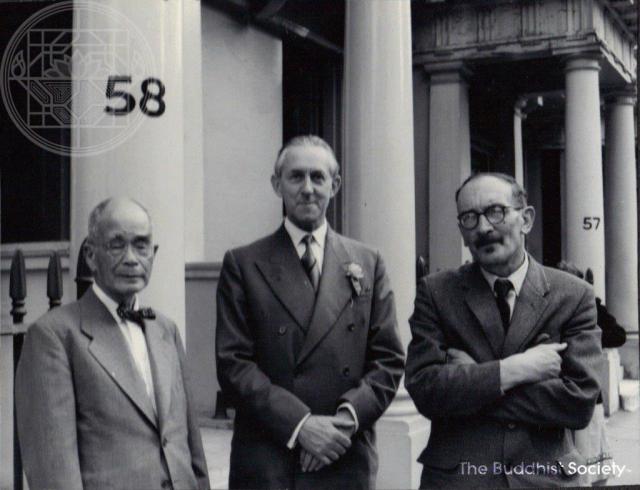
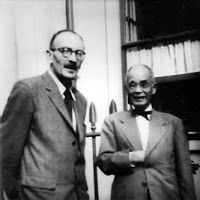
Conze and D. T. Suzuki

Edward Conze and D. T. Suzuki

The Diamond Sutra

The Diamond Sutra is part of the Mahaprajnaparamita Sastra, written by Nagarjuna in around the second century.

It was upon hearing a man reciting this sutra that Hui-neng experienced an awakening. When the fifth patriarch read it to him several months later, Hui-neng attained complete enlightenment. Thus he fulfilled the Buddha’s prophecy: “For even at that time, Subhuti, there will be bodhisattvas who are endowed with good conduct, endowed with virtuous qualities, endowed with wisdom, and who, when these words of the sutra are being taught, will understand their truth.”

Vajra is the hardest substance imaginable; it is also luminous and transparent. The Vajracchedika Sutra is said to cut through illusions just as a diamond cuts through inferior substances.

Vajracchedika Prajnaparamita Sutra

Based on translations from the Sanskrit by Paul Harrison and Edward Conze

Homage to Śakyamuni, Tathagata, Arhat, Completely Enlightened One!

Homage to the Prajnaparamita, the Lovely, the Holy!

1. The Setting of the Sermon

Thus have I heard at one time. The Lord (Bhagavat) (1) was staying at Sravasti, in the Jeta Grove, in the garden of Anathapindika, together with a large gathering of monks, consisting of 1,250 monks, among them many bodhisattvas, great beings.(2) In the morning the Lord put on his cloak, took his bowl, and entered the great city of Sravasti to collect alms. When he had returned from going house to house and had eaten, the Lord put away his bowl and cloak, washed his feet, and sat down on his seat, his legs crossed, his body upright, his attention fixed mindfully in front of him. Then a great many monks approached the Lord, and after approaching him they prostrated themselves at the Lord’s feet, walked around the Lord three times, and sat down on one side.

2. Subhuti, Foremost of the Disciples

Furthermore, on that occasion the Venerable Subhuti had joined that assembly and was seated with it. Then the venerable Subhuti rose from his seat, arranged his upper robe over one shoulder, knelt on his right knee, made obeisance to the Lord with his palms pressed together, and said to the Lord: It is wonderful O Lord, it is exceedingly wonderful, O Well-Gone, how much the bodhisattvas, the great beings, have been helped with the greatest help by the Tathagata, the Arhat, the Fully Enlightened One. It is wonderful, O Lord, how much the bodhisattvas, the great beings, have been favoured with the highest favour by the Tathagata, the Arhat, the Fully Enlightened One. How then, O Lord, should a son or daughter of good family who has set out in the path of the bodhisattva stand, how should he advance, how should he pacify his mind?(3)

After these words the Lord said to the venerable Subhuti: Well said, well said, Subhuti! So it is, Subhuti, so it is, as you say! Subhuti, the Tathagata has helped the bodhisattvas, the great beings, with the greatest help, and he has favoured them with the highest favour. Therefore, Subhuti, listen well and attentively! I will teach you how those who have set out in the bodhisattva path should stand, how they should advance, how they should pacify their mind.

So be it, O Lord, replied the venerable Subhuti, and listened.

3 The vow to save all living beings

The Lord said: Here, Subhuti, someone who has set out in the path of a bodhisattva should form the following thought: However many beings there are in the universe of beings, whether born of an egg or a womb, born from moisture or born miraculously, having form or without form, having discrimination or without discrimination:(4) as many kinds of beings as can be conceived, all these I must lead to nirvana, into that realm of nirvana in which nothing remains.(5) And yet, although innumerable beings have thus been led to nirvana, not one being has been led to nirvana.

And why? If in a bodhisattva there should arise knowledge of a being, he could not be called a bodhisattva. And why? He is not to be called a bodhisattva in whom arises knowledge of a self, nor in whom arises knowledge of a being, or knowledge of a living soul, or knowledge of a man.(6)

atman, sattva, jiva, pudgala: Na sa Subhute bodhisattvo vaktavyo yasya-atma-samjna pravarteta, sattva-samjna va jiva-samjna va pudgala-samjna va pravarteta

God is one in all ways and according to every reasoning, so that in him no plurality is to be found, within the mind or without. For he who sees any distinction clearly does not see God. – Meister Eckhart

4 The Perfection of Giving (Dana Paramita)

Moreover, Subhuti, a bodhisattva who gives of himself is not to dwell in anything, nor is he to dwell anywhere. When he gives of himself, he is not to dwell in that which is seen, nor in that which is heard or smelled or tasted or felt or thought. For, Subhuti, the bodhisattva, the great being, is to give of himself in such a way that he does not dwell in the slightest difference between things. And why? Because the accumulation of merit of that bodhisattva who gives of himself without dwelling anywhere is incalculable.

5 What do you think, Subhuti? Is it easy to take the measure of space in the east?
Subhuti said: Indeed not, Lord.
Likewise, is it easy to take the measure of space in the south, west, north, below, above—in all of the ten directions?
Subhuti said: Indeed not, Lord.
The Lord said: In the same way, it is difficult to measure the accumulation of merit of that Bodhisattva who gives of himself without dwelling. That is why those who have set out in the bodhisattva path are to give of themselves without dwelling in any knowledge of a difference.

6 Subhuti asked: Lord, in the future, in the last time, in the last epoch, in the last five hundred years, at the time of the collapse of the good doctrine, will there be any beings who, when these words of the sutra are being taught, will understand their truth?

The Lord replied: Do not speak thus, Subhuti! Yes, even then there will be such beings. For even at that time, Subhuti, there will be bodhisattvas who are endowed with good conduct, endowed with virtuous qualities, endowed with wisdom, and who, when these words of the sutra are being taught, will understand their truth.

And those bodhisattvas, Subhuti, will not be such as have honoured only one buddha, nor such as have planted their roots of merit under one buddha only. On the contrary, Subhuti, those bodhisattvas who, upon hearing these words of the sutra, experience even a single thought of serene faith, will be those who have honoured many hundreds of thousands of buddhas, those who have planted their roots of merit under many hundreds of thousands of buddhas. The Tathagata knows of them by his buddha-knowledge; the Tathagata sees them with his buddha-eye; the Tathagata penetrates their souls. They will all accumulate for themselves an immeasurable quantity of merit.

And why? Because, Subhuti, in those bodhisattvas there arises no knowledge of a self, or knowledge of a being, or knowledge of a soul, or knowledge of a man. Nor will knowledge of a thing or a concept arise in those boddhisattvas. No knowledge or non-knowledge (asamjna) will arise in them. And why? If, Subhuti, knowledge of a thing or a concept should arise in those bodhisattvas, they would thereby seize upon a self, a being, a soul, or a man. And why? Because a bodhisattva ought not to seize upon either a thing or a concept. Thus the meaning of the Tathagata’s words: Those who understand the discourse about the doctrine being like a raft should forsake things; even more so, concepts.(7)

7 Furthermore, the Lord said to the Venerable Subhuti: What do you think, Subhuti? Is there any Dharma (8) that the Tathagata has known as utmost, perfect enlightenment, or is there any doctrine that the Tathagata has demonstrated?
Subhuti said: No, not as I understand what the Lord has said. And why? This Dharma which the Tathagata has fully known and demonstrated cannot be grasped; it cannot be talked about; it is neither thing nor concept. And why? Because all sages, though they are different from one another, belong to non-doing (asamskara or asamskrta). (Suzuki, 1935)

9a Subhuti, what do you think? Does a stream-enterer ever have the thought: I have attained the stage of stream-enterer?
Subhuti said: No indeed, Lord. And why? Because, Lord, he does not enter any thing: that is why he is called a stream-enterer. He does not enter that which is seen, nor does he enter that which is heard, smelled, tasted, felt, or thought. Thus he is called a stream-enterer. O Lord, if the stream-enterer were to have the thought: I have attained the stage of stream-enterer, then he would be seizing upon a self, seizing upon a being, seizing upon a soul, seizing upon a man.

9b The Lord said: What do you think, Subhuti? Does a once-returner ever have the thought: I have attained the stage of once-returner?
Subhuti said: No indeed, Lord. A once-returner does not have the thought: I have attained the stage of once-returner. And why? Because there is no thing whatsoever that enters the stage of once-returner; thus is the once-returner spoken of.

9c Subhuti, what do you think? Does a non-returner ever have the thought: I have attained the stage of non-returner?
Subhuti said: No indeed, Lord. A non-returner never has the thought that he has attained the stage of non-returner. Why? There is no thing whatsoever which observes that it is a non-returner; thus is the non-returner spoken of.

9d The Lord said: What do you think, Subhuti? Does an arhat ever have the thought: I have attained arhatship?
Subhuti said: No indeed, Lord. And why? Because there is no thing whatsoever, Lord, which is called an arhat. If an arhat were to have the thought: I have attained arhatship, then he would indeed be seizing upon a self, seizing upon a living being, seizing upon a soul, seizing upon a man.

9e I am the one, Lord, whom the Tathagata, the Arhat, the Fully Enlightened One has called Foremost Among Those Who Dwell in Peace. I am, Lord, an arhat, free of passion. But the thought does not occur to me, Lord, that I am an arhat. If, O Lord, the thought should occur to me that I had attained arhatship, then the Tathagata would not have called me Subhuti, Son of a Good Family, Foremost Among Those Who Dwell in Peace. But a dweller in peace does not dwell anyplace: thus is a dweller in peace spoken of.

14a Thereupon the impact of the doctrine moved the Venerable Subhuti to tears. Having wiped away his tears he said to the Lord: It is wonderful, O Lord, it is exceedingly wonderful, O Well-Gone, how well the Tathagata has taught this discourse on the Dharma. Ever since cognition was produced in me, Lord, I have not heard such a discourse on the Dharma. Most wonderfully blessed will be those who, when this sutra is being taught, have true knowledge. And true knowledge, that is verily nonexistent knowledge (abhuta-samjna); thus the Tathagata speaks of true knowledge.

It is not difficult for me to accept and believe this discourse on the doctrine when it is being taught. However those beings who will be in the future, in the last time, in the last epoch, in the last 500 years, at the time of the collapse of the good doctrine, and who, O Lord, take up this Sutra, memorize it, recite it, study it, and illuminate it in full for others, those will be most wonderfully blessed. However, no knowledge of a self will arise in them, nor of a being or a soul or a man. And why? That, O Lord, which is true knowledge of self, that is non-knowledge (asamjna). That which is true knowledge of a being or a soul or a man, that is non-knowledge. And why? Because the buddhas, the lords, have left all knowledge behind.

14d The Lord said: So it is, Subhuti. Most wonderfully blessed will be those beings who, upon hearing this sutra, do not tremble or become frightened or terrified. And why? The Tathagata has taught that this is the highest perfection (parama-paramita). And what the Tathagata teaches to be the highest perfection, that also do the innumerable blessed buddhas teach. Thus do I speak of the highest perfection.

14e The Perfection of Forbearance (Ksanti Paramita)

Furthermore, Subhuti, the Tathagata’s perfection of forbearance is really non-perfection. And why? Because, Subhuti, while my body was being dismembered by the King of Kalinga (9) I had no knowledge of a self, a being, a soul, or a man. And why? If, Subhuti, I had had knowledge of a self, ill-will would have arisen in me; and likewise if I had had knowledge of a being or a soul or a man. With my supernormal power I remember that I was the Rishi (10) of Forbearance for five hundred lifetimes. During that time, moreover, no knowledge of a self or a being or a soul or a man arose in me.

Sickness or poverty, hunger or thirst—whatever God sends you or does not send you, what He grants you or withholds, that is best for you. Even should you lack fervour and inwardness—whatever you have or lack, be minded to honour God in all things, and then whatever He sends you will be the best. Be assured, if it were not God’s will it would not be. You have neither sickness nor anything else unless God wills it. And so, knowing it is God’s will, you should rejoice in it and be so content that pain would be no pain to you. – Meister Eckhart (Sermon Forty)

Therefore, Subhuti, bodhisattvas, great beings, are to detach themselves from all appearances in order to cultivate the mind of utmost, perfect enlightenment. They are to cultivate a mind which does not dwell in that which is seen; they are to cultivate a mind which does not dwell in that which is heard, smelled, tasted, felt or thought. They are to cultivate a mind which does not dwell in things or concepts. They are to cultivate a mind which does not dwell in anything. And why? Correct dwelling is non-dwelling. For this reason the Tathagata teaches that giving is to be practiced without dwelling in forms.

You are among things, but they are not in you, for those who are careful are unhindered in their activity. They are unhindered who organize all their works guided by the eternal light. Such people are among things and not [dwelling] in them. They are very close [to the world], and yet have no less than if they were up yonder on the circle of eternity. Very close, I say, for all creations are means [to get to God]. There are two kinds of means. One means, without which I cannot get to God, is work or activity in time, which does not interfere with eternal salvation. Works are performed outwardly, but activity is when one performs with care and understanding inwardly. The other means is to be free of all that. For we are set down in time so that our sensible worldly activity may make us closer and more like to God. (Meister Eckhart, Sermon Nine)

14f Subhuti, when bodhisattvas give in this manner it benefits all sentient beings. The Tathagata teaches that all attributes are non-attributes, and all sentient beings are non-beings. And why? Because the Tathagata speaks in accordance with the Dharma, speaks the truth, speaks of what is, not otherwise. A Tathagata does not speak falsely. Nevertheless, Subhuti, with regard to that Dharma which the Tathagata has fully known and demonstrated, there is neither truth nor falsehood.

14g Subhuti, in the darkness one sees nothing; just so should one regard a bodhisattva who has fallen among things and who gives of himself while abiding in things. When the night sky lightens and the sun rises, a man endowed with sight sees myriad forms; just so, Subhuti, should one regard a bodhisattva who gives of himself without abiding in things.

16 Subhuti, those sons and daughters of good family who take up these sutras and memorize them, recite and study them, they will be humbled, well humbled they will be! And why? Whatever wrongful deeds (karma) leading to evil paths that these beings have done in their former lives, in this very life they will, by that humiliation, free themselves of those wrongful deeds of former lives, and they will attain the enlightenment of a buddha.

17a Subhuti asked: How, O Lord, should one who has set out in the bodhisattva path stand, how should he advance, how should he still his thoughts?
The Lord replied: Here, Subhuti, someone who has set out in the bodhisattva path should form the following thought: All beings I must lead to nirvana, into that realm of nirvana which nothing remains; and yet, after beings have thus been led to nirvana, no being at all has been led to nirvana. And why? If knowledge of a being should arise in a bodhisattva, he could not be called a bodhisattva, and likewise if knowledge of a soul or a man should arise in him. And why? Because he who has set out in the bodhisattva path is not one of the [worldly] things.

17b What do you think Subhuti? When I was with the Tathagata Dipankara, is there any doctrine by which I came to fully know utmost, perfect enlightenment?
Subhuti replied: There is no doctrine by which the Tathagata, when he was with the Tathagata Dipankara, fully came to know utmost, perfect enlightenment.
The Lord said: So it is, Subhuti, so it is: there is no doctrine by which the Tathagata, when he was in the presence of Dipankara, the Tathagata, Arhat, Fully Enlightened One, came to fully know utmost, perfect enlightenment. Moreover, Subhuti, if I had fully known some doctrine, the Tathagata Dipankara would not have predicted of me: You, young Brahmin, will in a future time be Tathagata, Arhat, Fully Enlightened One, by the name of Shakyamuni!  And why? The title, Tathagata, signifies suchness.

17d Should anyone say, Subhuti, that the Tathagata has fully known utmost, perfect enlightenment, he would be speaking falsely. And why? There is not any doctrine by which the Tathagata has fully known the utmost, right and perfect enlightenment. And that Dharma which the Tathagata has fully known and demonstrated, with regard to that there is neither true nor false. Therefore the Tathagata preaches: All things are buddha-things. And why? Subhuti, the Tathagata has demonstrated that all things are non-things: thus all things are said to be buddha-things.

17f The Lord said: Subhuti, the bodhisattva who would say: I will lead beings to nirvana is not to be called a bodhisattva. And why? Is there, Subhuti, any thing called a bodhisattva?
Subhuti replied: No, O Lord, there is no thing called a bodhisattva.
The Lord said: Therefore the Tathagata teaches: Devoid of self are all things: devoid of a being, devoid of a soul, devoid of a man—all things are thus. (Niratmanah sarvadharma, nihsattvah nirjiva nispudgalah sarva-dharma iti.) However, Subhuti, the bodhisattva who remains focused on Devoid of a self are all things, him the Tathagata, the Arhat, the Fully Enlightened One has declared to be a bodhisattva, a great being.

18b The Lord said: What do you think, Subhuti? Has the Tathagata used the phrase, As many grains of sand as there are in the great river Ganges?
Subhuti replied: So it is, O Lord, so it is, O Well-Gone! The Tathagata has done so.
The Lord asked: What do you think, Subhuti? If there were as many Ganges rivers as there are grains of sand in the great river Ganges, and if there were as many world-systems as there are grains of sand in them, would those world-systems be many?
Subhuti replied: So it is, O Lord, so it is, O Well-Gone. Those world-systems would be many.

The Lord said: However many beings are in those world-systems, I know, in my wisdom, their manifold patterns of thought (anusaya). And why? Subhuti, the Tathagata has shown patterns of thought to be non-patterns of thought; thus do I speak of patterns of thought. And why? Past thought is unattainable, future thought is unattainable, present thought is unattainable.

21 The Lord asked: What do you think, Subhuti? Does the Tathagata have the thought: I have taught the doctrine? Subhuti, whosoever were to say that the Tathagata has taught the doctrine would speak falsely; he would misrepresent me by seizing upon what is not. And why? The teaching of the doctrine, Subhuti, is that there is no such thing as a teaching of the doctrine that could be grasped

Subhuti asked: Are there, O Lord, any beings in the future, in the last time, in the last epoch, in the last 500 years, at the time of the collapse of the good doctrine who, upon hearing such teachings, will truly believe?
The Lord replied: Subhuti, there are no beings or non-beings. And why? All beings, Subhuti, have been shown by the Tathagata to be non-beings; thus do I speak of all beings.

bhagavān āha | na te subhūte satvā nāsatvās tat kasya hetoḥsarvasatvā iti subhūte asatvās te tathāgatena bhāṣitās tenocyante sarvasatvā iti

22 What do you think, Subhuti? Is there any thing which the Tathagata has fully known utmost, perfect enlightenment?
Subhuti replied: No indeed, O Lord, there is no thing which the Tathagata has fully known utmost perfect enlightenment.
The Lord said: So it is, Subhuti, so it is. Not even the least (anu) thing is to be found or grasped there: thus do I speak of utmost (anuttara), perfect enlightenment.

23 Furthermore, Subhuti, that Dharma is of a sameness (samata), and nothing is therein at variance (vishama). Thus do I speak of utmost, perfect enlightenment. Being of a sameness due to the absence of a self, a being, a soul, or a man, utmost, perfect enlightenment is fully known as the totality of all wholesome things. Furthermore, Subhuti, the Tathagata has shown wholesome things to be non-things; thus do I speak of wholesome things.

25 What do you think, Subhuti, in the Tathagata does the thought arise: There are beings who have been liberated by me? You should not see it thus, Subhuti! And why? There is not a single being who has been liberated by the Tathagata. Furthermore, if there had been any being liberated by the Tathagata, then surely the Tathagata would be seizing upon a self, a being, a soul, a man. Subhuti, the Tathagata has taught that seizing upon a self is non-seizing, yet the foolish ordinary men seize upon it. Furthermore, Subhuti, the Tathagata has taught that foolish ordinary men are non-men; thus do I speak of foolish ordinary men.

26 What do you think, Subhuti? Is the Tathagata recognized by the signs of a buddha? (11)
Subhuti replied: No indeed, O Lord.
The Lord said: If, Subhuti, the Tathagata could be recognized by the signs of a buddha, then a wheel-turning sage-king would also be a Tathagata.10 Therefore, the Tathagata is not recognized by the signs of a Buddha.

Further, the Lord spoke on that occasion the following verse:

Those who by my form did know me
And those who followed me by my voice
Engaged in wrong efforts
Those people will not see me

By their teaching does one recognize the buddhas
From their Dharma-body comes their guidance
Yet the Dharma’s true nature cannot be discerned
And no one can be conscious of it as an object

27 Subhuti, No one should say to you: Those who have set out in the bodhisattva path have conceived the destruction of a thing, nor its annihilation. Not so should you see it, Subhuti! For those who have set out in the bodhisattva path have not conceived the destruction of a thing or its annihilation.

28 Subhuti, suppose a bodhisattva, in the practice of giving, filled as many world-systems with the seven precious treasures as there are grains of sand in the Ganges River. If there is a man with the awareness that all things are void of self, and if he accomplishes their complete extinction, then this is superior, and the merit accumulated by this bodhisattva surpasses that of the former. Subhuti, this is because bodhisattvas accumulate no merit.

Now listen to a true saying! If a man gave a thousand marks of gold for building churches and convents, that would be a great thing. Yet that man would give far more who could regard a thousand marks as nothing; he would have done far more than the other. – Meister Eckhart (Sermon Forty)

Subhuti asked the Buddha: Lord, why do you say that bodhisattvas do not accumulate merit?
Subhuti, in order for bodhisattvas to accumulate merit they should not covet merit; therefore it is said that they do not accumulate merit.

29 Whosoever says that the Tathagata goes or comes, stands, sits or lies down does not understand the meaning of my teaching. And why? Tathagata is the title given one who has not gone any place, nor come from any place; therefore is he called Tathagata, Arhat, Fully Enlightened One.

31 What do you think? Subhuti, if someone said that the Tathagata had taught a view (drishti) of a self, a view of a being, a view of a living soul, a view of a man, would he be speaking rightly?
Subhuti replied: No indeed, O Lord, no indeed, O Well-Gone, he would not be speaking rightly. And why? The Tathagata has taught that [the proper] view of a self is no view: thus has he spoken of a view of a self.

The Lord said, Subhuti, regarding all things, one who is developing the mind of utmost, perfect enlightenment should thus know, thus see, and thus believe, not allowing knowledge of things (samjna) to arise. Subhuti, the true attributes of things are non-attributes: thus do I speak of the attributes of things.

32 And finally, Subhuti, if a bodhisattva, a great being, had filled world-systems immeasurable and incalculable with the seven precious things, and gave them as a gift to the tathagatas, the arhats, the fully enlightened ones, and if, on the other hand, a son or daughter of good family had taken from this Prajnaparamita Sutra but one stanza of four lines, and were to memorize, teach, recite and study it, and illuminate it in full for others, on the strength of that this latter would accumulate a greater quantity of merit, immeasurable and incalculable. How should he illuminate it? By not illuminating it. This is what I mean when I say he should illuminate it.

As a shooting star, spots before the eyes, a lamp
A mirage, dew drops,  a bubble
A dream, a lightning flash, a cloud
So should one view what is conditioned

Thus spoke the Lord. Enraptured, the venerable Subhuti, the monks and nuns, the pious laymen and laywomen, and the bodhisattvas, and the whole world with its gods, men, asuras (12) and gandharvas rejoiced in the Lord’s teaching.

This completes the Diamond-hard Cutter of Perfect Wisdom.

Footnotes:

1. The title of Lord: see Why is the Buddha called Bhagavat

2. The Bodhisattvas are called Mahasattvas, great beings, because they take the great vow, because they want to do the great work, and because they want to arrive at the great place. – The Mahaprajnaparamita Sastra

3. Mind – thoughts (cittam).

4. Samjna: knowledge of differences; discrimination between good and bad attributes.

5. Nothing remains: there is no mind left.

6. With respect to the doctrine of ‘no-self’, Edward Conze (1975) states,

It is noteworthy that the ontology of the Prajnaparamita is represented here and elsewhere as a continuation or extension of the traditional Buddhist doctrine of “not-self ” (anatta). It is supposed to be well known and agreed upon that the self, and other expressions which imply a self, such as ‘being’, ‘living soul’, ‘person’, ‘individual’, ‘sentient being’, or ‘thinking subject’, etc., are mere words to which nothing at all corresponds in ultimate reality. What is true of the self is now said to be true also of all other supposed entities which, in their differentiation, are data which somehow imply a separate self, and therefore will be unreal on the level of accomplished self-extinction, upon which alone the truth becomes discernible. (p. 3)

7. Adharma is the negation of the word dharma. Literally a non-thing, it refers to things that exist only in the mind, such as ‘the Buddha’ and ‘the Dharma’ (doctrine). As the Lankavatara Sutra explains, these thought-objects are just as impossible to grasp as physical phenomena. The simile of the raft is that just as one abandons a raft as soon as one has crossed a river, one abandons doctrine as soon as one has had a realization of the truth.

We climb a ladder, and each time we get up to another rung we forget about the rungs below. Then, when we get to the top, we kick the ladder away. – Lester Levenson

8. Dharma: The Law; ultimate reality. Where the word refers to the teaching of the Law, I have used ‘doctrine’. Where the word refers to things that are discriminated by the mind, I have used ‘phenomena’.

9. Kaliraja, or King Kalinga: In a previous existence, when the Buddha was a bodhisattva, he dwelt in a certain mountain. The king went on a hunting trip to this mountain, bringing along his concubines. While the king was off hunting, the women found the Buddha and stayed to listen to him teach. The king came upon the scene and accused the Buddha of harboring passions. When the Buddha denied knowledge (samjna) of any passions the king cut off first his ear, then his nose, then his limbs in order to test him. Every part of his body grew back, which proved that the Buddha had not experienced any passions. The tale illustrates that the Buddha had let go of desire (attachments), anger (aversions), and delusion — the three hindrances.

10. Rishi: A sage, saint, ascetic, anchorite. (https://www.wisdomlib.org/definition/rishi)

11. The thirty-two features and eighty auspicious signs are various unusual physical marks possessed by a buddha. They derive from earlier Indian thought, where they were said to distinguish a wheel-turning king [Chakravarti Raja] or ideal ruler. (Burton Watson: Lin-chi)

12. Asuras: Fierce beings who possess certain powers but lack love and compassion.

References:

Conze, Edward (1958). Buddhist Wisdom Books: Containing the Diamond Sutra and the Heart Sutra. Translated and Explained by Edward Conze. London: Allen & Unwin. (Diamond-Sutra-Conze)

Conze, Edward (1975). The Large Sutra on Perfect Wisdom. University of California Press.

Paul Harrison, from two oldest surviving Sanskrit manuscript copies:
1. MS 2385, Schøyen Collection, edited by Harrison & Watanabe, is presumed to have come from Afghanistan, possibly the Bamiyan area, and is dated on paleographical grounds to the 6th–7th centuries.
2. The Gilgit Vajracchedikā, discovered in Northern Pakistan in 1931, and subsequently
edited by Chakravarti (1956), Dutt (1959), and Schopen (1989), and is dated 6th-7th centuries. (VajracchedikaSutraHarrison)

Also available, translated from the Chinese:

Hsuan Hua (2001). A General Explanation of the Vajra Prajna Paramita Sutra. San Francisco: Sino-American Buddhist Association, Inc. (Diamond-Sutra-BTTS)

Suzuki, D. T. (1935). Manual of Zen Buddhism (p. 30).

Hsuan Hua

Dhyana Master Hsuan Hua

Conze Humphreys Suzuki

D. T. Suzuki, Christian Humphreys, Edward Conze

The Heart Sutra

The Heart Sutra

Thus have I heard. Once the Blessed One was dwelling in Rajagriha at Vulture Peak, together with a great gathering of the community of monks and a great gathering of the community of Bodhisattvas. At that time the Blessed One entered the samadhi called “profound illumination,” and at the same time noble Avalokiteshvara, the Bodhisattva, great being, while practicing the profound Prajna Paramita, saw things thus: he saw the five skandhas to be empty of self-nature.

Then, through the power of the Buddha, the venerable Shariputra said to noble Avalokiteshvara, the Bodhisattva, great being: If a son or daughter of noble family wishes to practice the profound Prajna Paramita, how should this be done?

Addressed thus, noble Avalokiteshvara, the Bodhisattva, great being, said to the venerable Shariputra: O Shariputra, a son or daughter of noble family who wishes to practice the profound Prajna Paramita should view things thus: he or she should see the five skandhas to be empty of self-nature. Form is emptiness, emptiness also is form; emptiness is not other than form, form is not other than emptiness. In the same way, feeling, discrimination, expectations and consciousness are emptiness. Thus, Shariputra, all dharmas are emptiness. There are no characteristics. There is no birth and no cessation. There is no impurity and no purity. There is no loss and no gain.

Therefore, Shariputra, in emptiness there is no form, no feeling, no discrimination, no expectations, no consciousness; there is no eye, ear, nose, tongue, body or mind; there is no thing seen, heard, smelled, tasted, felt or thought; there is no realm of sights, sounds, smells, flavors, sensations or thoughts. There is no ignorance nor end of ignorance, no expectations nor end of expectations, no consciousness nor end of consciousness,  no body and mind nor end of body and mind, no senses and sense-objects nor end of senses and sense-objects, no feelings nor end of feelings, no craving nor end of craving, no attachment nor end of attachment, no becoming nor end of becoming, no birth nor end of birth, no old age and death nor end of old age and death. There is no suffering, no origin of suffering, no cessation of suffering; there is no Noble Eightfold Path; there is no enlightenment, nor anything attained, nor anything not attained. Therefore, Shariputra, having attained nothing, the Bodhisattva, great being, abides in the Prajna Paramita.

Because nothing is attained, the Bodhisattva, through reliance on the Prajna Paramita, is unhindered in his mind. Because there is no hindrance, he is not afraid, and he leaves delusional dream-thinking far behind. Ultimately Nirvana! All Buddhas of the past, present and future attain unsurpassed perfecte awakening through reliance on the Prajna Paramita. Therefore, know that the Prajna Paramita is a great spiritual mantra, a great bright mantra, a supreme mantra, an unequaled mantra. It can remove all suffering; it is genuine and not false. That is why the mantra of the Prajna Paramita was spoken. Recite it this way:

Gaté Gaté Paragaté Parasamgaté

Bodhi Svaha!

Shariputra, thus should the Bodhisattva, great being, discipline himself in the profound Prajna Paramita.

Then the Blessed One arose from that samadhi and praised noble Avalokiteshvara, the Bodhisattva, great being, saying: Good, good, O son of noble family. Thus it is, O son of noble family, thus it is. One should practice the profound Prajna Paramita just as you have taught, and all the Tathagatas will rejoice.

When the Blessed One had said this, the venerable Shariputra and noble Avalokiteshvara, the Bodhisattva, great being, the whole assembly and the world with its gods, humans, asuras and gandharvas,* rejoiced and praised the words of the Blessed One.

*Asuras are gods who delight in battles; gandharvas (गन्धर्व) are divine artists or musicians who accompany the gods. (Wisdom Library)


Translation by the Nalanda Translation Committee (https://www.dharmanet.org/HeartSutra.htm)

Meister Eckhart: Sermon Eighty Seven

He becomes a monk in all the different creeds of the world
so that thereby he may free others from ignorance
and save them from falling into erroneous beliefs. – Vimalakirti Sutra

Question: “It said that the Great Way is very easy to find and easy to follow, yet no one who is in the world is capable of finding it and following it.”
Bodhidharma: “These words are true. Being above the world, unmoved, letting go, indifferent to it, not doing a single thing, is called following the Way. Not seeing a single thing is called seeing the Way. Not knowing a single thing is called cultivating the Way. Not practising a single thing is called practising the Way. Thus it is said to be easy to enter and easy to follow.” (Bodhidharma’s Method for Quieting the Mind)


Sermon Eighty Seven

Beatitude itself opened its mouth of wisdom and said: “Blessed are the poor in spirit, for theirs is the kingdom of heaven”. All angels, all saints, and everything that was ever born must keep silent when the wisdom of the Father speaks, for all the wisdom of angels and all creatures is pure folly before the unfathomable wisdom of God. This wisdom has declared that the poor are blessed.

Now there are two kinds of poverty. The one is external poverty, and this is good and much to be commended in the man who practises it voluntarily for the love of our Lord Jesus Christ, for he himself possessed this on earth. About this poverty I shall say no more now. But there is another poverty, an interior poverty, to which this word of our Lord applies when he says: “Blessed are the poor in spirit”.

Now I beg you to be like this in order that you may understand this sermon, for by the eternal truth I tell you that unless you are like this truth we are about to speak of, it is not possible for you to follow me.

Some people have asked me what poverty is in itself, and what a poor man is. This is how we shall answer.

Bishop Albert [Albertus Magnus] says a poor man is one who finds no satisfaction in all things God ever created, and this is well said. But we shall speak better, taking poverty in a higher sense: A poor man is one who wants nothing, knows nothing and has nothing. We shall now speak of these three points, and I beg you for the love of God to understand this wisdom if you can. But if you can’t understand it, don’t worry, because I am going to speak of such truth that few good people can understand.

Firstly, we say that a poor man is one who wants nothing. There are some who do not properly understand the meaning of this: these are the people who cling with attachment [Eigenschaft – possessiveness] to penances and outward practices, making much of these. May God have mercy on such folk for understanding so little of divine truth! These people are called holy from their outward appearances, but inwardly they are asses, for they are ignorant of the actual nature of divine truth. These people say that a poor man is one who wants nothing and they explain it this way: A man should so live that he never does his own will in anything, but should strive to do the dearest will of God. It is well with these people because their intention is right, and we commend them for it. May God in His mercy grant them the kingdom of heaven! But by God’s wisdom I declare that these folk are not poor men or similar to poor men. They are much admired by those who know no better, but I say that they are asses with no understanding of God’s truth. Perhaps they will gain heaven for their good intentions, but of the poverty we shall now speak of they have no idea.

If then, I were asked what is a poor man who wants nothing, I should reply as follows: As long as a man is so disposed that it is his will with which he would do the most beloved will of God, that man has not the poverty we are speaking about, for that man has a will to serve God’s will, and that is not true poverty! For a man to possess true poverty he must be as free of his created will as he was when he was not. For I declare by the eternal truth: as long as you have the will to do the will of God, and longing for eternity and God, you are not poor, for a poor man is one who wills nothing and desires nothing.

While I yet stood in my first cause, I had no God and was my own cause: then I wanted nothing and desired nothing, for I was bare being and the knower of myself in the enjoyment of truth. Then I wanted myself and wanted no other thing. What I wanted I was and what I was I wanted, and thus I was free of God and all things. But when I left my free will behind and received my created being, then I had a God. For before there were creatures, God was not ‘God’: He was That which He was. But when creatures came into existence and received their created being, then God was not ‘God’ in Himself: He was ‘God’ in creatures.

Now we say that God, inasmuch as He is ‘God’, is not the supreme goal of creatures, for the same lofty status is possessed by the least of creatures in God. And if it were the case that a fly had reason and could intellectually plumb the eternal abysm of God’s being out of which it came, we would have to say that God with all that makes Him ‘God’ would be unable to fulfil and satisfy that fly! Therefore let us pray to God that we may be free of God that we may gain the truth and enjoy it eternally, there where the highest angel, the fly and the soul are equal, there where I stood and wanted what I was, and was what I wanted. We conclude, then: if a man is to be poor of will, he must will and desire as little as he willed and desired when he was not. And this is the way for a man to be poor by not wanting.

Secondly, he is a poor man who knows nothing. We have sometimes said that a man should live as if he did not live either for himself, or for truth, or for God. But now we will speak differently and go further, and say: For a man to possess this poverty he must live so that he is unaware that he does not live for himself, or for truth, or for God. He must be so lacking in all knowledge that he neither knows nor recognises nor feels that God lives in him. More still, he must be free of all the understanding that lives in him, for when that man stood in the eternal being of God, nothing else lived in him: what lived there was himself. Therefore we declare that a man should be as free from his own knowledge as he was when he was not. That man should let God work as He will, and himself stand idle.

For all that ever came out of God, a pure activity is appointed. The proper work of man is to love and to know. Now the question is: Wherein does blessedness lie most of all? Some masters have said it lies in knowing, some say that it lies in loving; others say it lies in knowing and loving, and they say better. But we say it lies neither in knowing nor in loving, for there is something in the soul from which both knowledge and love flow, but it does not itself know or love in the way the powers of the soul do. Whoever knows this, knows the seat of blessedness. This has neither before nor after, nor is it expecting anything to come, for it can neither gain nor lose. And so it is deprived of the knowledge that God is at work in it; rather, it just is itself, enjoying itself God-fashion. It is in this manner, I declare, that a man should be so acquitted and free that he neither knows nor realises that God is at work in him; in that way can a man possess poverty.

The masters say God is a being, an intellectual being that knows all things. But we say God is not a being and not intellectual and does not know this or that. Thus God is free of all things, and so He is all things. To be poor in spirit, a man must be poor of all his own knowledge, not knowing any thing–not God, nor creature nor himself. For this it is needful that a man should desire to know and understand nothing of the works of God; in this way a man can be poor of his own knowledge.

Thirdly, he is a poor man who has nothing. Many people have said that perfection is attained when one has none of the material things of the earth, and this is true in one sense–when it is voluntary. But this is not the sense in which I mean it. I have said before, the poor man is not he who wants to fulfil the will of God but he who lives in such a way as to be free of his own will and of God’s will, as he was when he was not. Of this poverty we declare that it is the highest poverty. Secondly, we have said he is a poor man who does not know of the working of God within him. He who stands as free of knowledge and understanding as God stands of all things, has the purest poverty. But the third is the straightest poverty, of which we shall now speak: that is when a man has nothing.

Now pay earnest attention to this! I have often said, and eminent authorities say it too, that a man should be so free of all things and all works, both inward and outward, that he may be a proper abode for God where God can work. Now we shall say something else. If it is the case that a man is free of all creatures, of God and of self, and if it is still the case that God finds a place in him to work, then we declare that as long as this is in that man, he is not poor with the strictest poverty. For it is not God’s intention in His works that a man should have a place within himself for God to work in: for poverty of spirit means being so free of God and all His works, that God, if He wishes to work in the soul, is Himself the place where He works–and this He gladly does. For, if he finds a man so poor, then God performs His own work, and the man is passive to God within him, and God is His own place of work, being a worker in Himself. It is just here, in this poverty, that man enters into that eternal essence that once he was, that he is now and evermore shall remain. [. . . ]

So we say that a man should be so poor that he neither is nor has any place for God to work in. To preserve a place is to preserve distinction. Therefore I pray to God to make me free of God, for my essential being is above God, taking God as the origin of creatures. For in that essence of God in which God is above being and distinction, there I was myself and knew myself so as to make this man. Therefore I am my own cause according to my essence, which is eternal, and not according to my becoming, which is temporal. Therefore I am unborn, and according to my unborn mode I can never die. According to my unborn mode I have eternally been, am now and shall eternally remain. That which I am by virtue of birth must die and perish, for it is mortal, and so must perish with time. In my birth all things were born, and I was the cause of myself and all things; and if I had so willed it, I would not have been, and all things would not have been. If I were not, God would not be either. I am the cause of God’s being God: if I were not, then God would not be God. But you do not need to know this.

A great master says that his breaking-through is nobler than his emanation, and this is true. When I flowed forth from God, all creatures declared: ‘There is a God’; but this cannot make me blessed, for with this I acknowledge myself as a creature. But in my breaking-through, where I stand free of my own will, of God’s will, of all His works, and of God himself, then I am above all creatures and am neither God nor creature, but I am that which I was and shall remain for evermore. There I shall receive an imprint that will raise me above all the angels. By this imprint I shall gain such wealth that I shall not be content with God inasmuch as He is God, or with all His divine works, for this breaking-through guarantees to me that I and God are one. Then I am what I was, then I neither wax nor wane, for then I am an unmoved cause that moves all things. Here, God finds no place in man, for man by his poverty wins for himself what he has eternally been and shall eternally remain. Here, God is one with the spirit, and that is the strictest poverty one can find.

If anyone cannot understand this sermon, he need not worry. For so long as a man is not equal to this truth, he cannot understand my words, for this is a naked truth which has come direct from the heart of God.

That we may so live as to experience it eternally, may God help us. Amen.


M. O’C. Walshe. Meister Eckhart: Sermons and Treatises Volume II. UK, Element Books Limited, 1987.


Q: What happens when you reach the desireless state?
Lester: Well, what is desire? Desire comes from thinking we are not the All. When you reach the desireless state, you see yourself as the All, as the sum total, and there’s no more need, there’s no more lack, everything is you. It’s not yours–you are it!
Q: So, it’s really a state of “Seek ye first the kingdom of God and all this shall be added unto you.”*
Lester: Everything, every last atom in the universe. Please note that most of your questions have been on possessing, the possession of things. This indicates what you think happiness is. However, you will discover that should you obtain all the things you desire, you would still find yourself unhappy. You must go beyond the possessing state and reach the beingness realm where you only are. There you know that you lack nothing and that you are the infinite All. There lies the ultimate joy which is a deep and a most profound peace, the ultimate satiation.

*Therefore take no thought, saying, What shall we eat? or, What shall we drink? or, How shall we be clothed?

For after all these things do the Gentiles seek: for your heavenly Father knows that you have need of all these things.

But seek you first the kingdom of God, and his righteousness; and all these things shall be added unto you.

Take therefore no thought for tomorrow: for tomorrow shall take thought of the things for itself. Sufficient unto the day is the evil thereof. (Matt 6:31)

***
Levenson, Lester (1993). Keys to the Ultimate Freedom. Phoenix, Arizona: The Sedona Institute (p. 85). (Recorded in Los Angeles on February 10, 1966. “Mastering mind and matter”)

Death and enlightenment

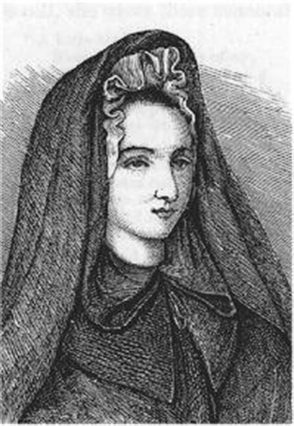
All that is of man and of his own industry, however noble and elevated it may be, must die. – Madame Guyon

The man who stands in love should be dead to himself and to all created things, so that he may care as little for himself as for one who is a thousand miles away. That man is in equality and abides in unity. — Meister Eckhart (Blakney, “The Defense” p. 182)

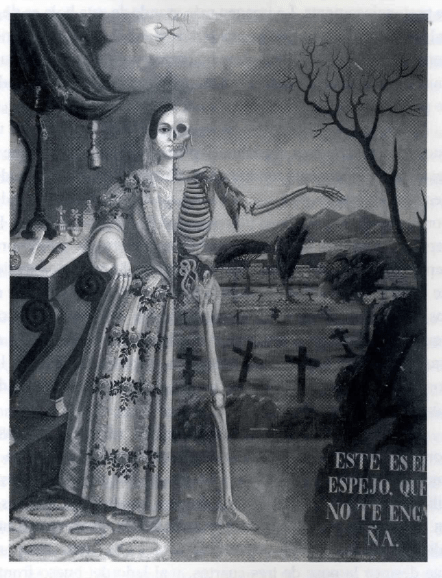
This is one mirror that doesn't deceive you

“This is one mirror that doesn’t deceive you” – Jose Guadalupe Posada

Enlightenment is the awakening to the realization that one is no other than God. In order this awakening to occur, we must stop living in fear of death and look it in the face. Death is nothing to be afraid of; what is to be feared is to have wasted one’s life, like a student who spends his days in class looking out the window, oblivious to the lessons being taught and the passing of time.

When we identify with a “self” we are both the subject and the object. We have a “divided mind,” or as James, the brother of Jesus said, we are “double-minded.” There is a self-aware “I”, which is the only reality, and there is a mind and body, which I believe to be me. I am like a puppet-master who thinks he is his puppet, because when I will it to move about and talk, it moves about and talks! I hear my puppet thinking, “I am so skillful and attractive and clever; I hope others admire me!” and I believe that these are my thoughts.

When we are forced to face the reality of death, however, our delusions drop away. It is no wonder, then, that suicidal depression and near-death experiences often bring about spiritual awakenings. Here is Eckhart Tolle’s story, taken from the Introduction to The Power of Now:

One night not long after my twenty-ninth birthday, I woke up in the early hours with a feeling of absolute dread. I had woken up with such a feeling many times before, but this time it was more intense than it had ever been. The silence of the night, the vague outlines of the furniture in the dark room, the distant noise of a passing train – everything felt so alien, so hostile, and so utterly meaningless that it created in me a deep loathing of the world. The most loathsome thing of all, however, was my own existence. What was the point in continuing to live with this burden of misery? Why carry on with this continuous struggle? I could feel that a deep longing for annihilation, for nonexistence, was now becoming much stronger than the instinctive desire to continue to live.

“I cannot live with myself any longer.” This was the thought that kept repeating itself in my mind. Then suddenly I became aware of what a peculiar thought it was. “Am I one or two? If I cannot live with myself, there must be two of me: the ‘I’ and the ‘self’ that ‘I’ cannot live with.” “Maybe,” I thought, “only one of them is real.”

I was so stunned by this strange realization that my mind stopped. I was fully conscious, but there were no more thoughts. Then I felt drawn into what seemed like a vortex of energy. It was a slow movement at first and then accelerated. I was gripped by an intense fear, and my body started to shake. I heard the words “resist nothing,” as if spoken inside my chest. I could feel myself being sucked into a void. It felt as if the void was inside myself rather than outside. Suddenly, there was no more fear, and I let myself fall into that void. I have no recollection of what happened after that.

Tolle’s suicidal thoughts made him realize that the ego which made him so unhappy wasn’t what he really was—that in fact it wasn’t real at all.

Jill Bolte Taylor, a brain researcher, had an enlightenment experience as a result of a brain hemorrhage at the age of 37, which would have killed her but for her decision to “come back” to show others the way. Since the bleeding was in the left hemisphere, her thinking mind (manas in Sanskrit) shut down before her intuitive mind (citta), and so she was able for a few hours to experience pure, unfiltered creation: (“The citta dances like a dancer, the manas is like a jester”). Then her spirit left her physical body as well:

And a little while later, I am riding in an ambulance from one hospital across Boston to Massachusetts General Hospital. And I curl up into a little fetal ball. And just like a balloon with the last bit of air, just right out of the balloon, I just felt my energy lift and I felt my spirit surrender.* And in that moment, I knew that I was no longer the choreographer of my life. And either the doctors rescue my body and give me a second chance at life, or this was perhaps my moment of transition.

When I woke later that afternoon, I was shocked to discover that I was still alive. When I felt my spirit surrender, I had said goodbye to my life. And my mind was now suspended between two very opposite planes of reality. Stimulation coming in through my sensory systems felt like pure pain. Light burned my brain like wildfire, and sounds were so loud and chaotic that I could not pick a voice out from the background noise, and I just wanted to escape. Because I could not identify the position of my body in space, I felt enormous and expansive, like a genie just liberated from her bottle. And my spirit soared free, like a great whale gliding through a sea of silent euphoria. Nirvana. I found Nirvana. And I remember thinking, there’s no way I would ever be able to squeeze the enormousness of myself back inside this tiny little body.

“All things are too small to hold me, I am so vast.” – Hadewijch

But then I realized, “But I’m still alive! I’m still alive, and I have found Nirvana. And if I have found Nirvana and I’m still alive, then everyone who is alive can find Nirvana.” And I pictured a world filled with beautiful, peaceful, compassionate, loving people who knew that they could come to this space at any time. And that they could purposely choose to step to the right of their left hemispheres and find this peace. And then I realized what a tremendous gift this experience could be, what a stroke of insight this could be to how we live our lives. And it motivated me to recover.

*The meaning of Nirvana is “blown out”: vana, (blown) is the past participle of the root va (blow); nis means out. “And the LORD God formed man of the dust of the ground, and breathed into his nostrils the breath of life; and man became a living being.” (Genesis 2:7)

D. T. Suzuki: (1965)

A monk came from Okinawa to study Zen under Suio, one of Hakuin’s great disciples and a rough and strong-minded fellow. The monk stayed with Suio for three years working on the koan of the sound of one hand. Eventually, when the time for him to go back to Okinawa was fast approaching and he had still not solved his koan, he got very distressed and came to Suio in tears. The Master consoled him, saying, “Don’t worry. Postpone your departure for another week and go on sitting with all your might.” Seven days passed, but still the koan remained unsolved. Again the monk came to Suio, who counseled him to postpone his departure for yet another week. When that week was up and he still had not solved the koan, the Master said, “There are many ancient examples of people who have attained satori after three weeks, so try a third week.” But the third week passed and still the koan was not solved, so the Master said, “Now try five more days.” But the five days passed, and the monk was no nearer solving the koan, so finally the Master said, “This time try three more days and if after three days you have still not solved the koan, then you must die.” Then, for the first time, the monk decided to devote the whole of whatever life was left to him to solving the koan. And after three days he solved it. (Early Memories, pp. xix-xxi)

Lester Levenson:

I was at the end of my rope. I was told not to take a step unless I absolutely had to because there was a possibility that I could drop dead at any moment. This was a terrible, shocking thing to suddenly be told that I couldn’t be active anymore, having been so active all my life. It was a horrible thing.

An intense fear of dying overwhelmed me, the fear that I might drop dead any minute. This stayed with me for days. I went through a real, horrible, low, spinning period there, in the grip of intense fear of dying or of being a cripple for the rest of my life in that I wouldn’t be able to be active. How could I take care of all that, and take care of myself!? I felt that life would not be worthwhile anymore.

This caused me to conclude with determination, ‘Either I get the answers, or I’ll take me off this Earth. No heart attack will do it!’ I had a nice, easy way to do it, too: I had morphine the doctors gave me for my kidney stone attacks.

After several days of this intense fear of dying, I suddenly realized, ‘Well, I’m still alive. As long as I’m alive, there’s hope. As long as I’m alive, maybe I can get out of this. What do I do?’  (Lester Levenson (1909-1994) )

Blakney, Raymond B. (1941). Meister Eckhart: A Modern Translation. New York: Harper & Row. (Internet Archive)

Levenson, Lester (1993). Keys to the Ultimate Freedom: Thoughts and Talks on Personal Transformation. Phoenix, Arizona: Sedona Institute. (http://www.freespiritualebooks.com/keys-to-the-ultimate-freedom.html) (download)

Lester Levenson — The True Story. http://www.presentlove.com/lester-levenson/

Suzuki, Daisetz Teitaro (1932). The Lankavatara Sutra: A Mahayana Text (Translated from the original Sanskrit). London.

Suzuki, Daisetz Teitaro (1965). The Training of the Zen Buddhist Monk. New York: University Books.

Suzuki, D. T. (2014). (Richard M. Jaffee, editor). Selected Works of D. T. Suzuki, Volume I. Oakland: University of California Press.

Walshe, Maurice O’Connell (1978). “Buddhism and Death.” The Wheel, No. 261, Buddhist Publication Society. (https://www.accesstoinsight.org/lib/authors/walshe/wheel261.pdf)

“Maurice O’Connell Walshe”, edited by Access to Insight. Access to Insight (BCBS Edition), 2 November 2013, http://www.accesstoinsight.org/lib/authors/walshe/index.html .

Austerity, self-mortification and miracles

They may rightly and legitimately feast who would have been as ready and willing to fast. – Meister Eckhart (Walshe, Vol. III, p. 38)

His disciples asked him, “Do you want us to fast? How should we pray? Should we give to charity?
Yeshua said to them, “If you fast, you will bring sin upon yourselves, and if you pray, you will be condemned, and if you give to charity, you will harm your spirits.
When you go into any region and walk about in the countryside, when people take you in, eat what they serve you and heal the sick among them. After all, what goes into your mouth will not defile you; rather, it’s what comes out of your mouth that will defile you.” (Gospel of Thomas, Meyers, ed.)

“If you do not abstain from the world, you will not find the kingdom.” (Gospel of Thomas)

“It was by his unremitting self-denial in all things that Jesus achieved godship; he ate and drank in a peculiar manner, without any waste. The power of continence was so great in him that his food did not decay in him, for he himself was without decay.” – Valentinus (Mead, 1900, p. 302)

If I felt a craving for food, I would have to eat. – Giri Bala

Even though I am past seventy now my vitality is ten times as great as it was when I was thirty or forty. My mind and body are strong and I never have the feeling that I absolutely must lie down to rest. Should I want to, I find no difficulty in going without sleep for two, three, or even seven days without any decline in my mental powers. I am surrounded by three to five hundred demanding students, and even though I lecture on the scriptures or on the masters’ sayings for thirty to fifty days in a row, it does not exhaust me. – Hakuin (Orategama)

During all the time of my seeking, sleep got less and less until it disappeared entirely. We need sleep for one reason only–to escape from this world we think is so real. When you’re in tune and in harmony, you never get tired. All the energy in the universe is available to you when you’re in tune. In the days that I didn’t sleep, I had far more energy than at the time I did sleep. Wanting to be like other people, I started to sleep again. At first I tried it for an hour, then two hours, and finally up to six hours. Now I keep it that way. I can sleep one hour or six; it’s all the same to me now. – Lester Levenson (2003, p. 101)

When the mind is tranquillized in its deepest abode, its bonds are cut asunder. How unfathomable! How abysmal! The mind in its absolute purity is the Void itself. How almost unconcerned it appears! Like death, there is no breathing. It abides in the utmost purity of the Dharmakaya, and is no longer subject to a future becoming. – Tao-hsin (The Abandoning of the Body)

* * *

The practices of asceticism and self-mortification have existed before the recording of history, and even in the modern era there are people for whom the laws of science do not apply. Pralad Jhani hasn’t taken food or water for 80 years, yet no scientist dares to draw the only possible conclusion. Catholic mystic and stigmatic Therese Neuman stopped taking food in 1922 until her death forty years later. Nevertheless, she was never canonized, and her Church defines fasting as eating no more than three meals, with milk and alcohol permitted in-between. Friday fasting means abstaining from meat, but not fish.

There are many practices aimed at letting go of attachment to existence in a body. Besides fasting there is the slowing or stopping of breathing (kriya yoga), going without sleep, exposure to extreme cold (e.g. tumo training), and various kinds of mortification and discomforts. We know that anything is possible because we have seen that saints do not need to eat, drink, sleep or even breathe, and they are not affected by pain or disease.

Mastery over matter and energy isn’t limited to the religious. It has been developed by sorcerers and the gifted–people such as Daniel Dunglas Home, who levitated for audiences. Moreover, miraculous deeds are routinely accomplished by ordinary people simply because they don’t know that what they do is impossible. Some free divers, who can hold their breath for an amazingly long time, are so uninterested in the spiritual that they got so-called covid vaccinations. We know this because some reported that the injections reduced the amount of time they could go without breathing. The natives of southern Chile calmly went about their lives in the extreme cold for thousands of years. There was no one around to tell them that they should die from exposure, or even that the water was too cold to go diving for shellfish. Unaware of the danger, they paddled around in their canoes with a single sealskin covering their windward side. As D.T. Suzuki (1971) pointed out, all accomplishments are purely mental:

The Buddha-nature is in every one of us, in every sentient being. Only when we see it do we recognize the Bodhisattva in one of his transformations. When a Manjusri or a Samantabhadra, or an Avalokitesvara is thus brought to our own social level, we meet him or her every day and everywhere in our daily life. The meanest thing we do, the most insignificant deed we perform, is the Bodhisattva’s vikurvita, and all the wonders achieved by the Indian Mahayanists and recorded so grandly in their various sutras have also been performed by Hjui-neng and Hung-jen, Han-shan and Shi-te; more than that, performed by every Tom Dick and Harry. What is needed to become aware of this, to see how it is done, is only to open our own prajna-eye. (pp. 382-383)

Lester Levenson (1993, “Healing”) advised his students to pay no attention to developing psychic abilities:

Getting interested in these psychic powers is a wrong approach. Being interested in the powers one might develop the powers. Then using the powers without having your understanding up to them, you will misuse them. You will use them too selfishly and they’ll boomerang and hurt you, your growth, and the powers, causing you to lose the powers. This happens to all psychic people who develop beyond their level of understanding. So I suggest that you develop your understanding until all the powers naturally open up to you, and then if you choose to use them, you’ll use them rightly and you won’t be hurt.

Someday we all go back to recognizing that we are all-powerful, that all the powers are ours, and they happen with no effort. When you try to develop these powers it’s extremely difficult because you need to use effort.

As Alexandra David-Neel (1931) says, the goal of spiritual practice is not to be able to do miraculous things, but to attain the wisdom that sees all events as Mind in motion:

It is said that the Buddha was once journeying with some of his disciples and met an emaciated Yogin, all alone in a hut in the middle of a forest. The Master stopped and inquired how long the man had been living there, practicing austerities.
“Twenty-five years,” answered the Yogin. “And what power have you acquired by such long and arduous exertion?” asked the Buddha. “I am able to cross a river by walking on the water,” proudly replied the anchorite.
“My poor fellow,” said the Buddha with commiseration, “have you really wasted so many years for such trifling result? Why, the ferry man will take you to the opposite bank for a small coin.” (“Psychic Sports”)

Monastic life

The monastic life in India, China, Japan and Tibet was severe, with food strictly limited and often scarce. In traditional Zen Buddhism it was customary for masters to strike and abuse their monks. But the abuse was out of of love, not anger; its purpose was to provoke an emotional reaction in the monk, whose monastic life deprived him of the day-to-day hurts and frustrations he needed to grow. Ksanti is the perfection of patient sufferance, and its aim is to help people let go of feelings arising from the ego. Masters who hit monks were giving their egos a whack, in effect saying, “Who is it that feels the pain?” And it was effective. Unable to respond to the master, the student was obliged to turn within and figure out where the pain came from.

All of you: if it’s for the sake of the Dharma, don’t hesitate to sacrifice your bodies or give up your lives! Twenty years ago, when I was at Huang-po’s place, I asked three times what was central point of Buddhism, and three times he was good enough to hit me with his stick. It was as though he had brushed me with a sprig of mugwort. Thinking of it now, I wish I could get hit once more like that. Is there anyone who can give me such a blow? – Lin-chi

The most dramatic practice of self-mortification is found in Tibet: it is called chod (chöd). As described by Alexandra David-Neel (1931), the  chöd is an elaborate ritual of self-sacrifice in which the sorcerer’s apprentice, or naljorpa, emaciated by austerity and placed in a terrifying setting, blows a trumpet made from a human femur and summons hungry demons to feast on his body. As a practice which serves multiple purposes it has no equal.

He imagines that a feminine deity, which esoterically personifies his own will, springs from the top of his head and stands before him, sword in hand. With one stroke she cuts off the head of the naljorpa. Then, while troops of ghouls crowd round for the feast, the goddess severs his limbs, skins him and rips open his belly. The bowels fall out, the blood flows like a river, and the hideous guests bite here and there, masticate noisily, while the celebrant excites and urges them with the liturgic words of unreserved surrender:

“For ages, in the course of renewed births I have borrowed from countless living beings—at the cost of their welfare and life—food, clothing, all kinds of services to sustain my body, to keep it happy in comfort and to defend it agaist death. Today I pay my debt, offering for destruction this body which I have held so dear. . . . Shame on me if I shrink from giving myself! Shame on you, wretched and demoniac beings, if you do not dare to prey upon it. . . .”

This act of the mystery is called the “red meal.” It is followed by the “black meal,” whose mystic signification is disclosed only to those disciples who have received an initiation of high degree.

The vision of the demoniacal banquet vanishes, to laughter and cries of the ghouls die away. Utter loneliness in a gloomy landscape succeeds the weird orgy, and the exaltation aroused in the naljorpa by his dramatic sacrifice gradually subsides.

Now he must imagine that he has become a small heap of charred human bones that emerges from a lake of black mud—the mud of misery, of moral defilement, and of harmful deeds to which he has added during the course of numberless lives, whose origin is lost in the night of time. He must realize that the very idea of sacrifice is but an illusion, an offshoot of blind, groundless pride. In fact, he has nothing to give away, because he is nothing. These useless bones, symbolizing the destruction of his phantom I, may sink into the muddy lake—it will not matter. (“Dealing With Ghosts and Demons”)

The cultivation of the mind focuses on the elimination of habits of thinking which hinder us. Generally these are categorized as attachments, aversions and ignorance. The Pali scriptures contain a more detailed list of hindrances, called tendencies (anusaya). Tendencies are not developed during one lifetime but are established over a very long time. Some of them are:

1. sensual desire
2. aversion
3. views
4. doubt
5. conceit
6. craving for existence
7. ignorance

This list helps one to better understand a dance performed during the chöd in which the celebrant turns successively towards the four quarters, reciting “I trample down the demon of pride, the demon of anger, the demon of craving, the demon of ignorance.”

Should I fast?

The disciplines wouldn’t exist if they weren’t effective, but should you try them? The short answer is, if you have to ask, don’t do it. Whenever Lester Levenson talked about the things he had done—ignoring a herniated disc and a badly injured ankle, traveling from New York to Los Angeles without any money—he emphasized that he never did things to challenge himself but to confirm what he already knew he could do. Adi Shankara, in his treatise on Self-Realization, advised yogins not to torture their bodies with stressful positions, nor their noses by attempting to hold their breath.

Mastery over the body and mind are achieved by letting go of your ego. As Meister Eckhart explained, you shouldn’t imitate people you admire, because your attachments are not the same as theirs:

Now see how your imitation should be. You should note and have paid attention to what God has chiefly enjoined you to do, for not all people are called to God by the same route. If you then find that your nearest way is not in the doing of outward works or in great endurance or deprivation—which are actually of small account unless a man is specially driven to them by God or has the power to perform them without damage to his inner life—if you find that this is not in you, then be at peace and do not take much of this upon yourself.

But you may say, ‘If this does not matter, then why did our forbears, many of them saints, do it?’ Consider this: our Lord gave them this way and also the strength to do it, so that they could follow this way, and he was pleased with them for this, in which they should profit best. For God has not bound man’s salvation to any special mode. Whatever has one mode has not another, but God has endowed all good ways with effectiveness and denied this to no good way. For one good does not conflict with another good.

Let every man keep to his own good way and include all ways in it, and take up in his way all goodness and all ways. To change one’s way makes for instability of mind as well as of way. Whatever you can get from one way you can also obtain from another if it is good and praiseworthy and mindful only of God: but not all men can follow the same path. And so it is with imitating the austerities of such saints. You should love this way, and it may well appeal to you, even though you need not follow it.

As I have often said, I consider a spiritual work more valuable than a physical one. How is that? Christ fasted for forty days. Follow him this way, by observing whatever you are most inclined to or ready for: concentrate on that and observe yourself closely. Often it is more necessary for you freely to renounce that, than if you were to give up all food. And sometimes it is harder for you to keep silence about a single word than to cease speaking altogether. And sometimes, too, it is harder for a man to endure a single word of reproach, which means nothing, than a fierce blow that he was prepared for; or it is much harder for him to be alone in a crowd than in the desert; or he finds it harder to abandon a small thing than a great, or to do a small task than one which is considered much greater. In this way a man can well follow our Lord (even) in his weakness, without feeling or needing to feel himself far removed. (Walshe 2009, Talks of Instruction, pp. 505-506)

The masters advise caution also because they know that if not done correctly, self-denial can produce karma, as Lin-chi explains in the following:

Those who go off to live all alone on a solitary mountain, eating only one meal a day at dawn, sitting in meditation without lying down through the six periods–such persons are only producers of karma. Then there are those who renounce their head and eyes, marrow and brains, their domains and cities, wives and children, elephants, horses, the seven precious things–giving them all away. People who think thus are all inflicting pain on their body and mind, and in consequence will invite a painful retribution. Better to do nothing, to be simple, no more. Then even the Bodhisattvas who have completed the ten stages will be seeking the traces1 of you, Followers of the Way, and will not find them. All the devas rejoice, the spirits of the earth support your feet, and all of the Buddhas of the ten directions do not withhold their praise. And why? Because this man of the Way who is now listening to the Dharma acts in a manner which leaves no traces.(Lin-chi (Rinzai))

1. Traces: karma.

Meister Eckhart (Sermon Eight) warned against attachment to outward forms of penance:

Married folk bring forth little more than one fruit in a year. But it is other wedded folk that I have in mind now: all those who are bound with attachment to prayer, fasting, vigils, and all kinds of outward discipline and mortification. All attachment to any work that involves the loss of freedom to wait on God in the here and now, and to follow Him alone in the light wherein He would show you what to do and what not to do, every moment freely and anew, as if you had nothing else and neither would nor could do otherwise. Any such attachment or set practice which repeatedly denies you this freedom, I call a year. (Walshe, Vol. I)

I will follow a discipline only so long as I feel comfortable with it. I have tried breath-holding in the past and I fast, but if there is any fear or physical manifetations beyond my control, I stop.

Fasting

Fasting is a gentle way of letting go of the body. Hunger pangs are a physical manifestation of the craving for security. If you think about it, you have been attempting to satisfy your hunger over many, many lifetimes, but every time you eat, hunger always returns.

Like all practices, fasting should be gradual and controlled. A fast means that at most, you drink water with lemon juice in it or tea. No sugar, no milk, no nutritional supplements. It means no food from midnight to midnight. Finally, your fast should be easy and short: you should feel calm and happy. If you feel anxious or depressed, if you can’t stop thinking about eating, you chose a fast that is too hard. Here are some suggestions.

Eat two meals per day for a week, OR, eat one meal per day for a week (for 1 week only). Objective: Learn to eat less

Eat only one or two kinds of food, such as bananas and unflavored rice (1 week only). Objective: Learn to view all food as exactly the same.

Full-day fasting. Objective: Learn to go without food for a day and longer. Below are three suggestions:

1-day fast; 2-day fast. (2 weeks). Fast on Monday the first week; fast on Monday and Tuesday the second week. Break your fast on the morning of the following day with a a normal serving of unflavored oatmeal, rice or quinoa gruel (porridge); then wait a couple of hours for it to digest. Then eat a normal midday meal.

Three 1-day fasts in one week (1 week only). Fast on Monday, Wednesday and Friday.

A one-day fast and a two-day fast (1 week only). Fast on Monday; fast on Thursday and Friday. Break your fasts on Tuesday and Saturday morning with a simple bowl of gruel.

Two 2-day fasts in one week (1 week only). Fast Monday and Tuesday, eat on Wednesay, and fast Thursday and Friday.

A three-day fast (1 week only).

Releasing

While fasting, sit and use your hunger pangs to release negative feelings. Welcome the physical sensation and release it along with the associated emotions. This is the reason practices must be controlled—releasing requires concentration and peace of mind.

When I’m tempted to break a fast early, I use the following thought: It isn’t a fast if you eat; you can eat tomorrow. Then I do some activity I enjoy.

Holding the breath.

Slowing the breath is another way of letting go of the body. You can begin by limiting your breaths to six per minute for about an hour; then limit them to five per minute, then four, then three. Always maintain mental serenity: if your diaphragm begins to contract involuntarily, take a breath. You can learn to prevent the diaphragm from contracting by relaxing the muscles of the thorax. You can also follow a training program for free-divers: https://freediveuk.com/how-to-hold-your-breath-for-5-minutes-in-1month-freediving-training/. There is an apnea application for mobile phones called STAmina, which is like having your own yoga coach. Begin by doing the CO2 sessions for a couple of weeks.

Sleep deprivation: don’t do it

Monks detest going to sleep, because they have no control over the id–it runs wild and indulges all of the passions that we are trying to do away with. The Chan Whip Anthology tells of a monk who kept himself awake by stabbing himself with an awl, a pointed tool for making holes in wood or leather. Another used a wooden ball as a pillow: when his head rolled off he would wake up and meditate. Zealous monks would put away their bedding and not lie down for months on end, but in the end this only exhausted them.

Sleep is actually useful because it reveals deeply repressed feelings we may not even be aware of. When we dream of something that brings up a feeling, we can begin releasing it the instant we wake up. Also, the practice of releasing takes concentration and requires periods of rest. When every trace of the ego is gone, the need for sleep will go away on its own.

He said then . . . “Cast out the servant and her son,* for he shall not inherit with the freeborn chil­dren”. All corporeal prayer and fasting and all outward ways do not belong to the inheritance. And after that, all spiritual things that work in the spirit do not belong to the in­heritance. However great the desire, cast out the servant and her son, then one can gain a great and immeasurable reward from fasting and praying and spiritual works . . .  (Walshe, 2009, p. 578) (*I.e., the self, which is in bondage, and must first be cast out in order to inherit the Kingdom.)

* * *

Broughton, Jeffrey L. (2015). The Chan Whip Anthology. New York: Oxford University Press.

Crane, Lawrence. Abundance Course Workbook. (Abundance-course-workbook)

David-Neel, Alexandra (1931). Magic and Mystery in Tibet. London: Penguin Books. (https://www.theosophy.world/sites/default/files/ebooks/magic-and-mystery-in-tibet1931.pdf).

Guyon, J. M. B. de la Mot (1875). A Short Method of Prayer. London: Sampson Low, Marston, Low & Searle. https://faculty.gordon.edu/hu/bi/ted_hildebrandt/spiritualformation/texts/guyon_shortmethodofprayer.pdf

Levenson, Lester (2003). No Attachments, No Aversions: The Autobiography of a Master. Sherman Oaks, California: Lawrence Crane Enterprises.

Mead, George Robert Stow (1900). Fragments of a Faith Forgotten. ISBN 0-922802-22-X

Suzuki, D. T. (1971). Essays in Zen Buddhism (Third Series). New York: Samuel Weiser.

M. O’C. Walshe (1987). Meister Eckhart: Sermons & Treatises Volume III. UK: Element Books Limited.

Walshe, Maurice O’C. (2009). The Complete Mystical Works of Meister Eckhart. New York: The Crossroad Publishing Company. (download)

Anatta-lakkhana Sutta

The doctrine of Anatman, not-Self, is one of the central teachings of Bud­dhism. It says that the ego-self does not exist in the sense of a separate, unchanging, eternal entity. Though it exists over many lifetimes spanning thousands or even millions of years, at the moment of awakening it is perceived that the ego-self was never real to begin with.

What we erroneously identify with as our self can be broken down into five creative functions of the mind, which are called skandha. The first function is rupa, or form. The second, vedana, are feelings. The third, samjna, is knowledge of differences, or discrimination. The fourth, samskara, is expectations. These create all events in the phenomenal world. The fifth function, vijnana, means consciousness. There are five types of sensory consciousness—that which is seen, heard, felt, tasted and smelled—and the sixth consciousness is thoughts. It must be understood that all things, from the sun to mosquitoes, have no existence of their own: they are only your consciousness of sensory data. Your own mind produced the bites and the sunburn. Likewise, thoughts do not arise from a real foundation, but are simply patterns established over the ages.

In the first part of the sutra, the Buddha points out that although the mind produces form, feelings, discrimination, expectations and consciousness, it has no control over what it produces, and this gives rise to unhappiness. The Self, on the other hand, is all-powerful, and everything that happens, happens according to its wisdom, or divine Law.

Anatman, without self, is one of three attributes (lakkhana or laksana) of people and things. The other two attributes are that they are impermanent (anicca) and that they produce dissatisfaction (duhka). This is the reason the Buddha asks his listeners whether each skandha is permanent or impermanent, satisfactory or unsatisfactory.

Anatta-lakkhana Sutta: Discourse on the Characteristics of That Which is Not Self

Translated from the Pali by N.K.G. Mendis © 2007

Thus it was heard by me. At one time the Blessed One was living in the deer park of Isipatana near Benares. There, indeed, the Blessed One addressed a group of monks regarding the five skandha.

Form (rupa), O monks, is not Self. If form were Self, then form would not lead to passions, and one would be able to will regarding form: May my form be thus, may my form not be thus. And indeed, O monks, since form is not Self, therefore form leads to passions, and one is not able to will regarding form: May my be thus, may my form not be thus.

Feeling (vedana), O monks, is not Self. If feeling were Self, then feeling would not lead to passions, and one would be able to will regarding feeling: May my feeling be thus, may my feeling not be thus. And indeed, O monks, since feeling is not Self, therefore feeling leads to passions, and one is not able to will regarding feeling: May my feeling be thus, may my feeling not be thus.

Discrimination (samjna), O monks, is not Self. If discrimination were Self, then discrimination would not lead to passions, and one would be able to will regarding discrimination: May my discrimination be thus, may my discrimination not be thus. And indeed, O monks, since discrimination is not Self, therefore discrimination leads to passions, and one is not able to will regarding discrimination: May my discrimination be thus, may my discrimination not be thus.

Expectations (samskara), O monks, are not Self. If expectations were Self, then expectations would not lead to passions, and one sould be able to will regarding expectations: May my expectations be thus, may my expectations not be thus. And indeed, O monks, since expectations are not Self, therefore expectations lead to passions, and one is not able to will regarding expectations: May my expectations be thus, may my expectations not be thus.

Consciousness (vijnana), O monks, is not Self. If consciousness were Self, then consciousness would not lead to passions and one would be able to will regarding consciousness: May my consciousness be thus, may my consciousness not be thus. And indeed, O monks, since consciousness is not Self, therefore, consciousness leads to passions, and one is not able to will regarding consciousness: May my consciousness be thus, may my consciousness not be thus.

What do you think, O monks? Is form permanent or impermanent?

Impermanent, O Lord.

Now, it being impermanent, is it unsatisfactory or satisfactory?

Unsatisfactory, O Lord.

Now, form being impermanent, unsatisfactory, subject to change, is it proper to view it thus: This is mine, this am I, this is my Self?

Indeed, not, O Lord.

What do you think, O monks? Is feeling permanent or impermanent?

Impermanent, O Lord.

Now, it being impermanent, is it unsatisfactory or satisfactory?

Unsatisfactory, O Lord.

Now, feeling being impermanent, unsatisfactory, subject to change, is it proper to view it thus: This is mine, this am I, this is my Self?

Indeed, not, O Lord.

What do you think, O monks? Is discrimination permanent or impermanent?

Impermanent, O Lord.

Now, it being impermanent, is it unsatisfactory or satisfactory?

Unsatisfactory, O Lord.

Now, discrimination being impermanent, unsatisfactory, subject to change, is it proper to view it thus: This is mine, this am I, this is my Self?

Indeed, not, O Lord.

What do you think, O monks? Are expectations permanent or impermanent?

Impermanent, O Lord.

Now, they being impermanent, are they unsatisfactory or satisfactory?

Unsatisfactory, O Lord.

Now, expectations being impermanent, unsatisfactory, subject to change, is it proper to view them thus: These are mine, these I am, these are my Self?

Indeed, not, O Lord.

Now what do you think, O monks? Is consciousness permanent or impermanent?

Impermanent, O Lord.

Now, it being impermanent, is it unsatisfactory or satisfactory?

Unsatisfactory, O Lord.

Now, consciousness being impermanent, unsatisfactory, subject to change, is it proper to regard it thus: This is mine, this I am, this is my Self?

Indeed, not, O Lord.

Therefore, surely, O monks, whatever forms, past, future or present, internal or external, coarse or fine, low or lofty, far or near, all those forms must be regarded with proper wisdom, according to the Dharma, thus: These are not mine, this I am not, this is not my Self.

Therefore, surely, O monks, whatever feelings, past, future or present, internal or external, coarse or fine, low or lofty, far or near, all those feelings must be regarded with proper wisdom, according to the Dharma, thus: These are not mine, this I am not, this is not my Self.

Therefore, surely, O monks, whatever discrimination, past, future or present, internal or external, coarse or fine, low or lofty, far or near, all of that discrimination must be regarded with proper wisdom, according to the Dharma, thus: This is not mine, this I am not, this is not my Self.

Therefore, surely, O monks, whatever expectations, past, future or present, internal or external, coarse or fine, low or lofty, far or near, all those expectations must be regarded with proper wisdom, according to the Dharma, thus: These are not mine, this I am not, this is not my Self.

Therefore, surely, O monks, whatever consciousness, past, future or present, internal or external, coarse or fine, low or lofty, far or near, all those consciousnesses must be regarded with proper wisdom, according to the Dharma, thus: This is not mine, this I am not, this is not my Self.

O monks, the well-instructed noble disciple, seeing thus, becomes wearied of form, becomes wearied of feeling, becomes wearied of discrimination, becomes wearied of expectations, becomes wearied of consciousness. Being wearied, he frees himself of passions. In his freedom from passions, he is emancipated. Being emancipated, there is the knowledge that he is emancipated. He knows: Birth is no more, lived is the holy life, what had to be done is done, there is nothing more of this becoming.

This the Blessed One said. Pleased, the monks were overjoyed with the discourse of the Blessed One; moreover, as this discourse was being spoken, the minds of the monks were freed of passions, without attachment.

Madame Guyon: Mystical experience

I possessed God after a manner so pure and so immense as nothing else could equal. In regard to thoughts or desires, all was so clean, so naked, so lost in the divinity, that the soul had no selfish movement, however praiseworthy or subtle;1 both the powers of the mind and the very senses being wonderfully purified. Sometimes I was surprised to find that there appeared not one selfish thought. The imagination, formerly so restless, now no more troubled me. I had no more perplexity or uneasy reflections. The will, being perfectly dead to all its own appetites, was become void of every human inclination, both natural and spiritual,2 and only inclined to whatever God pleased, and to whatever manner He pleased. This vastness or enlargedness, which is not bounded by anything, however plain or simple it may be, increases every day. My soul in partaking of the qualities of her Spouse seems also to partake of His immensity. My prayer was in an openness and singleness inconceivable. I was, as it were, borne up on high, out of myself. I believe God was pleased to bless me with this experience. At the beginning of the new life, He made me comprehend, for the good of other souls, the simplicity and desirableness of this passage of the soul into God.

When I went to confess, I felt such an immersion of the soul into Him that I could scarcely speak. This ascension of the spirit, wherein God draws the soul so powerfully, not into its own inmost recess but into Himself, is not operated till after the death of self. The soul actually comes out of itself to pass into its divine object. I call it death, that is to say, a passage from one thing to another. It is truly a happy passing for the soul, and its passage into the promised land. The spirit, which is created to be united to its divine Origin, has so powerful a tendency to Him that if it were not stopped by a continual miracle, its moving quality would cause the body to be drawn after it by reason of its impetuosity and noble assent; but God has given it a terrestrial body to serve for a counterpoise. This spirit then, created to be united to its Origin without any medium or intervening space, and feeling itself drawn by its divine object, tends to it with such violence that, God suspending for a time the power which the body has to hold back the spirit, it follows with ardour.

When it is not sufficiently purified to pass into God it gradually returns to itself. As the body resumes its own quality, it turns to the earth. The saints who have been the most perfect have advanced to that degree as to have nothing of all this [the worldly]. Some have lost it toward the end of their lives, becoming single and pure as the others, because they then had in reality and permanence what they had at first only as transient fruitions in the time of the prevalence or dominion of the body. It is certain then that the soul, by death to itself, passes into its divine Object. This is what I then experienced. I found that the farther I went, the more my spirit was lost in its Sovereign, who attracted it more and more to Himself. He was pleased at first that I should know this for the sake of others and not for myself. Indeed He drew my soul more and more into Himself till it lost itself entirely out of sight and could perceive itself no more. It seemed at first to pass into Him. As one sees a river pass into the ocean and lose itself in it, its water for a time distinguished from that of the sea till it gradually becomes transformed into the same sea and possesses all its qualities, so was my soul lost in God, who communicated to it His qualities, having drawn it out of all that it had of its own. Its life is an inconceivable innocence, not known or comprehended by those who are still shut up in themselves or only live for themselves.

The joy which such a soul possesses in its God is so great that it experiences the truth of those words of the royal prophet [Isaiah]: “All they who are in thee, O Lord, are like persons ravished with joy.”3 To such a soul the words of our Lord seem to be addressed: “Your joy no man shall take from you” (John 16:22). It is as it were plunged in a river of peace. Its prayer is continual. Nothing can hinder it from praying to God or from loving Him. It amply verifies these words in the Canticles: “I sleep but my heart waketh” (Song of Solomon 5:2), for it finds that even sleep itself does not hinder it from praying. Oh, unutterable happiness! Who could ever have thought that a soul that seemed to be in the utmost misery should ever find a happiness equal to this? Oh, happy poverty, happy loss, happy nothingness, which gives no less than God Himself in His own immensity, no more circumscribed to the limited manner of the creature but always drawing it out of that to plunge it wholly into His own divine essence.

Then the soul knows that all the states of self-pleasing visions, openings, ecstasies and raptures are rather obstacles; that they do not serve this state which is far above them because the state which has supports has pain to lose them, yet cannot arrive at this without such loss. In this are verified the words of an experienced saint: “When I would possess nothing through self-love, everything was given me without going after it.” Oh, happy dying of the grain of wheat, which makes it produce an hundredfold! The soul is then so passive, so equally disposed to receive from the hand of God either good or ill as is astonishing. It receives both the one and the other without any selfish emotions, letting them flow and be lost as they come. They pass away as if they did not touch.

1.The translation uses the word ‘plausible’, which originally meant ‘praiseworthy.’ I believe she is referring to seemingly selfless inclinations, such as wanting to give or to heal, which disguise a desire for approval.
2. Natural: worldly, bodily.

3. Perhaps Isaiah 61:10

I greatly rejoice in Yah-weh [“All who are in thee are ravished with joy”]
My soul will exult in my God
For He hath clothed me with garments of salvation
And wrapped me in a robe of righteousness
As a groom wears a priestly headdress
And as a bride adorns herself with her jewels. (https://www.biblehub.com/isaiah/61-10.htm)

(During a retreat with the Ursulines in Tonon during her time in Gex, approximately 34 years old)

Jeanne Marie Bouvier de La Motte Guyon. The Autobiography of Madame Guyon. Chicago: Moody Press. https://archive.org/stream/theautobiography22269gut/pg22269.txt

Madame Guyon: The surest way to arrive at divine union

The following is an excerpt from A Short Method of Prayer. It was written between 1681 and 1682, after Jeanne had moved to Geneva but before she had left Gex to stay with the Ursulines at Tolon. The translation by “A. W. Marston” (likely Frances Cashel Hoey) from the Paris Edition of 1790 is followed here, with some minor editing.

A Short Method of Prayer

CHAPTER XVII: OF THE ACT

DISTINCTION BETWEEN EXTERIOR AND INTERIOR ACTIONS — THOSE OF THE SOUL IN THIS CONDITION ARE INTERIOR, BUT HABITUAL, CONTINUED, DIRECT, PROFOUND, SIMPLE, AND IMPERCEPTIBLE — BEING A CONTINUAL SINKING IN THE OCEAN OF DIVINITY — SIMILITUDE OF A SEAGOING VESSEL — HOW TO ACT IN THE ABSENCE OF SENSIBLE SUPPORTS.

An act is an action that is good, useless or offensive. The actions of creatures are either external or internal. The external are those that appear outwardly and have their object in the realm of the senses, having neither good nor evil qualities in themselves except those that are attached to them by the motivating principle. It is not of these that I intend to speak, but only of internal actions, those actions of the soul by which it turns inwardly toward some object or turns away from another.

When, being turned toward God, I desire to perform an action of a different nature from those that He would prompt, I turn away from God and I turn towards created things to a greater or lesser degree according to the force or weakness of my action. If, being turned towards the creature, I wish to return to God, I must perform the action of turning away from the creature and turning towards God. The more perfect is this action, the more complete will be the conversion.

Until I am perfectly converted, I need several actions to turn me towards God. Some are performed all at once, others gradually; but my action ought to lead me to turn to God, employing all the strength of my soul for Him. As it is written, “Therefore even now, saith the Lord, turn you even to me with all your heart” (Joel 2:12); “You shalt return unto the Lord your God . . . with all your heart and with all your soul” (Deut. 30:2). God only asks for our heart: “My son, give me your heart, and let your eyes observe my ways” (Prov. 23:26). To give one’s heart to God is to have its gaze, its strength, and its vigour all centred on Him, to follow His will. We must, then, after we have applied to God, remain always turned towards Him.

But as the mind of the creature is weak, and the soul, accustomed as it is to turn towards worldly things, is easily turned away from God, as soon as it perceives that it is turned towards outward things it must resume its former position in God by a simple act of returning to Him. And as several repeated acts form a habit, the soul acquires a habit of conversion, and from action it passes to a habitual condition.

The soul, then, must not seek by means of any efforts or works of its own to come near to God; this is seeking to perform one action by means of others [indirect action], instead of by a single [direct] action of remaining attached to God alone.

If we believe that we must commit no actions, we are mistaken, for we are always acting; but each one must act according to his degree. I will endeavour to make this point clear, as, for want of understanding it, it presents a difficulty to many Christians.

There are passing and distinct actions, and continuous actions; indirect actions and direct actions. Not everyone can perform the first, and not everyone is in a condition to perform the others. The first actions [passing and distinct] must be performed by those who are turned away from God. They must turn to Him by a distinct action, more or less strong according to their distance from Him.

By a continuous action I mean that by which the soul is completely turned towards its God by a direct action, which it does not renew, unless it has been interrupted, but which subsists. The soul altogether turned in this way is in love and remains there: “And he that dwells in love, dwells in God” (1 John 4:16). Then the soul may be said to be in a habitual action, resting even in this action. But its rest is not idle, for it has an action always in force: a gentle sinking in God, in which God attracts it more and more strongly. And, following this attraction and abiding in love, it sinks more and more in this love, and has an action infinitely stronger, more vigorous, and more prompt than that action which forms only the return to God. Now the soul which is in this profound and strong action, being turned towards its God, does not perceive this action because it is direct and not indirect, so that people in this condition, not knowing how rightly to describe it, say that they have no action. But they are mistaken—they were never more active. It would be better to say they do not perceive any action than that they do not perform any.

The soul does not act of itself, I admit, but it is drawn, and it follows the attracting power. Love is the weight which sinks it, as a person who falls in the sea sinks, and it would sink to infinity if the sea were infinite, and without perceiving its sinking it would sink to the most profound depths with incredible speed. It is, then, incorrect to say that no actions are performed. All perform actions, but not everyone performs them in the same manner, and the error arises from the fact that those who know that action is inevitable wish it to be distinct and sensed. But action that is sensed is for beginners, and the other for those more advanced. To stop at the first would be to deprive ourselves of the last, and to wish to perform the last before having passed the first would also be a mistake.

Everything must be done in its season; each state has its beginning, its progress, and its end — there is no act which has not its beginning. At first we must work with effort, but afterwards we enjoy the fruit of our labour. When a galley is in the harbour, the sailors labour to row it out to the open sea; but once there they easily set course. Just so, when the soul is in sin it needs an effort to pull it out; the ties that bind it must be loosened. Then, by means of strong and vigorous action, it must be drawn within itself, little by little leaving the harbour and being turned within, which is the place to which it should be steered.

When the vessel is offshore the sails catch the wind and the oars are useless. What does the master do then? He is content to set the sails and remain at the helm. Setting the sails is simply laying ourselves before God to be moved by His Spirit; remaining at the helm is preventing our heart from abandoning the right way, steering it gently and guiding it according to the movement of God’s spirit, who gradually takes possession of it, [just] as the wind gradually fills the galley’s sails and carries it forward. So long as the vessel sails by the wind, the oarsmen rest from their labour. They travel farther by the wind in an hour than they would in a much longer time rowing; and if they attempted to row, besides becoming fatigued, their labour would only serve to slow the vessel.1

This is the conduct we should pursue in our inner life, and in acting thus we shall advance more in a short time by the Divine guidance, than we ever could do by our own efforts. If only you will try this way, you will find it the easiest possible.

When the mind gets free enough, then the Self of you takes over and you are from then on Self-propelled. – Lester Levenson

CHAPTER XIX: WHAT IS THE SUREST WAY TO ARRIVE AT DIVINE UNION?

AFTER THE PRECEDING WAYS, THERE REMAINS AN AFTER-WAY, PREPARATORY TO DIVINE UNION, IN WHICH WISDOM AND JUSTICE MAKE THE PASSIVE PURIFICATION OF THE SOUL, ALL OF WHICH IS TREATED IN DETAIL IN THE FOLLOWING TREATISE, ENTITLED “SPIRITUAL TORRENTS.”

It is impossible to attain divine union by the way of meditation alone, or even by the affections, or by any luminous or understood prayer. There are several reasons: these are the main ones. First, according to Scripture, “No man shall see God and live” (Exod. xxxiii. 20). Now all discursive exercises of prayer, or even of active contemplation, regarded as an end and not as a preparation for the passive, are exercises of life by which we cannot see God, that is, become united with Him. All that is of man and of his own industry, however noble and elevated it may be, must die.

St John tells us, “there was silence in heaven.” Heaven represents the depths and centre of the soul, where all must be in silence when the majesty of God appears. All that belongs to our own efforts or to ourselves in any way must be destroyed. The self is a force opposed to God, and all the malignity of man lies in this self-appropriation, which is the source of his evil, so that the more a soul lets go of its appropriation, the more pure it becomes. Secondly, in order to unite two things so opposed as the purity of God and the impurity of the creature, the simplicity of God and the multiplicity of the creature, God must operate alone; for this can never be done by the effort of the creature, since two things cannot be united unless there is some identity or likeness between them.

Knowledge comes through likeness. And so, because the soul may know everything, it is never at rest until it comes to the original idea, in which all things are one. And there it comes to rest in God. – Meister Eckhart (Blakney, p. 141)

What does God do then? He sends before Him His own wisdom, as will be sent upon the Earth to consume by its activity all the impurity that is there. Fire consumes all things and nothing resists its activity; it is the same with wisdom. It consumes all impurity in the creature to prepare him for divine union.

This impurity, so opposed to union, is grasping and activity. Grasping, because it is the source of the real impurity that can never be united with essential purity. As the sun’s rays may touch the earth but cannot unite with it, so the divine never unites with grasping. Activity, because God being in an infinite stillness, for the soul to be united to Him it must participate in His stillness, without which there can be no union because there is no likeness, and in order for two things to unite they must be in a like stillness. It is for this reason that the soul can only attain divine union by the pacification of its will, and it can only be united with God when it is in a central stillness and in the purity of its creation.

To purify the soul God makes use of wisdom as fire is used to purify gold . . . until it is fit to be employed in the most excellent workmanship. This being understood, I say that in order that the soul may be united with God, wisdom and divine justice, like a pitiless and devouring fire, must take from him all grasping, all that is worldly, carnal, and of his own activity; and having taken all this from him, they must unite him to God. This is never brought about by the labours of the creature; on the contrary, it even causes him regret, because as I have said, man so loves what is his own and is so fearful of its destruction that if God did not accomplish it Himself and by His own authority, man would never consent to it.

God then so purifies this soul of all natural, distinct, and perceived operations that at last He makes it more and more conformed to Himself, and then uniform, raising the passive capacity of the creature, enlarging it and ennobling it, though in a hidden and unperceived manner which is termed mystical. But in all these operations the soul must concur passively, and as the working of God becomes stronger the soul must continually yield to Him until it is absorbed altogether.

We do not say, then, as some assert, that there must be no action, since, on the contrary, action is the door; but only that we must not remain in it, seeing that man should tend towards the perfection of his end, and that he can never reach it without quitting the first means, which, though they were necessary to introduce him into the way, would greatly hinder him afterwards if he obstinately attached himself to them. . . . 49 Should we not consider a person destitute of reason who, after undertaking a journey, stopped at the first inn because he was assured that several had passed it, that a few had lodged there, and that the landlord lived there? What the soul is required to do, then, is to advance towards its end, to take the shortest road, not to stop at the first point . . .

It is well known that the sovereign good is God, that essential blessedness consists in union with God, and that this union cannot be the result of our own efforts, since God only communicates Himself to the soul according to its capacity. We cannot be united with God without passivity and simplicity, and this union being bliss, the way that leads to it must be the best, and there can be no risk in walking in it.

This way is not dangerous. If it were, Christ would not have represented it as the most perfect and necessary of all ways. All can walk in it; and as all are called to blessedness, all are called to the enjoyment of God, both in this life and in that which is to come, since the enjoyment of God is blessedness. I say the enjoyment of God Himself, not of His gifts, which can never impart essential blessedness, not being able fully to satisfy the soul, which is so constituted that even the richest gifts of God cannot thoroughly content it. The desire of God is to give Himself to us according to the capacity with which He has endowed us, and yet we fear to abandon ourselves to God! We fear to possess Him and to be prepared for divine union!

You say we must not bring ourselves to this condition. I agree with that; but I say too, that no one ever could bring himself to it, since no man could ever unite himself to God by his own efforts, and God Himself must do the work.

Grace is your Self. It’s your very own Self, which is always trying to take over. You’re always trying to return to this infinite being that you are—that’s the grace. The real grace is the Self, always there. Your own infinite beingness is always there, and that’s the real grace. – Lester Levenson

You say that some pretend to have attained it. I say that this state cannot be feigned, any more than a man dying of hunger can for any length of time pretend to be satisfied. It will soon be known whether or not people have attained this end.

Since, therefore, none can arrive at the end unless he be brought there, it is not a question of introducing people to it but of showing them the way which leads to it, and begging them not to rest in those practices which must be relinquished at God’s command.

Would it not be cruelty to show a fountain to a thirsty man and then hold him bound and prevent his going to it, leaving him to die of thirst? That is what is being done now. Let us all be agreed both as to the way and the end. The way has its beginning, its progress, and its terminus. The more we advance towards the terminus, the farther we go from the beginning; and it is impossible to reach the terminus but by constantly going farther from the starting-point, being unable to go from one place to another without passing through all that comes between them: this is incontestable.

Oh, how blind are the majority of men, who pride themselves upon their learning and talent!

1 Compare this analogy to Suzuki (1929): “This effortlessness is again compared in the Dasabhumika to a great seafaring boat. When the boat is not yet at sea, much labour is needed to make it move forward, but as soon as it reaches the ocean, no human power is required; let it alone and the wind will take care of it. One day’s navigation thus left to itself in the high seas will surely be more than equal to one hundred years of human labouring while still in the shallows. When the Bodhisattva, accumulating the great stock of good deeds, sails out onto the great ocean of Bodhisattvahood, one moment of effortless activity will infinitely surpass deeds of conscious striving.” (p. 226)

London: Sampson Low, Marston, Low, & Searle, 1875. Printed by Ballantyne and Company, Edinburgh and London. (guyon_shortmethodofprayer)

Suzuki, D. T. (1998). Studies in the Lankavatara Sutra. New Delhi: Munshiram Manoharlal Publishers. (originally published in 1929)