Return to Index
Apr 21, 2023
John Whitberg offers a first-hand account of Project Looking Glass, dealing primarily with supervision and manipulation of the branches of our timeline. In part 2, John describes his assignments on- and off-world, as well as inside the Earth.
(28:00) DANIEL: What about— have you met any famous figures?
JOHN: Oh, yeah. I met Winston Churchill once. We met historical figures, kings and queens.
DANIEL: Any we would have heard of?
JOHN: Oh, yeah: I can recall a meeting with Queen Isabella in Spain at one point.
DANIEL: Any creatures from really far back, like that are bordering on mythology, like King Arthur or something?
JOHN: Yeah, we met— well, we met Egyptian, Greek— Greek and Egyptian gods, and even Mesopotamian gods like Marduk and Enki, and people like that. And we met— I can literally never remember his name, the Greek god of the festival — Dionysus. We met him once.
DANIEL: And was he chubby?
JOHN: No, he was actually quite good-looking, surprisingly enough. He was not chubby. Maybe he did become chubby in his later years; I don’t know.
DANIEL: So, all these gods . . . are just ETs that have been around . . . [before] they had to stop showing up because we were too submissive, I guess.
JOHN: Yeah.
DANIEL: But what did Marduk look like?
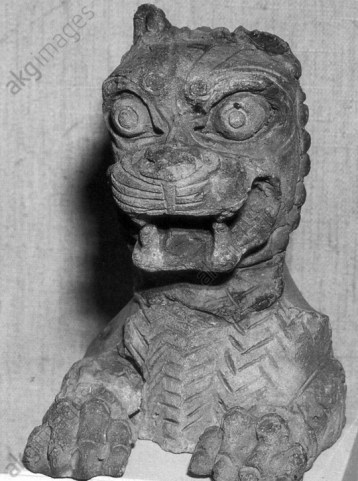
Image of a statue of Marduk (New York Public Library)
JOHN: He looked more reptilian than not. From what I can tell, he’s a Draco-Anunnaki hybrid. But he’s— you can definitely tell. You would never mistake him for a pure Draco or a pure Anunnaki. You would think he was just like some weird reptilian species if he didn’t tell you what he is.
DANIEL: And what did he have to do with this mission? I mean, what was his connection to your particular protocol?
JOHN: We wanted something from his palace in— it was near what is now Baalbek, Lebanon. He had a palace there. We wanted something from it; I can’t remember what it was.
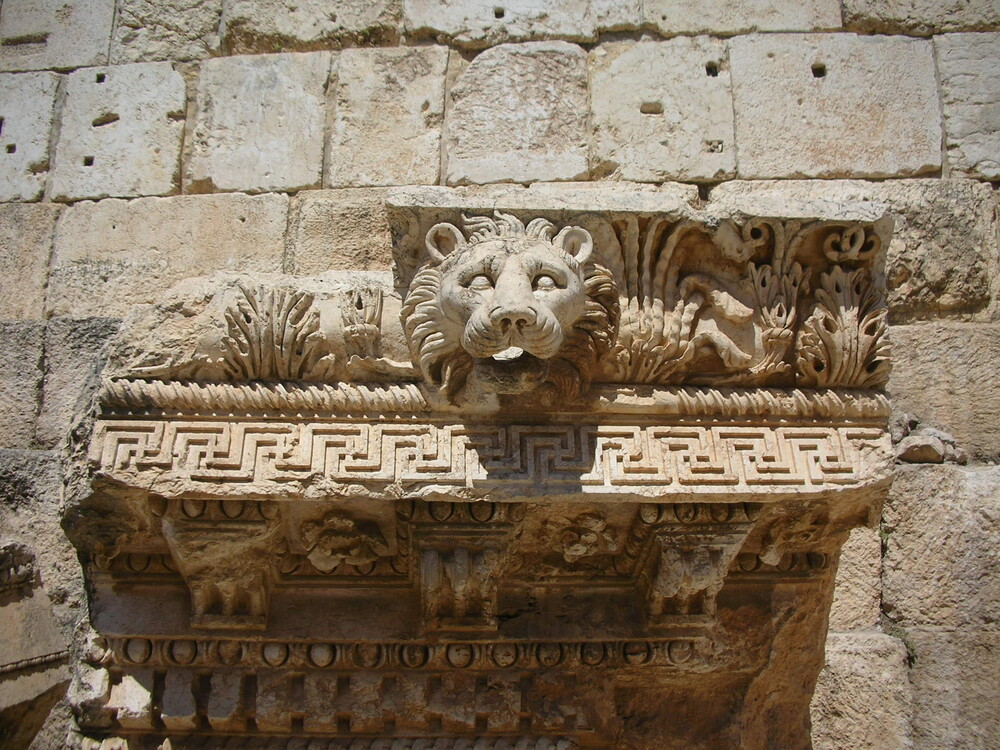
The lion features prominently in the worship of the reptilians, possibly because Marduk’s head resembled a lion. Note how the House of Windsor (Saxe-Coburg and Gothe) has reptilian lions in its coat of arms (below). (Baalbek, Lebanon)
DANIEL: And did you manage to retrieve it?
JOHN: After much negotiation, yes. We eventually— we had to sell him some genetic material so he could print out more slaves for himself. That was pretty much the only payment he would accept, and we eventually gave in.
DANIEL: Did you have any more recent encounters or— because he is allegedly still alive.
JOHN: He is still alive; that’s— that’s a topic I actually can’t discuss.
DANIEL: That’s fine; okay.
JOHN: It’s ongoing operations that I think might actually have a good outcome and I— I don’t want to jinx them.
DANIEL: That’s fine.
JOHN: ‘Cause it’s ongoing operations that I think might actually have a good outcome and I—
DANIEL: You don’t want to jinx them.
JOHN: Yeah.
We had to sell him some genetic material so he could print out more slaves for himself. That was pretty much the only payment he would accept.
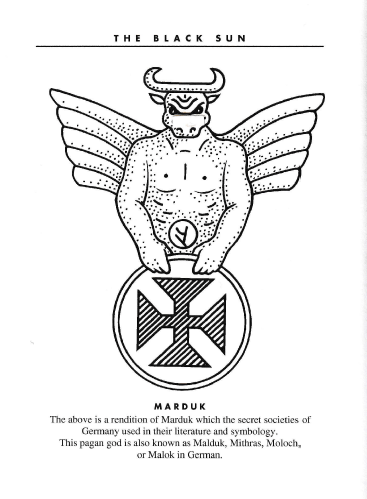
Marduk of German secret societies (Peter Moon, The Black Sun)
From what I can tell, he’s a Draco-Anunnaki hybrid. You can definitely tell. You would never mistake him for a pure Draco or a pure Anunnaki. You would think he was just like some weird reptilian species if he didn’t tell you what he is. – John Whitberg
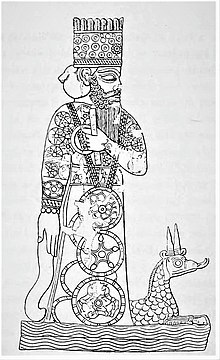
Drawing of statue of Marduk with Tiamat
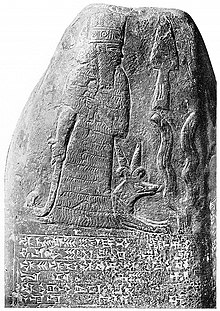
Engraving of the statue of Marduk on a stele
The Statue of Marduk, also known as the Statue of Bêl (Bêl, meaning “lord”, being a common designation for Marduk), was the physical representation of the god Marduk, the patron deity of the ancient city of Babylon, traditionally housed in the city’s main temple, the Esagila. There were seven statues of Marduk in Babylon, but ‘the’ Statue of Marduk generally refers to the god’s main statue, placed prominently in the Esagila and used in the city’s rituals. This statue was made of a type of wood called mēsu and covered with gold and silver.
Similar to statues of deities in other cities in Mesopotamia, the Babylonians conflated this statue with their actual god, believing that Marduk himself resided in their city through the statue. As such, the statue held enormous religious significance. It was used during the Babylonian New Year’s festival and the kings of Babylon incorporated it into their coronation rituals, receiving the crown “from the hands” of Marduk. (Wikipedia)
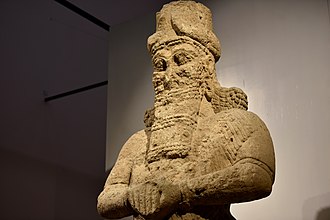
Nabu, son of Marduk (Iraq Museum)
Marduk during the Pyramid Wars
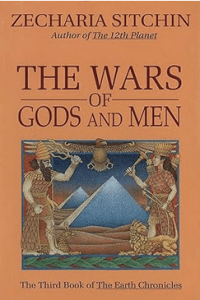
By Zecharia Sitchin (The Wars of Gods and Men, 1992)
This war, which we call the Second Pyramid War, was commemorated extensively in Sumerian records — both written and pictoral chronicles.
Hymns to Ninurta contain numerous references to his feats and heroic deeds in this war; a great part of the psalm “Like Anu Art Thou Made” is devoted to a record of the struggle and the final victory. But the principal and most direct chronicle of the war is the epic text, Lugal-e Ud Melam-bi, best collated and edited by Samuel Geller in Altorientalische Texte und Untersuchungen. Like all Mesopotamian texts, it is so titled after its opening line:
King, the glory of thy day is lordly;
Ninurta, Foremost, possessor of the Divine Powers,
who into the throes of the Mountainlands stepped forth.
Like a flood which cannot be stopped,
the enemy land as with a girdle you tightly bound.
Foremost one, who in battle vehemently enters;
Hero, who in his hand the Divine Brilliant Weapon carries;
Lord: the mountain land you subdued as your creature.
Ninurta, royal son, whose father (Enlil) to him had given might;
Hero: in fear of thee the city has surrendered . . .
O mighty one —
the Great Serpent, the heroic god,
you tore away from all the mountains.
Thus extolling Ninurta, his feats and his Brilliant Weapon, the poem also describes the location of the conflict (the mountain lands) and his principal enemy: “the Great Serpent,” leader of the Egyptian deities. The Sumerian poem identifies this adversary several times as Azag and once refers to him as Ashar, both well known epithets for Marduk, thereby establishing the two principal sons of Enlil and Enki — Ninurta and Marduk — as the leaders of the opposing camps in the Second Pyramid War. (pp. 186-187)
Sitchin, Janet (editor, 2015). The Anunnaki Chronicles. Rochester, Vermont: Bear & Company.
* * *

Some Maya replaced the names of certain deities with names that sound like Moloch (Muluk) and Ishtar (Ix). There is evidence that the Phoenicians (Caananites) traveled to America in ancient times, and that the Maya abandoned the Law of One and took up human sacrifice. (Dr. Diane Davies – https://www.mayaarchaeologist.co.uk/public-resources/maya-world/maya-calendar-system/
* * *
Jessie Czebotar – “My arch-nemesis demon is Moloch”
CHANTELLE: You said something earlier, that the Satanists are not necessarily part of the red shoe club. But isn’t Satanism that they do blood sacrifices, they do child sacrifices? Is it just not in the same way or in the same level that these guys with red shoes use the skins?
JESSIE: Right. There’s different— You should remember that across the board in each of these departments, different people will bring their philosophies that they’ve connected with. So, a lot of the Satanists, unless you’re in the really high levels, the majority of them are more into what we call white or gray magic. So, they may get to the point of sacrificing animals, but most of the time many of them practice the white magic, which, with the white magic, they don’t do any sacrifices at all, but they still call on the same— they invoke the same demons.
The majority of those people deal with lower or mid-level demons, so they’re not dealing with the the general demons that I grew up with. Once you’re dealing with the general demons or the higher-level demons, those are the bloodlusty demons and they demand— like if you’re hosting that demon, they demand blood. And I know very few — it would probably be less than five people — who have made it to those higher levels without ever sacrificing or killing. But the cost is that they [the five who didn’t sacrifice] have to give their own blood, and more and more [is required] each time. All of those individuals suffer from major seizures, so, the demons will kind of try to take over that way. Most of the higher-level people, if they’ve got those general demons, they’re— usually it’s only like a five-to-ten-year relationship, and then the demons will kill them and and go on to another host.
CHANTELLE: Do they actually murder them, or do the people actually end up dying because this energy is just too much to work through their body?
JESSIE: No, the deaths that I saw were pretty graphic. My arch-nemesis demon is Moloch, and he literally will rip his hosts apart from the inside out. So, he shreds them to pieces when he’s done with them.
CHANTELLE: When he wants more.
JESSIE: Yeah, yeah. I mean, all of them usually have more than one host at a time but they just— they go from one host to the other. They can’t be in all of them at the same time. https://inscribedonthebelievingmind.blog/2023/10/10/jessie-czebotar-aquarius-rising-3/
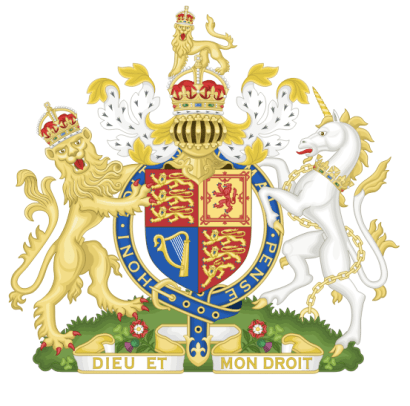
Royal coat of arms for the United Kingdom The chained unicorn is Scotland.
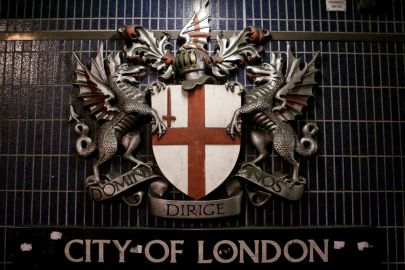
City of London coat of arms, Blackfriars Station
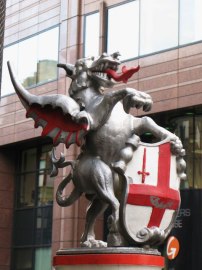
City of London
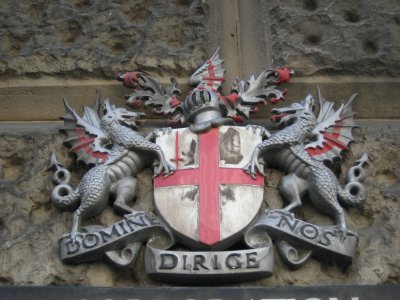
Coat of Arms City of London “DOMINE DIRIGE NOS”
Saxe Coburg Gotha Kings and Queens
Queen Victoria was the daughter of Prince Edward, the fourth son of King George III, and Princess Victoria of Saxe-Coburg-Saalfeld. She was wedded to her first cousin, Prince Albert of Saxe-Coburg and Gotha, in 1840. Their nine children married into royal and noble families across the continent, earning Victoria the sobriquet “grandmother of Europe.” Wikipedia
On the death of Queen Victoria in 1901 the royal house took the Germanic surname of her consort Prince Albert of Saxe-Coburg-Gotha. Their son, King Edward VII (reigned 1901 – 1910), was the only sovereign of the Saxe-Coburg and Gotha dynasty to reign in Britain.
The House of Saxe-Coburg-Gotha descended in the male line from the Wettin family, German Prince-Electors of Saxony. The earliest traceable member of the House of Wettin was Thiedericus (died in 982), who was probably based in the Liesgau. Its earliest known ancestors pushed the frontier of Germany eastward into formerly Slav territory.
At the height of World War I, when England was at war with Germany, Edward VII’s son, King George V (reigned 1910 – 1936) changed the family name to House of Windsor.
Members of the House of Saxe-Coburg-Gotha occupied the thrones of other European countries, including Belgium, Portugal and Bulgaria. https://www.englishmonarchs.co.uk/saxe_coburg_gotha_5.html
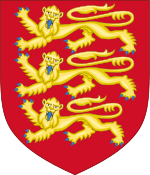
The royal arms of England. Blue-tongued and clawed lions come from the Normans, who invaded England under William the Conqueror.
“The Royal Arms of England (left) is the coat of arms historically used as arms of dominion by the monarchs of the Kingdom of England, and now used to symbolise England generally. The three lions on a red field, formally Gules, three lions passant guardant, or armed and langued azure, were adopted c. 1200 by the Plantagenet kings and continued to be used by successive English and British monarchs.” Wikipedia
The blue tongue and claws may signify the blue (copper-containing) blood of reptilians.
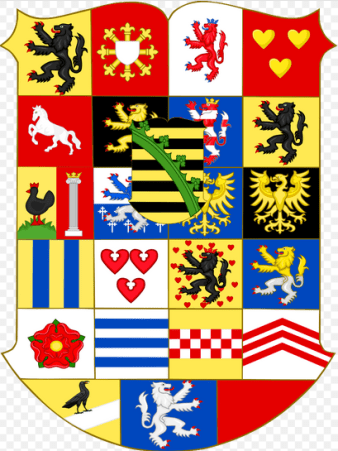
Heraldic Shield of Saxe-Coburg and Gotha, with phoenixes, rose pentagram and blue and white stripes also seen on the Israeli flag and Epstein’s island.
See also Jeanette Archer, survivor of royal family Satanic ritual abuse: https://davidicke.com/2021/10/17/satanic-ritual-abuse-survivor-jeanette-archer-exposing-the-satanic-queen-at-windsor-castle-they-are-reptilians/
Sitchin, Zecharia (1992). The Wars of Gods and Men