Hui-neng’s marvelous powers

Making the Western Paradise Appear

35. The prefect bowed deeply and asked: I notice that some monks and laymen always invoke the Buddha Amitabha and desire to be reborn in the West [Paradise].1 I beg of you to explain whether one can be born there or not, and thus resolve my doubts.

The Master said: Prefect, listen and I shall explain things for you. At Sravasti the World-Honored One preached of the Western Land in order to convert people, and it is clearly stated in the sutra, “It is not far.” It was only for the sake of people of inferior capacity that the Buddha spoke of remoteness; to speak of nearness is only for those of superior attainments. Although in man there are naturally two types, in the Dharma there is no inequality.  In delusion and awakening there is a difference, as may be seen in slowness and quickness of understanding. The deluded person concentrates on Buddha and wishes to be born in the other land; the awakened person purifies his own mind. Therefore the Buddha said: “In so much as the mind is pure, the Buddha land is pure.”

Prefect, if people of the East [China] have a pure mind, they are without fault; if people of the West have an impure mind, they have fault. The deluded person wishes to be born in the East or West; [for the enlightened] all lands are exactly the same. If only the mind is free of impurity the Western Land is not far. If the mind allows impurities to arise, even though you invoke the Buddha and seek to be reborn, it will be difficult to reach. If you eliminate the ten evils 2 you will travel one hundred thousand li; if you do away with the eight wrong discriminations 3 you will travel eight thousand li.4 But if you practice straightforward mind, you will arrive there in an instant.

Prefect, just practice the ten virtues. Why seek rebirth? If you do not cut off the ten evils, what Buddha can you ask to come welcome you? If you awaken to the Sudden Teaching of birthlessness, you will see the Western Land in an instant. If you do not awaken to the Sudden Teaching of Mahayana, even if you concentrate on the Buddha and seek to be reborn, the road will be long. How can you hope to get there?

The Sixth Patriarch said: I will move the Western Land in an instant and display it for you, right before your eyes. Does the prefect wish to see it or not?

The prefect bowed deeply: If I can see it here, why should I be reborn there? I ask you in your compassion to make the Western Land appear for my sake. It would be wonderful.

The Master said: There is no doubt that the Western Land can be seen here in China. [Here there is the character t’ang: passageway] 5 Now let us disperse. The assembly was amazed and did not know what to do.

1. The Western Paradise is the form or astral realm.

2. Killing, stealing, sexual misconduct, lying, sowing discord, harsh speech, idle chatter, covetousness, ill will, and wrong views.

3. Pa-hsieh The eight wrong discriminations:  birth and destruction, simplicity and multiplicity, past and future, permanence and impermanence.

4. The theory that the Western Paradise was located 108,000 li from China has not been found in any canonical work. The Sukhsvativyuha Sutra, locates it “a hundred thousand Buddhalands to the West.” There is a story, whose source I have not been able to trace, which states that from the west gate of Ch’ang-an to the east gate of Kapilavastu is 108,000 li.

5. The translation here is tentative. Chan, The Platform Scripture, p. 93, 182, n. 156, following Ui, Zenshu shi kenkyu, II, 148, translates t’ang as “passageway.” Later texts omit this passage.

Yampolsky, Philip B. (1967). The Platform Sutra of the Sixth Patriarch. (The text of the Tun-Huang manuscript) New York: Columbia University Press (p. 156-158) (http://www.fodian.net/world/Platform_Sutra_Yampolsky.pdf)

* * *


Compassion for a hired assassin

Brother Chih Ch’e, whose secular name was Chang Hsing-Ch’ang, was a native of Kiangsi. As a young man, he was fond of chivalric exploits (swordsmanship). Since the two Dhyana Schools, Hui-Neng of the South and Shen Hsiu of the North, flourished side by side, a strong sectarian feeling ran high on the part of the disciples, in spite of the tolerant spirit shown by both masters. As they called their own teacher, Shen Hsiu, the Sixth Patriarch on no better authority than their own, the followers of the Northern School were jealous of the rightful owner of that title whose claim, supported by the inherited robe, was too well known to be ignored. (So in order to get rid of the rival teacher) they sent Chang Hsing Ch’ang (a layman) to murder the Patriarch. With his psychic power of mind-reading the Patriarch was able to know of the plot beforehand. (Making ready for the coming of the assailant), he put ten taels by the side of his own seat. Chang duly arrived, and at night entered the Patriarch’s room to carry out the murder. With outstretched neck the Patriarch waited for the fatal blow. Thrice did Chang strike, (but) not a single wound was thereby inflicted! The Patriarch then addressed him as follows:

A straight sword is not crooked,
A crooked one is not straight.
I owe you money only;
But my life I do not owe you.

The surprise was too great for Chang; he fell into a swoon and did not revive for a long while. Remorseful and penitent, he asked for mercy and volunteered to join the Order at once. Handing him the money, the Patriarch said, “You had better not remain here, lest my followers should do you harm. Come to see me in disguise some other time, and I will take good care of you.” As directed, Chang ran away the same night. Subsequently, he joined the Order and, when fully ordained, proved himself to be a very diligent monk.

Price, A. F. and Wong Mou-Lam (2004). Sutra Spoken by the Sixth Patriarch on the High Seat of “The Treasure of the Law”. Kessinger Publishing Company. (https://terebess.hu/zen/PlatformPrice.pdf)

Hui-neng: The Mahaprajnaparamita (24-33)

24. Now that all of you have yourselves devoutly taken refuge in the three treasures, I shall expound to you on the doctrine of the Mahaprajnaparamita. Good friends, although you recite it, you do not understand its meaning, so I shall explain. Listen every one of you!

Mahaprajnaparamita is an Indian Sanskrit term; in Chinese it means the Great Perfection of Wisdom, reaching the other shore. This Dharma must be practiced; it has nothing to do with recitations. If you recite it and do not practice it, it will be like an illusion or a phantom. The dharma-body (dharmakaya) of the practitioner is the same as that of the Buddha.

What is Maha? Maha is great. The capacity of the mind is broad and enormous, like the vast sky. Do not sit with a mind fixed on emptiness: if you do you will fall into a vacant kind of emptiness. The illimitable emptiness of the universe is capable of holding myriads of things of various forms, such as the sun, the moon, stars, mountains, rivers, men, things good or bad, the heavens, the hells, great oceans, and all the mountains of the Mahameru. Emptiness contains all of these, and so does the emptiness of our self-nature.

I have said before that God’s lordship does not consist merely in His being lord of all creatures, but His lordship consists in this, that He could create a thousand worlds and transcend them all in His pure essence: therein lies His lordship. – Meister Eckhart, Sermon Twenty Seven

25. Our self-nature contains the ten thousand things—this is great. The ten thousand things are all in our self-nature. Although you see all men and non-men, evil and good, evil things and good things, you must not push them away, nor must you cling to them, nor must you be defiled by them, but you must regard them as being just like the empty sky. This is what is meant by great; this is the practice of maha.

The deluded person merely recites; the wise man practices with his mind. There are deluded people who make their minds empty and do not think, and they call this practice ‘great’. This, too, is wrong. The capacity of the mind being vast and wide, practice should not be small. Do not merely speak of emptiness with the mouth and fail to practice it. Such a person is not a disciple of mine.

Learned Audience, what the ignorant merely talk about, wise men put into practice with the mind. There is also a class of foolish people who sit quietly and try to keep their mind blank. They refrain from thinking of anything and call themselves ‘great’. This is heretical.

Learned Audience, you should know that the mind is very great in capacity, since it pervades the whole Dharmadhatu. When we use it, we can know something of everything, and when we use it to its fullest we shall know all. All in one and one in all. When our mind functions unhindered and is at liberty to come or go, then it is in this state.

Do not talk about the void all day and fail to practice it in the mind. The capacity of the mind being great, our practice should not be small: that is like a king acting like a commoner. Prajna can never be attained in this way, and such are not my disciples. (Platform_Sutra_Price)

26. What is prajna? Prajna is wisdom (chih-hui). When at all times successive thoughts are free of delusion and one always practices wisdom, this is known as the practice of prajna. With one deluded thought, prajna is cut off; but with one wise thought, prajna returns. With the mind there is always delusion. They tell themselves: ‘I practice prajna,‘ but prajna has neither shape nor form: it is the nature of wisdom.

What is paramita? This is the Indian Sanskrit word and it means “other shore reached.” When its meaning is understood, you are apart from birth and destruction. When you are attached to the world, birth and death arise like waves rising on the water: they are something that occurs on this shore. Being apart from the world and putting an end to birth and death is like going along with the flow of the water: thus it is called reaching the other shore, hence, paramita.

The deluded person recites it; the wise one practices with the mind. If you have delusion when you recite it, the very existence of this delusion is not your true being. If in successive thoughts you practice it, this is called your true being. Those who awaken to this teaching have awakened to the teaching of prajna and are practicing the prajnaparamita. If you do not practice it you are an ordinary person; if you practice for one instant of thought, you will have the dharma-body, the same as the Buddha. Good friends, even the unwholesome passions (klesa) are themselves enlightenment (bodhi). When past thoughts are deluded, this is the ordinary person; when future thoughts are enlightened, this is the Buddha

Good friends, the Mahaprajnaparamita is the most honored, the supreme, the foremost. It does not remain, it does not depart, nor does it come, and all of the Buddhas of the three worlds come forth from it.1 With great wisdom it leads us to the other shore and destroys the passions (klesa) and the hindrances of the five skandhas. Since it is the most honored, the supreme, the foremost, if you praise the supreme Dharma (doctrine) and practice according to it, you will certainly become Buddha. Not departing, not remaining, not going or coming, with singleness of wisdom and meditation (prajna and samadhi), and unsullied while in the midst of all things, the various Buddhas of the three worlds come forth from it and transform the three poisonous roots into conduct, meditation, and wisdom.2

27. Good friends, this teaching of mine is born of eighty-four thousand wisdoms. Why is this so? Because there are eighty-four thousand klesa in this world. If the klesa are done away with, prajna always remains; it is not separate from your own nature. If you awaken to this Dharma you will have no thoughts, no memories, no attachments. Do not push away delusions and faults [3] for they themselves are the Dharma. When all things are illuminated by wisdom and there is neither grasping nor rejecting, then you can see into your own nature and gain the Buddha Way.

28. Good friends, if you wish to enter the most profound Dharma realm of the prajna samadhi (a permanent state of higher awareness) you must straightforwardly practice the prajnaparamita. With only the one volume of the Diamond Sutra you may see into your own natures and enter into the prajna samadhi. You will surely understand that the merit of such a person is boundless. In the sutras it is clearly praised and there is no need for me to elaborate. It is the Dharma of the Supreme Way that is expounded for men of great wisdom and high capacity. Should a man of small capacity for understanding hear this Dharma, faith would not be produced in his mind. Why is this so? Should the Dragon King deluge the earth with a great rain, [then cities, towns, and villages would all be washed away] like floating grass and leaves. But should this great rain fall in the great ocean, its waters would neither increase nor decrease.

Should a person of the Mahayana hear the Diamond Sutra, his mind will open and he will gain awakening. Therefore we can say that the wisdom of prajna exists in one’s original nature, and that by using this wisdom to illuminate your own mind there is no need to depend on written words. It is as though the rain did not come from heaven, but from the beginning the dragon king gathered up the water from the rivers and seas and covered all beings, trees and grasses, things sentient and nonsentient, with its moisture. All these waters flow together and enter into the great sea, and the sea gathers them together and combines them into one. So it is with the prajna wisdom of the original nature of sentient beings.

29. When those of shallow capacity hear the Sudden Doctrine being preached they are like nature’s shallow-rooted plants on this earth, which after a deluge of rain are all beaten down and cannot continue their growth. People of shallow capacity are like such plants. Although these people have prajna wisdom and are no different from sages, why is it that even though they hear the Dharma they are not awakened? It is because the obstructions of their heterodox views are heavy and the hindrances deep-rooted. It is like when great clouds cover the sun: unless the wind blows the sun will not appear. There is no great and small in prajna wisdom. Because all sentient beings have deluded minds, they seek the Buddha by external practice and are unable to awaken to their own nature. But even these people of shallow capacity, if they hear the Sudden Doctrine and do not place their trust in external practices but only in their own minds, and always raise correct views in regard to their own original nature, then even these sentient beings, filled with passions and troubles, will gain awakening at once. It is like the great sea, which gathers all the flowing rivers and combines rivers both large and small into one. This is seeing into your own nature. [Such a person] does not abide either within or without; he is free to come or go. Readily he casts aside the mind that clings and he is limitless. If  this practice is carried out in the mind then it is no different from the prajnaparamita.

30. All the sutras and written words–Hinayana, Mahayana, the twelve divisions of the canon–all have been expounded by men. Because of man’s wisdom-nature it has been possible to expound them. If we lacked this wisdom, from the beginning all things would not exist, because they have no existence in themselves. Therefore, it is clear that all things originally arise from man and that all of the sutras exist because they are spoken by man.

Among men there are the deluded and the wise. The deluded are small, the sages are great. If deluded ones ask the sages, the sages will expound the Dharma for them to enable them to understand and gain a deep awakening. If the deluded one understands and his mind is awakened, then there is no difference between him and the sage. Therefore we know that, unawakened, a Buddha is a sentient being, and that a sentient being awakened in an instant of thought is a Buddha, and he knows that the ten thousand things are all within his own mind. Why not make your original nature, True Reality (tattva), suddenly appear within yourselves? The Boddhisattva-sila-sutra says: “From the beginning our own nature is pure.” If we look into our own mind and see our own nature, we have achieved the Buddha Way. “At once, in an instant, we regain our original mind.” (Vimalakirti Sutra)

31. Good friends, when I was at Priest Jen’s place, upon hearing it (the Diamond Sutra) just once, I immediately gained the great awakening and immediately saw that the Dharma was my original nature. Therefore, I have taken this teaching and, passing it on to later generations, shall cause you students of the Way to have a sudden awakening to enlightenment, and allow each of you see into your own minds and awaken to your own original nature. If you cannot gain enlightenment for yourselves, you must seek a good teacher to show you the way to see into your own self-nature. What is a good teacher? He is one who understands at once that the Dharma of the Supreme Vehicle is indeed the correct path. This is a good teacher. This is the great causal event, the so-called conversion, which will enable you to see Buddha. All of the good dharmas [4] are activated by a good teacher. Therefore, although the Buddhas of the three worlds and all the twelve divisions of the canon are within the nature of man from the beginning, if he cannot gain awakening by his own nature he must obtain a good teacher to show him how to see into his own self-nature.

But if you awaken by yourself, do not rely on outside teachers. If you try to seek an outside teacher and hope to obtain liberation, you will find it to be impossible. If you have recognized the good teacher within your own mind, you have already obtained liberation. If you are deluded in your own mind and harbor erroneous thoughts and contrary concepts, even though you go to an outside teacher, you will not be able to obtain it. If you are not able to obtain self-awakening, you must give rise to prajna and illuminate with it: instantly false thoughts will be destroyed. Once you have awakened to the fact that you yourself are your own true good teacher, in one awakening you will know the Buddha. If, standing upon your own nature and mind, you illuminate with wisdom and make things clear within and without, you will know your own original mind. If you know your original mind, this is liberation.

Once you have attained liberation this, then, is the prajna samadhi. If you have awakened to the prajna samadhi, you have no-thought. What is no-thought? The doctrine of no-thought is thus: even though you see all things, you are not attached to them, but, always keeping your own nature pure, you allow the six thieves (consciousness of a sight, of a sound, etc.) to pass through the six gates (senses). Even though you are in the midst of the six dusts (the visual field, the field of sound, etc.), you do not stand apart from them, yet you are not sullied by them and are free to come and go. This is the prajna samadhi, and freedom and liberation are attained through the practice of no-thought. If you do not think of the manifold things but constantly cut off your thoughts, you will be Dharma-bound. This is known as an erroneous view. Grasping the Sudden-School doctrine of no-thought, you will have a deep insight into all things and you will see the realm of the Buddha. One who grasps the Sudden-School doctrine of no-thought reaches the stage of Buddha.

32. Good friends, those in later generations who obtain my teaching will always see that my Dharma body is not apart from where they are. Good friends, take this Dharma of the Sudden Teaching, look at it and practice it together, fix your resolve on it, and receive and guard it. Because it is tantamount to serving the Buddha, if for all your lives you receive and keep it and do not regress, you will enter into the ranks of the sacred. Now I should like to hand it on. But from the past the Dharma has been handed down in silence; only when a person has great resolve and has not regressed from enlightenment should it be passed on to him. When you meet people whose understanding is not the same as yours and who lack firm resolve, never recklessly demonstrate the teaching to them. If you do so you will do them harm, and in any event it will be of no value whatsoever. If you happen to meet someone who does not understand and he despises this teaching, he may be hindered from attaining buddhahood for many lifetimes.

33. The Master said: Good friends, listen: I will preach to you a free-form verse; it will cause the destruction of your karma. It is called The Verse for Destroying Evil Karma. The verse goes:

The ignorant one practices seeking future happiness and does not practice the Way,
And says that to practice seeking future happiness is the Way.
Though he hopes that almsgiving and offerings will bring boundless happiness,
As before, in his mind the three karmas are produced.
If you wish to destroy your evil karma by practicing seeking future happiness,
Even though you obtain this happiness in a future, the evil karma will remain.
If you can, cast the cause of your karma from your mind, and each of you, within your own nature, will truly be redeemed.
If you awaken to the Mahayana and are truly redeemed,
Evil being removed and good achieved, you will truly attain to perfection.

If a student of the Way observes well his self,
He will be the same as the awakened ones.

I am causing this Sudden Teaching to be transmitted,
And one who aspires to learn it will become one with me.

If in the future you wish to seek your original body,
Rid your mind of the evil of the three poisonous roots.

Work hard to practice the Way; do not be absent-minded.
If you spend your time in vain, your whole life will soon be forfeited.

If you encounter the teaching of the Mahayana Sudden Doctrine,
Press together your palms in devotion and sincerity and earnestly strive to reach it.

When the Master had finished preaching, the Prefect Wei, the government officials and the monks and laymen uttered words of praise: What boundless teaching! This we have never heard before!

* * *

  1. “All of the Buddhas of the three worlds come forth from it”: The Mahaprajnaparamita is the means by which all have attained enlightenment. The three worlds of the unenlightened are the desire realm, the form realm and the formless realm.
  2. Three poisonous roots: attachment (greed), aversion (anger), ignorance. Conduct, meditation and wisdom are the Tripitaka, the Buddhist cannon, which consists of the rules of monastic life (Vinaya), discourses on the way to liberation (Sutras or Suttas) and the teaching about the Dharma (Abhidhamma).
  3. “Do not push away delusions and faults, for they themselves are the Dharma.” Compare with Bodhidharma:”Even though the mind has entered delusion, do not push delusion away. Instead, when a thought arises, rely on the Dharma to gaze at the place from which it arises. If your mind discriminates, rely on the Dharma to gaze at the place of the discrimination. Whether greed, anger or ignorance arise, rely on the Dharma to gaze at the place from which they arise. To see that there is no place from which these can arise is to cultivate the Way. ” (Bodhidharma’s Method for Quieting the Mind)
  4. Good dharmas: spiritual gifts
  5. Six thieves, six gates, six dusts: sense-awareness (an eye-vijnana, an ear-vijnana), sense-organs (eyes, ears), sense-objects. Sense-awarenesses pass in and out of the sense-gates like thieves.

Yampolsky, Philip B. (1967). The Platform Sutra of the Sixth Patriarch. (The text of the Tun-Huang manuscript with translation, introduction and notes by Philip B. Yampolsky.) New York: Columbia University Press. (Platform Sutra Yampolsky)

Hui-neng: “No-thought is the foundation” (17-19)

The consciousness of Zen specifically as the immediate understanding of the Dharma dawned in the mind of Hui-neng. If Bodhidharma used the term, wu-hsin (no-mind) for the Dharma, Hui-neng replaced hsin with nien. Nien is generally ‘memory’, ‘recollection’, ‘thinking of the past’, etc., and is used as equivalent to the Sanskrit smrti. Therefore, when it is used in connection with wu as wu-nien, this is asmrti, that is ‘loss of meaning’ or ‘forgetfulness’, and in this sense it is used in the Sanskrit texts. . . . When Hui-neng makes wu-nien the most fundamental fact in the life of Zen, it corresponds to the Triple Emancipation—sunyata, animitta, and apranihita* —for the realization of the wu-nien means emancipation for Zen followers. – D. T. Suzuki (1971, p. 30)

*empty, undifferentiated, desireless

It is only without thought that you can be the Self. – Lester Levenson

(First part translated by D. T. Suzuki)

17.  Good friends, our teaching, from ancient times up to the present, whether of the Abrupt school or of the Gradual, is established on the foundation of no-thought (wu-nien), while no-form (wu-hsiang) is the body, and non-abiding (wu-chu) is the root. What is meant by no-form? It means to be detached from form while in the midst of form. No-thought is to be without thought while in the midst of thought. Non-abiding is the original nature of human beings.

Consciousness moves ever forward, never halting in its progression through past, present and future as one thought succeeds another without interruption.1 In order to descend to the Dharma body the stream of thought must be cut off just once; then we separate from the form body, and here there is no dwelling of thought anywhere on anything. If thought dwells anywhere on anything just once it ceases to flow freely: this is called being in bondage. When there is no dwelling of thought anywhere on anything, this is being unbound. Therefore, not abiding anywhere is made the root of the teaching.

Good friends, being detached from all external forms—this is no-form. When you are detached from form, the essence of your nature is pure. Therefore, no-form is made the body of the teaching.

To be free of defilements at all times is called no-thought. This is to be detached from things even though one is aware of them, for consciousness is not busy weaving thoughts concerning them. When all thoughts are thus cast out, consciousness is cleared of all its defilements. When consciousness is swept clean once and for all, there will be no rebirth. Let students of Buddhism take heed not to misunderstand this matter. If the meaning is not well understood, not only will they become confused but others will share the confusion and will be led to misrepresent the teaching. Therefore, no-thought is made the foundation of the teaching.

When names are grasped, various thoughts about the world arise; these thoughts lead people astray. All erroneous ideas about the world arise from this. Thus it is that our teaching is established on the foundation of no-thought. In order not to become entangled in thoughts one must cast out views. If thoughts are not aroused, no-thought is no place. “No” (wu) is no what? “Thought” (nien) means thinking of what? Wu is no dualism, no passions. Thought rises from original nature. Original nature is [like] the body, and thoughts are the function of original nature.2 Thoughts arise from original nature and are manifested in what is seen, heard, believed and known (drista-sruta-mata-jnata), but original nature itself is not defiled by the myriad things; it remains forever pure. So we read in the Vimalakirti, “Adept in the discrimination of the manifold phenomena, he abides immovably in the Dharma.”3  (Suzuki, 1971, pp. 33-35)

(Second part translated by Philip Yampolsky)

18. Good friends, in this teaching, from the outset tso-ch’an (sitting meditation) is not meditating on the mind nor is it meditating on purity; this is not what we call steadfastness [a persistent state of mindfulness]. If someone speaks of meditating on the mind, the mind is itself an illusion, and as we come to realize that it is only a phantom we realize that there is nothing to be seen. If someone speaks of meditating on purity, that man’s original nature is pure, but because of false thoughts his original nature is obscured. If you cast out delusions then original nature reveals its purity; but if you focus your mind on purity without realizing that your own nature is originally pure, delusions of purity will be produced. Since delusion does not exist anywhere, you know that whatever you see is nothing but delusion.

Purity has no form, but, nonetheless some people try to postulate purity as a form and consider this to be Ch’an practice. People who hold this view obstruct their own original nature and end up by being bound by purity [i.e. become judgmental]. One who practices steadfastness does not see the faults of people anywhere. This is the steadfastness of self-nature. But the deluded man, even if he doesn’t move his body, will speak of the merits and faults of others the moment he opens his mouth, and will thus behave in opposition to original nature. Therefore, meditating on the mind and meditating on purity cause an obstruction to original nature.

19. Now that we know that this is so, what is it in this teaching that we call tso-ch’an (sitting meditation)? In this teaching ‘sitting’ means being free of obstruction everywhere [you happen to be], externally and under all circumstances not to activate thoughts. [i.e., ‘sitting’ is not to be taken literally] Meditation is to see original nature within and not to become distracted.

And what do we call Ch’an meditation (ch’an-ting)? To be detached from external form is ch’an; internally to be free of distraction is meditation. Even though there is external form, when internally your nature is not distracted [you know that] from the beginning you are pure and in meditation. Contact with circumstances can cause distraction. Detachment from external form is ch’an; being untouched internally is meditation. Being ch’an externally and in meditation internally is known as Ch’an-ting. The Vimalakirti Sutra says: ‘At once, suddenly, you regain the Original Mind.’ The P’u-sa-chieh says: ‘From the beginning your original nature is pure.’

Good friends, see for yourselves the purity of your original nature; practice and accomplish it for yourselves. Your original nature is the Dharmakaya and self-practice is the practice of Buddha. By self-accomplishment you may achieve the Buddha Way for yourselves.

* * *

1.”Consciousness moves ever forward, never halting in its progression through past, present and future as one thought succeeds another without interruption.” Consciousness is vijnana in Sanskrit. A vijnana is an awareness of something. Since nothing really exists outside of the mind, all that really exists of phenomena, including thoughts, is our awareness of them.

2. “Original nature is [like] the body, and thoughts are the function of original nature.” The skandhas are five functions performed by our Self, but we take them as proof of the existence of a separate self. We are like a man who makes a wooden puppet and takes it with him everywhere, making it move and speak in a lifelike manner. Forgetting that he made it and not realizing that he is manipulating the strings and speaking for it, he believes that he is the puppet.

Mahamati, it is like Pisaca, who by means of his magic makes a corpse or a machine-man dance with life though it has no power of its own: the ignorant cling to the non-existent, imagining it to have the power of movement. – The Lankavatara Sutra

3. The Vimalakirti Sutra: “They had learned to accept the fact that there is nothing to be grasped, no view of phenomena to be entertained. . . . Expert in comprehending the characteristics of phenomena (dharmalaksana), able to understand the capacities of living beings, they towered over the others of the great assembly and had learned to fear nothing. . . . In fame and renown they soared higher than Mount Sumeru; their profound faith was diamond-like in its firmness.” (Wisdom Library)

4. Sheng-Yen (1988) writes:

Hui-neng 惠能(638~713), who succeeded Hung-jen as the Sixth Patriarch, was not an advocate as sitting as the path to enlightenment. He said that when there is no mind, or no thoughts arising, that is to be called “sitting” (tso). When you see internally that the self-nature is [quiescent], that is ch’an. The Sixth patriarch took his inspiration from the Samadhi of One Act, described in the Manjusri Sutra. Any time, any place, whether walking, standing, sitting or lying down, there is no situation that is not an opportunity to practice tso-ch’an. In this view sitting was not only unnecessary, but could be a hindrance. (pp. 365-366)

5. Jan Yun-Hua (1989) writes:

The concept of no-thought is found in the translations of the Tathagata-jnana-mudra-samadhi-sutra, as well as the Vimalakiirtinirdesa by the Indo-scythian monk, Chihch’iene (fi. A.D. 222-229). The first text, related to samadhi, describes the process leading to sameness (samata) in meditation.

What is the nature of effortlessness (akarmaka)? The nature is the perception of the nonexistence of things (anupalabdhi). What is the nature of perception of nonexistence? The nature is the perception that things do not decay (aksaya). What is the nature of perception that things do not decay? The nature is the perception of the non-arising of things. What  is the nature of the perception of non-arising? The nature is the perception of the non-extinction of things. What is the nature of the perception of non-extinction? The nature is the perception that nothing new comes into existence. What is the nature of the perception that nothing new comes into existence? The nature is non-dependence. What is the nature of non-dependence? The nature is non-abiding (asthana: nowhere existing). What is the nature of non-abiding? The nature is non-departing. What is the nature of non-departing? The nature is immovability (acala: no regression). What is the nature of immovability? The nature is the freedom from regression. What is the nature of freedom from regression? The nature is no-mind (wu-hsin). What is the nature of no-mind? The nature is no-thought (wu-nien). What is the nature of no-thought? The nature is non-duality. What is the nature of non-duality? The nature is the sameness of things (samata).

6. As one can see from the above passage, no-thought is only attained after intense investigation. When Hui-neng says that one must not sit like a block of wood, he means that one does not achieve no-thought by emptying the mind, but by using the thoughts and feelings that arise to show us what attachments we have, so that we can let go of them. As Bodhidharma said,

Even though the mind has entered delusion, do not push delusion away. Instead, when something arises from the mind, rely on the Teaching to gaze at the place from which it arises. If the mind discriminates, rely on the Teaching to gaze at the place of the discrimination. Whether greed, anger or ignorance arise, rely on the Teaching to gaze at the place from which they arise. To see that there is no place from which these can arise is to cultivate the Way. If there is anything arising from the mind, then investigate it, and relying on the Teaching, clean house! (Bodhidharma’s Method For Quieting the Mind)

* * *

Yampolsky, Philip B. (1967). The Platform Sutra of the Sixth Patriarch. (The text of the Tun-Huang manuscript with translation, introduction and notes by Philip B. Yampolsky.) New York: Columbia University Press. (Platform Sutra Yampolsky)

Gregory, Peter N. (1991). Sudden and Gradual: Approaches to Enlightenment in Chinese Thought. Motilal Banarsidass.

Sheng-Yen. “Tso-Ch’an.” Chung-Hwa Buddhist Journal, No. 2, (1988) Taipei: Chung-Hwa Institute of Buddhist Studies.

Suzuki, D. T. (1971). Essays in Zen Buddhism (Third Series). New York: Samuel Weiser.

Yun-Hua, Jan. “A Comparative Study of ‘No-Thought’ (Wu-nien) in some Indian and Chinese Buddhist texts.” Journal of Chinese Philosophy, Vol. 16 (1989) 37-58. (https://doi.org/10.1111/j.1540-6253.1989.tb00730.x)

The Dharma of Hui-neng: Meditation (12-16)

What follows is from the Sutra Spoken on the Diamond Jewel Platform, better known as The Platform Sutra. In the year of his death, 713, Hui-neng had this platform erected so that he could give his final sermons. He intended his teaching to be taken down, copied and disseminated as the exposition of the Sudden School of Buddhism in China. The Sixth Patriarch is held in such high esteem that this teaching was called a sutra, a title reserved for teachings attributed to the Buddha.

Although there have been several translations of The Platform Sutra, I particularly like the translation by Philip B. Yampolsky (1967, Columbia University Press). The translation by Price and Wong is also excellent, and it contains a wonderful story about a man sent by monks of Shen Hsiu’s Northern School to murder Hui-neng. The controversy over Hui-neng’s Southern School, known as the “Sudden Teaching” or “Direct Teaching” (tun-wu means sudden awakening) and Master Shen Hsiu’s Northern School, known as the “Gradual School,” is discussed in Chapter VIII of the Price-Wong translation of The Platform Sutra.

This part of the Platform Sutra is about “skilful means,” or practices to attain satori. These are methods of cultivating the mind so that the truth is revealed within. By ‘Samadhi of One Act’ or ‘Samadhi of Oneness’ (i-hsing sanmei一行三昧) Hui-neng refers to the awakened consciousness of a stream-enterer, a state which persists regardless of whether one is “sitting, walking, standing or lying down.” Zen masters discovered that this samadhi could be attained more quickly if meditation was practiced in all activities. As methods evolved, masters often redefined terms in order to avoid contradicting the teachings of previous masters; thus Hui-neng redefined ‘sitting’ to signify a state of mind rather than a physical position.

The Dharma taught by Hui-neng

12. “I was predestined to come to live here and to preach to you officials, monks and laymen. My teaching has been handed down from the sages of the past; it is not my own knowledge. If you wish to hear the teachings of the sages of the past, each of you must quiet his mind and hear me to the end. Please cast aside your own delusions; then you will be no different from the sages of the past.”

(p. 135) The Master Hui-neng called, saying: “Good friends, enlightenment (bodhi ) and prajna (intuitive wisdom 般若) are from the outset possessed by men of this world themselves. It is just because the mind is deluded that people cannot attain awakening to their self. They must seek a good teacher to show them how to see into their own natures. Good friends, if you awaken to prajna, enlightenment will be achieved.

13. “Good friends, my teaching of the Dharma (jian dun 漸頓 – doctrine) takes meditation (ting) and prajna (hui) as its basis. Never under any circumstances make the mistake of saying that meditation and prajna are different: they are one, not two. Meditation is the body of prajna; prajna is the function of meditation. When you have prajna, meditation is in prajna; when you have meditation, prajna is in meditation. Good friends, this means that meditation and prajna are one and the same. Students, be careful not to say that meditation gives rise to prajna, or that prajna gives rise to meditation, or that meditation and prajna are different from one other. To hold this view implies duality. If one speaks straight but the mind is crooked, meditation and prajna will not be alike. If mind and speech are both straight, then the internal and the external are in accord and meditation and prajna are the same. The practice of self-realization does not lie in verbal arguments. If you argue about which comes first, meditation or prajna, you are deluded. You won’t be able to settle the argument and instead will cling to objective things, and you will never escape from the four states of phenomena.

14. “The Samadhi of One Act1 is having a straight mind at all times—walking, standing, sitting, and lying. The Vimalakirti Sutra says: ‘The straight mind  is the place of practice; the straight mind is the Pure Land.’ Do not with a crooked mind speak of the straight teaching. If while speaking of the Samadhi of One Act you fail to practice the straight mind, you will not be disciples of the Buddha. Only practicing the straight mind, and in all things having no attachments whatsoever, is called the Samadhi of One Act. The deluded man clings to the characteristics of things, latches onto the Samadhi of One Act, [thinking that] the straight mind is sitting without moving, pushing away delusion and allowing nothing to arise in the mind. This he considers to be the Samadhi of One Act. This kind of practice is the same as insentience and causes an obstruction to the Tao. Tao must be something that flows freely—why impede it? If the mind does not abide in things the Tao flows freely; if the mind abides in things, it becomes entangled. If sitting in meditation without moving is good, why did Vimalakirti scold Sariputra for sitting in meditation in the forest?

“Good friends, there are some who teach people to sit viewing the mind and viewing purity, not moving and not activating the mind, and to this they devote their efforts. Deluded people do not realize that this is wrong; they cling to this doctrine and become confused. There are many such people. Those who instruct in this way are, from the outset, greatly mistaken.2

15. “Good friends, how then are meditation and prajna alike? They are like the lamp and the light it gives forth. If there is a lamp there is light; if there is no lamp there is no light. The lamp is the source of light; the light is the function of the lamp. Thus, although they have two names, in substance they are not two. Meditation and prajna are also like this.

16. “Good friends, in the Dharma there is no sudden or gradual, but among people some are keen and others dull. The deluded adopt the gradual method, the enlightened practice the sudden teaching. To understand your original mind is to see into your own original nature. Once enlightened, one sees that from the beginning there was never any difference between these two methods; but until enlightenment, one is caught in the cycle of transmigration for many ages.”

* * *

1. Sheng-Yen (1988) writes:

The Chinese term tso-ch’an 坐禪 (zazen) was in use among Buddhist practitioners even before the appearance of the Ch’an (Zen) School. Embedded in the term is the word ch’an, a derivative of the Indian dhyana, which is the yogic practice of attaining samadhi in meditation. Literally translated, tso-ch’an means “sitting ch’an” and has a [general] and a specific meaning. The [general] meaning refers to any type of meditation practice based on taking the sitting posture. The specific meaning refers to the methods of practice that characterize Ch’an Buddhism.

The earliest Chinese translations of Buddhist sutras that describe methods of [attaining] samadhi appear around the end of the second century A.D. The most famous of these was the Tso-ch’an ching, The Sutra of Sitting Ch’an. In the beginning of the fifth century A.D., Kumarajiva translated a large number of sutras on the [attainment] of samadhi. One of these was the Sutra on Tso-ch’an and Samadhi. So we see that the term tso-ch’an was used in China as early as the second century, and there are at least two sutras that use the term in their titles. We know that many monks during this time practiced tso-ch’an to achieve samadhi in the Indian tradition. . . .

The Fourth Patriarch Tao-hsin (580~651) wrote

“He should contemplate the five skandhas as originally empty and quiescent, non-arising, non-perishing, identical, without differentiation. Constantly thus practicing, day or night, whether sitting, walking, standing or lying down, finally one reaches an inconceivable state without any obstruction or form. This is the Samadhi of One Act (i-hsing samadhi) 一行三昧.”  (pp. 361-364)

* * *

In his essay, “The Koan Exercise,” D. T. Suzuki (1953) translates i-hsing as “Samadhi of Oneness”:

In the second half of the Saptasatika-Prajnaparamita (Man-t’o-lo version) a Samadhi known as i-hsing is mentioned, whereby the Yogin realizes supreme enlightenment and also comes into the presence of the Buddhas of the past, present, and future. The passage in the Man-t’o-lo runs as follows:

Again, there is the Samadhi i-hsing; when the Samadhi is practised by sons and daughters of good family, supreme enlightenment will speedily be realized by them.

Manjusri asked: Blessed One, what is this i-hsing Samadhi?

The Blessed One said: The Dharma Realm is characterized by oneness, and as the Samadhi is conditioned by the Dharma Realm it is called the Samadhi of Oneness (i-hsing). If sons and daughters of good family wish to enter upon this Samadhi of Oneness they must listen to the discourse on Prajnaparamita and practise it accordingly; for then they can enter upon the Samadhi of Oneness whereby they will realize the Dharma Realm of immutability, of endlessness, of no-thought, of limitlessness, of formlessness.

If sons and daughters of good family wish to enter into the Samadhi of Oneness, let them sit in a solitary place, let go of all disturbing thoughts, not become attached to forms and features, have the mind fixed on one Buddha and devote themselves exclusively to reciting his name, sitting in the proper form and facing the Buddha squarely. When their thoughts are continuously fixed on this one Buddha, they will be able to see in these thoughts all the Buddhas of the past, present, and future.

2. See Hui-neng’s sermon on the Mahaprajnaparamita: “Do not push away illusions and faults, for they themselves are the Dharma. When all things are illuminated by wisdom and there is neither grasping nor rejecting, then you can see into your own nature and gain the Buddha Way.” Compare to Bodhidharma: “Even though the mind has entered delusion, do not push delusion away. Instead, when a thought arises, rely on the Dharma to gaze at the place from which it arises.”

Suzuki, D. T. (1953). Essays in Zen Buddhism (Second Series). London: Rider and Company (pp. 164-165).

Price, A. F. and Wong Mou-Lam (2004). Sutra Spoken by the Sixth Patriarch on the High Seat of “The Treasure of the Law.” Kessinger Publishing Company. (https://terebess.hu/zen/PlatformPrice.pdf)

Yampolsky, Philip B. (1967). The Platform Sutra of the Sixth Patriarch. (The text of the Tun-Huang manuscript with translation, introduction and notes by Philip B. Yampolsky.) Columbia University Press. (Platform Sutra Yampolsky)

Sheng-Yen (1988). “Tso-Ch’an.” Chung-Hwa Buddhist Journal, No. 2, (1988) Taipei: Chung-Hwa Institute of Buddhist Studies.

The Life of Hui-neng, the Sixth Patriarch

“I am from Ling-nan, a commoner from Hsin-chou in the south, and I have come this long distance to make obeisance to you. I seek only to become a Buddha, nothing more.”

“Four hundred ninety-nine of my disciples understand well what Buddhism is, except one Hui-neng. He is a man not to measured by an ordinary standard. Hence the robe and the Dharma were handed down to him.”

One asked: “When the lay brother was treading the millstone in the grinding room, where was he when he forgot to move his feet?”
The master replied: “Drowned in a deep spring.” (The Record of Lin-chi)

Hui-neng (638-713)Huineng angle

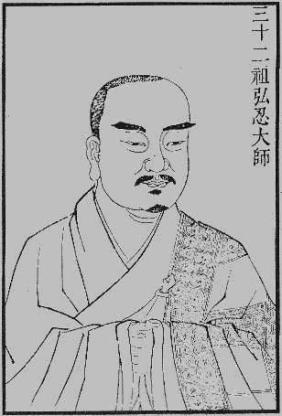
When he was between 22 and 24, Hui-neng, an illiterate peddler of firewood, by chance heard a man reciting the Diamond Sutra and experienced an awakening. He obtained some money for his mother’s support and traveled north to ask the Fifth Ch’an Patriarch, Hongren, to ordain him. The Patriarch knew at once that Hui-neng was more advanced than any of his disciples, but for reasons of his own he didn’t ordain Hui-neng but sent him to work milling rice and chopping firewood. After eight months, Hongren went to the milling room to speak with him; he told him that he knew of his spiritual attainment, but that it would be unwise to let the other monks know of it.

Hongren

Hongren

A short time later Hongren told all of the monks to write a verse. If any monk showed by his verse that he had insight into the meaning of Ch’an, he would receive the robe and Dharma (direct teaching) of the patriarchate, becoming the Sixth Patriarch. Unsure of himself, the head monk secretly wrote his verse on a wall. Hearing it read, Hui-neng composed his own verse and asked a visiting dignitary to write it on the wall for him. After the Patriarch saw Hui-neng’s verse he summoned him to his hall in the middle of the night and read the Diamond Sutra to him. Upon hearing the Sutra, Hui-neng awoke to his original nature; the Patriarch thereupon conferred upon Hui-neng the Dharma and the robe. But fearing that other monks might do him harm, he told Hui-neng to leave the monastery and to refrain from teaching for three years, since his life and the Dharma would be “hanging by a thread.”

After living in hiding for 15 or 16 years, Hui-neng traveled to Canton. At the age of 39 (c. 676 C.E.) he presented himself at Dafan Temple in Shaozhou, where it was immediately evident to the master that he was in the presence of the Sixth Patriarch. Hui-neng was ordained a monk and invited to teach.

In 713, the year he died, the Patriarch gave a series of discourses from a specially-erected platform, which signified the fulfillment of a prophecy and gave the teaching the stamp of being an authentic teaching of the Buddha. This is why Hui-neng’s teaching, alone among the Chinese scriptures, is called a sutra.

The following account opens the Platform Sutra, the only written record from Hui-neng’s 37 years as a Ch’an master. The majority of the passages (in black) are from the translation by Philip B. Yampolsky.

The Sixth Patriarch’s Dharma Jewel Platform Sutra

My worthy father was originally an official at Fanyang. He was dismissed from his post and banished as a commoner to Hsin-chou (Hsin Province) in Ling-nan. My father died when I was young, and my mother and I moved to Nan-hai. We suffered extreme poverty and here I sold firewood in the marketplace.

By chance a certain man bought some firewood and took me to the lodging house for officials. He took the firewood and left. Having received my money, I was turning toward the gate when I saw a man reciting the Diamond Sutra.

Upon hearing it my mind became clear and I experienced an awakening. I asked him, “Where do you come from that you have brought this sutra with you?” He replied, “I have made obeisance to Fifth Patriarch Hongren at the Feng-mu Monastery in Huangmei*, Ch’i-chou. While there I heard the Master urge the monks and and layman, saying that if  they recited only one volume, the Diamond Sutra, they could see into their own natures and with direct apprehension become Buddhas.” (*Hongren is sometimes referred to by the place of his monastery, Huangmei)

Hearing what he said I realized that it was predestined that I should have heard him. I obtained ten pieces of silver to provide for my old mother, and taking leave of her, I went to Feng-mu Monastery in Huangmei and paid obeisance to Fifth Patriarch Hongren.

The Master Hongren asked me, “Where have you come from that you come to this mountain to make obeisance to me? What is it that you seek here?”

I replied, “I am from Ling-nan, a commoner from Hsin-chou in the south, and I have come this long distance to make obeisance to you. I seek only the Buddhadharma, nothing more.”

The Patriarch said, “If you are from Ling-nan, you’re a barbarian. How can you become a Buddha?” I replied, “People may come from the north, or come from the south, but fundamentally there is no north or south to Buddha-nature. The body of a barbarian and that of a High Master are not the same, but what difference is there in our Buddha-nature?”

4. The Master wished to continue his discussion with me; however, seeing that there were others nearby, he said no more.

But I said, “This humble person begs your holiness: My mind has flashes of transcendental wisdom, and by not turning away from my essential nature I can become a ‘field of merits’ [a priest]. But I do not know what work his holiness would have me do.”  (Jordan)

The Fifth Patriarch wished to continue the conversation, but seeing his disciples gathering on all sides, he ordered his visitor to follow the group off to work. I said, “Hui-neng wishes to inform the High Master that wisdom (prajna) is always active in this disciple’s mind, as I never depart from my essential nature—this itself is the ‘field of blessings’ [attainment of priesthood]. What work would the High Master have me do?” (Heng Sure et al, 2014)

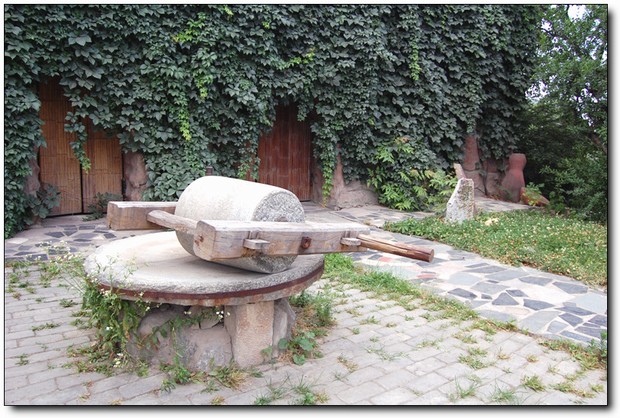
Then he sent me to work with the group. Later a lay disciple sent me to the threshing room, where I spent eight months treading the pestle.

ancient rice mill China

A little over eight months later, the Patriarch saw me one day and he said, “I think that your insight is very good, and I am afraid some wicked people might seek to harm you, so I have not been speaking to you. Do you understand that?” “Yes, sir,” I replied. “I will stay away from your hall. Others will not know.” (Jordan)

4. Unexpectedly one day the Fifth Patriarch called his disciples to come, and when they had assembled he said: “Let me preach to you. For people of this world, birth and death are vital matters. You disciples make offerings all day and seek only to become priests, but you do not seek to escape from the bitter sea of birth and death. Your own self-nature obscures the gateway to holiness; how can you be delivered? Return all of you to your halls and look within yourselves. Men of wisdom will grasp the original nature of their prajna on their own. Each of you, write a verse and bring it to me. I will read your verses; if there is one who is awakened to the cardinal meaning, I will give him the robe and the Dharma and make him the Sixth Patriarch.”

“Long thought is not needed. A man who has seen his essence can immediately talk about it, and thereafter cannot forget it. Even amidst swords and chariots, he never loses sight of it.” (Jordan)

5. The disciples received his instructions and returned to their halls. They talked it over amongst themselves, saying: “There’s no point in purifying our minds and making the effort to compose a verse to submit to the Master. Head Monk Shen-hsiu is our teacher. After he obtains the Dharma we will be under his authority, so let us not [offend him and] compose verses.” Then they all abandoned the idea of trying and didn’t bother to submit a verse.

In front of the Fifth Patriarch’s hall there was a corridor three rooms long. The walls were to be painted with stories from The Lankavatara Sutra, together with pictures of the Dharma transmissions of each of the five Patriarchs, in order to teach later generations and preserve a record of them. The Court artist Lu Chen had examined the walls and was to start work the next day.

6. Head Monk Shen-hsiu thought, “The others will not submit verses because I am their senior teacher. If I don’t submit a mind-verse, how can the Master judge the depth of my insight and understanding? If I offer my verse with the intention of gaining the Dharma, that is justifiable, but if I covet the title of Patriarch, that cannot be justified. It would be like a common person presuming to be a sage. But if I don’t submit a verse, I cannot obtain the Dharma. For a long time he thought, and was extremely perplexed.

At midnight, without letting anyone see him, he went to write his mind-verse on the central section of the south corridor wall, hoping to gain the Dharma. “If the Fifth Patriarch sees my verse tomorrow and is pleased, it will mean that I have an affinity with the Dharma. If he finds it unworthy, it will mean I am deluded, that there are karmic obstacles piled up from the past. Then I cannot attain the Dharma and I shall have to give up. The Patriarch’s intention is hard to fathom.

Then Head Monk Shen-hsiu, holding a candle, wrote the verse on the central section of the south corridor wall without anyone knowing. The verse read:

The body is the Bodhi tree
The mind* is like a mirror bright
At all times diligently polish it
And let no dust alight

[*hsin: the self; dust: the six sense-objects–thoughts, sights, sounds, the felt, scents, tastes]

7. After writing this verse, Head Monk Shen-hsiu returned to his room and lay down. No one had seen him.

At dawn the Fifth Patriarch called the painter Lu to draw illustrations from the Lankavatara Sutra on the south corridor wall. The Fifth Patriarch saw the verse and, having read it, said to the painter Lu: “I will give you thirty thousand. You have come a long distance to do this ambitious work, but I have decided not to have the pictures painted after all. It is said in the Diamond Sutra: “All forms everywhere are illusory and false.” It would be best to leave this verse here and to have the deluded ones recite it. If they practice in accordance with it they will not fall into the three evil paths. Those who practice by it will gain great benefit.”

The Master then called all his disciples to come, and burned incense before the verse. The disciples came in to see and all were filled with admiration. The Fifth Patriarch said: “You should all recite this verse so that you will be able to see into your own natures. With this practice you will not fall into the three evil paths.” The disciples all recited it, and greatly impressed cried out: “How excellent!”

The Fifth Patriarch then called Head Monk Shen-hsiu into the hall and asked: “Did you write this verse? If you wrote it you are qualified to receive my Dharma.”

Head Monk Shen-hsiu said: “I am ashamed to say that I did write the verse, but I do not dare seek the patriarchate. I beg you to have the compassion to tell me whether I have even a small amount of wisdom and insight into the cardinal meaning.

The Fifth Patriarch said: “This verse you wrote shows that you have not yet seen your original nature; you are still outside the gate and have yet to pass through it. If common people practice according to you verse they will not fall into the evil paths, but in seeking bodhi one will not succeed with such an understanding. You must pass through the gate and see your own original nature.”

“Unsurpassed bodhi means that right at the moment of speaking you are able to recognize your original mind, and see that your own fundamental nature is unborn and undying. Unsurpassed bodhi means you see this for yourself naturally, at all times and in every moment of thought; that the myriad dharmas are all one, all the same, and that what is true of one is true of all. The myriad dharmas are naturally such as they are, and a mind that sees in this way is in accord with the true reality. To see in this way is the essence of supreme bodhi.” (Heng Sure et al, 2014)

“Go and think about it for a day or two and then make another verse and present it to me. If you have been able to pass through the gate and see your own original nature, then I will invest you with the robe and the Dharma.” Head Monk Shen-hsiu left, but after several days he was still unable to write a verse.

8. Two days later an acolyte passed by the threshing room reciting this verse. As soon as I heard it I knew that the person who had written it had yet to know his own nature and to discern the cardinal meaning. I asked the boy: ‘What is the verse you are reciting?”

The boy answered, saying: “Don’t you know? The Master said that birth and death are vital matters, and he told his disciples to write a verse if they wanted to inherit the robe and the Dharma, and to bring them to him to look at. He who was awakened to the cardinal meaning would receive the robe and the Dharma and become the Sixth Patriarch. Head Monk Shen-hsiu wrote this verse on the wall of the south corridor. The Fifth Patriarch ordered everyone to recite it, because whoever cultivates in accord with this verse can avoid falling into the evil destinies and gain immense benefit.”

I said: “I have been treading the pestle for over eight months and have yet to visit the hall. I beg you to take me to the south corridor so that I can see this verse and make obeisance to it. I also want to recite it so that I can establish causation for my next birth and be born in a Buddha-land.”

The boy led me to the south corridor and I bowed before the verse. Because I was uneducated I asked someone to read it to me. As soon as I had heard it I understood the cardinal meaning. I composed a verse and asked someone who could write to put it on the wall of the west corridor so that I might offer my own original mind. If you do not know the original mind, studying the Dharma is to no avail. If you know the Mind and see its true nature, you then awaken to the cardinal meaning. My verse read:

With bodhi there never was a tree
The mirror is without a stand
Buddha-nature is forever clean and pure
Wherever can dust land?

I returned to the threshing room. The disciples were all amazed when they heard my verse. The Fifth Patriarch realized that I had a splendid understanding of the cardinal meaning, but afraid that those assembled should know this he said: “This is still not complete understanding” and rubbed out the verse with his shoe.

[Beginning of Goddard]
The next day the Patriarch came secretly to the hulling room and seeing me at work with a stone tied to my waist, he said, “A seeker of the Path would forfeit his life for the Dharma. Should he do thus?” Then he asked, “Is the rice ready?” “Ready long ago,” I replied, “only waiting for the sieve.” He struck the mortar thrice with his staff and left.

Knowing what he meant, at the third drum of the night I went to his room. Using his robe as a screen so that no one would see us, he read the Diamond Sutra to me. When he came to the sentence, “One should use one’s mind in such a way that it will be free from any attachment,” I suddenly became completely enlightened and realised that all things in the universe are Mind-essence itself.

I said to the Patriarch,
“Who could have conceived that Mind-essence is intrinsically pure!
Who could have conceived that Mind-essence is intrinsically free of becoming and annihilation!
That Mind-essence is intrinsically self-sufficient, and free of change!
Who could have conceived that all things are manifestations of Mind-essence!” 

Thus at midnight, to the knowledge of no one, was the Dharma transmitted to me, and I consequently became the inheritor of the teachings of the Sudden School, and the possessor of the robe and the begging-bowl.

“You are now the Sixth Patriarch,” said the Patriarch. “Take good care of yourself and deliver as many sentient beings as possible. Spread the teaching; keep the teaching alive; do not let it come to an end. Listen to my stanza:

“Sentient beings who sow seed of Enlightenment
In the field of causation will reap the fruit of Buddhahood.
Inanimate objects, which are void of Buddha-nature,
Sow not and reap not.”

The Patriarch further said: “When Patriarch Bodhidharma first came to China, few Chinese had confidence in him and so this robe has been handed down as a symbol from one patriarch to another. As to the Dharma, as a rule it is transmitted from heart to heart and the recipient is expected to understand it and to realise it by his own efforts. From time immemorial, it has been the practice for one Buddha to pass on to his successor the essence of the Dharma, and for one patriarch to transmit to the next, from mind to mind, the esoteric teaching. As the robe may give cause for dispute, you will be the last one to inherit it. If you should again hand it down to a successor, your life would be in imminent danger. You must now leave this place as quickly as you can, lest some one should harm you.” I asked him, “Where shall I go?” and he replied, “Stop at Wei and seclude yourself at Wui.”

As it was the middle of the night when I thus received the begging-bowl and the robe, I told the Patriarch that as I was a Southerner I did not know the mountain trails and it would be impossible for me to get down to the river. “You need not worry,” he replied, “I will go with you.” He then accompanied me to the Kiu-kiang landing where we got a boat. As he started to do the rowing himself, I asked him to be seated and let me handle the oar. He replied, “It is only right for me to take you across.” To this I replied, “Under delusion, I was dependent on you to take me across, but now it is different. It was my fate to be born on the frontier and my education is very deficient, but I have had the honor to inherit the Dharma from you. Since I am now enlightened, it is only right for me to cross the sea of birth and death by my own effort in order to realise my own mind-essence.”

“Quite so, quite so,” he agreed. “Beginning with you (Ch’an) Buddhism will become very widespread. Three years after your departure I shall pass from this world. You may start on your journey now; go as fast as you can toward the South. Do not begin preaching too soon; (Ch’an) Buddhism is not to be easily spread.” (Goddard & Suzuki, 1932)

10. [That night] I set out with the robe and the Dharma. The Fifth Patriarch saw me off as far as Chiu-chiang Station. He instructed me: “Leave, work hard, take the Dharma with you to the south. For three years do not spread the teaching, otherwise calamity will befall the Dharma. Later, work to convert people; you must guide deluded ones well. If you are able to awaken the mind of another, he will be no different from me.” After completing my leave-taking, I set out for the south.

11. After about two months I reached the Dayu Mountains. Unbeknownst to me, several hundred men were following behind, hoping to steal the robe and Dharma. By the time I had gone halfway up the mountain they had all turned back. But there was one monk, Hui-ming, whose family name was Chen. Formerly he had been a general of the third rank and he was by nature and conduct coarse and violent. Reaching the top of the mountain, he caught up with me. I offered him the dharma-robe, but he was unwilling to take it.

“I have come this long distance only for the Dharma,” he said. “I have no need for the robe.” Then on top of the mountain, I taught the Dharma to Hui-ming, who when he heard it was suddenly enlightened. I then ordered him to return to the north and to convert people there.

[In the Yampolsky translation, the teaching of the Dharma follows, beginning with stanza number 12. The continuation of Hui-neng’s life story, below, is from the translation by Heng Sure et al, 2014]

Returning to the foot of the mountain, Hui-ming said to the crowd of pursuers, “Up above there are only rocky, trackless heights; there’s no trace of him to be found. We should search elsewhere.” The pursuers all agreed. Afterwards, Hui-ming changed his name to Dao-ming, to avoid using the first name of his master.

Later I came to Caoxi, but was again pursued by evil men. So I fled to Sihui, where I lived among hunters for fifteen years, occasionally teaching them the Dharma when the opportunities arose. The hunters had me watch over their snares, but whenever I saw living creatures, I released them. At mealtime I steamed vegetables in the pot alongside the meat. If they asked me about this, sometimes I’d say, “I only eat the vegetables cooked alongside the meat.”

One day I thought, “The time has come to spread the Dharma. I cannot stay in hiding forever.” Accordingly, I went to Dharma Essence Monastery in Guang Province, where Master Yinzong was lecturing on The Nirvana Sutra. At that time there was a pennant waving in the breeze. One monk there said, “The wind is moving.” Another monk said, “The pennant is moving.” They argued on this incessantly. I stepped forward and said, “It is your minds that are moving, kind sirs.” Everyone was startled.

Dharma Master Yinzong invited me up to the dais where he questioned me closely about the deeper meaning behind my words. He noticed that my responses were direct, concise, and did not come from written texts. Yinzong said, “This cultivator is certainly no ordinary person. Long ago I heard that the Dharma robe and bowl of Huangmei (Hongren) had come south. Might you be that one, Cultivator?” To this I politely assented.

Yinzong bowed and asked me to show the robe and bowl I had been entrusted with to the community. He questioned me further: “How exactly was Huangmei’s teaching transferred?” I replied, “There was no transfer. We merely discussed seeing the nature. There was no discussion of Ch’an meditation or liberation.” Yinzong asked, “Why was there no discussion about Ch’an meditation or liberation?” I said, “Because those are dualistic teachings, not the Buddha-Dharma. The Dharma of the Buddha is a Dharma of non-dualism.” Yinzong further asked, “What is the Buddha-Dharma you call the Dharma of non-dualism?” I answered, “The Dharma Master has been lecturing on The Nirvana Sutra’s elucidation of the buddha-nature—this is the non-dual Dharma of the Buddha-Dharma. Just as when Lofty Virtue King Bodhisattva asks the Buddha, ‘Those who break the four major prohibitions, or commit the five rebellious offenses, or who are irredeemably ignorant and the like, do they sever their roots of goodness and the buddha-nature?’ And the Buddha replies, ‘There are two kinds of roots of goodness: permanent and impermanent. The buddha-nature, however, is neither permanent nor impermanent.’ Therefore, it cannot be severed. That is what is meant by non-dual. The first roots are good, the second bad; but the buddha-nature is neither good nor bad. That is what is meant by non-dual. Ordinary people think of the skandhas and sense-realms in a dualistic manner; the wise person knows that they are non-dual in nature. The non-dual nature is the buddha-nature.”

Yinzong was overjoyed when he heard this explanation. He put his palms together and said, “My explanation of this sutra is like broken clay tiles, whereas your explanation of its meaning, kind sir, is like pure gold.” He then shaved my head and asked me to be his teacher. Thus, under that Bodhi-tree, I first began the East Mountain teaching.

I received the Dharma at East Mountain and endured such extreme hardship that it was as if my life were hanging by a thread. Today there is this gathering of the Prefect and officials, the monks, nuns, Taoist priests and laity—how could this happen without karmic affinities amassed over aeons of time? And now you have had the good fortune to hear the Sudden Teaching, the seed for realizing the Dharma. All of this can only be because in the past you made offerings to the Buddha and planted roots of goodness.

This teaching has been passed down from sages of the past, it is not my own wisdom. You who wish to comprehend the teaching of the past sages should purify your minds. After listening to it, cast aside your doubts, and you will be no different from the sages of generations past.

Delighted with what they had heard, the whole assembly bowed and withdrew.

* * *

Jordan, David K. “The Tale of Huineng: The Platform Scripture of the Sixth Patriarch.” http://pages.ucsd.edu/~dkjordan/chin/LiowTzuu/HueyNeng.html

Suzuki, Daisetz Teitaro (1949). Essays in Zen Buddhism (First Series). New York: Grove Press.

Goddard, Dwight (1932). A Buddhist Bible (First Edition). (based on a translation by D. T. Suzuki) (http://www.sacred-texts.com/bud/bb/index.htm)

Heng Sure, Yuh-chirn Liang, Allen Huang, Yi-huan Shih, Madalena Lew and Martin J. Verhoeven (2014). The Sixth Patriarch’s Dharma Jewel Platform Sutra (Translated from the Chinese of Zongbao Taisho, Volume 48, Number 2008). Ukiah, California: Buddhist Text Translation Society.

Price, A. F. and Wong Mou-Lam (2004). Sutra Spoken by the Sixth Patriarch on the High Seat of The Treasure of the Law. Whitefish, Montana: Kessinger Publishing Company. (https://terebess.hu/zen/PlatformPrice.pdf)

Yampolsky, Philip B. (1967). The Platform Sutra of the Sixth Patriarch. (The text of the Tun-Huang manuscript with translation, introduction and notes by Philip B. Yampolsky.) New York: Columbia University Press. (http://www.fodian.net/world/Platform_Sutra_Yampolsky.pdf)

Introduction to the Platform Sutra

Translator’s Introduction to The Sixth Patriarch’s Diamond Jewel Platform Sutra       Martin Verhoeven, PhD.

Huineng (638-713) was the Sixth Patriarch in China, and the thirty-third in Patriarchal descendants from the time of the Buddha in India. He was the immediate successor of Master Hongren (601-674). The Sixth Patriarch himself wrote nothing, nor left any record of his life or teaching. This text, The Sixth Patriarch’s Dharma Jewel Platform Sutra, represents the only account we have of his life and lectures. So highly regarded is his place in the Buddhist tradition that, to our knowledge, this text is the only one that has been accorded the title “sutra,” a term traditionally reserved only for teachings directly attributed to the Buddha.

Overview

After the Fifth Patriarch, Hongren, had passed on the robe and bowl to the Sixth Patriarch, Huineng, he told him to immediately go into hiding. Huineng’s life might be in danger, the Fifth Patriarch warned. The Sixth Patriarch fled, but was quickly pursued by an evil crowd wishing to steal these symbols of the Dharma’s bequeathal. The first to catch up with him was a monk named Huiming, a rough and coarse-natured former military commander. Unable to wrest the items away by force, Huiming cried out, “Cultivator, cultivator! I have come for the Dharma, not for the robe.” The Sixth Patriarch told him to calm down, and then instructed him on the essentials of Dharma: your own mind in its original purity and stillness is the Buddha. Huiming felt he had now at last received the ‘secret meaning.’ Yet its purport was so simple and straightforward that he asked further, “Other than the secret words and secret meaning you just uttered, is there yet another secret meaning?” The Master answered, “What I just told you is not a secret. If you look within yourself, you’ll find the ‘secret’ is with you.”

Less than a year earlier when Huineng, the Sixth Patriarch to be, first visited his teacher, the Fifth Patriarch Hongren, the Master asked him, “Where are you from? What do you seek?” Huineng replied, “Your disciple is a commoner from Xin Province in Lingnan. I come from afar to bow to you, and seek only to be a Buddha, nothing else.” To test him, the Patriarch said, “If you are from Lingnan, you must be a barbarian. How could you become a Buddha?” But Huineng replied, “People may come from the north, or come from the south, but fundamentally there is no north or south to the buddha-nature. The body of a barbarian and that of a High Master are not the same, but what difference is there in our buddha-nature?”

This initial intuitive understanding, so strikingly evident in the Sixth Patriarch even before he commenced formal study and received training, would later mature into the platform of his entire teaching—called the “direct teaching” (dun jiao). He succintly conveyed its central tenet as follows:

“You should now believe that the knowledge and vision of the Buddha is just your own mind; there is no other Buddha.”

“Why don’t you immediately see, right within your own mind, the true reality of your original nature?” (p. 11)

Here then in these two encounters we find the essence of the Sixth Patriarch’s philosophy, and indeed the substance of the Buddha’s teaching: all beings have the buddha-nature; all can become Buddha. As the Patriarch himself pointed out, “This teaching has been passed down from sages of the past; it is not my own wisdom.” But what exactly is this nature? And how is it realized?

The Sixth Patriarch insists that this nature (xing), called the essential-nature or original-nature (zi xing; ben xing), is universally possessed by all sentient beings. It is not greater in the sage, or less in the average person. Human nature is the buddha-nature; Buddhas come from people. The difference between a Buddha and an ordinary living being, between the liberating joy of wisdom and the anguish of delusion, is one of degree, not of kind. In a fully awakened being, the nature is perfectly realized. In an ordinary person, this capacity lies dormant, covered over, and asleep, so to speak.

“You should know that the buddha-nature is fundamentally no different for the foolish and the wise. The only difference between them is: the foolish are confused; the wise are awakened.”

Buddhas and living beings are two forms of a single substance, just as water and ice belong to a common element. In yet another example of the direct teaching, the Sixth Patriarch tells his followers:

“Good and Wise Friends, unawakened, Buddhas are just living beings. At the moment they awaken, however, living beings are Buddhas. Therefore, you should realize that the ten thousand dharmas are all within your own mind.”

The fundamental sameness of the human and Buddha, the worldly and world-transcending, the ordinary mind and the Buddha mind, are all different ways of expressing a corollary axiom of this teaching: “non-duality”. In his very first formal lecture the Sixth Patriarch states unequivocally: “the Dharma of the Buddha is a non-dual Dharma.” The fundamental sameness of a Buddha and an ordinary person also means that Buddhahood is not a future state or a far-distant celestial abode, but exists “right within your own mind” and is immediately available. The implications are manifold. (p. 12)

When taken together, we are presented with a powerful and resounding totalistic vision of human nature as the buddha-nature, unconditioned by culture, schooling, gender, ethnicity, or even religious belonging. It is not even delimited by time and space, nor by birth or death. This indwelling capacity remains whole and complete within all of us, waiting to be fully expressed if only we could see it.

“Our real nature is non-dual. It is not diminished in ordinary people, nor is it greater in worthy sages. It is not disturbed amid the passions; nor is it stilled and static while in ch’an concentration. It does not end, nor last forever. It does not arrive or leave; and has no location: neither inside nor outside nor in the middle. Unborn, undying, its essence and appearance is ‘just so; as it really is.’ It is permanent and unchanging—it is called the Way.”

The ideas of innate and primary wholeness, non-duality, and immediacy form the unvarying thematic core of the Sixth Patriarch’s teaching career and color all of his talks and encounters.

Three interrelated themes flow from this direct teaching. First, because awakened nature is intrinsic to all beings, it cannot be sought for outside. Thus, the compound characters (ka wu, lit. ‘opening up’) meaning “awakening” suggest a releasing of what has been there all along, much as a flower opens to or unfolds in the sun. Rather than an acquisition of something novel, divine, or even transcendent, awakening connotes a natural enlivening of an immanent and inborn human capacity. In describing the path to awakening, the text avoids language hinting at mysticism, or any sense of striving, acquiring, obtaining, getting, or even having an experience. Instead, it favors a single term, “seeing” (jian) to convey the experience, which could also be rendered as “realizing” or “waking up to.” One is being led to behold something intrinsic and at-hand all along, rather than to yearn for a dreamy transcendent reward somewhere beyond.

Indeed, it was in the here-and-now, in the midst of his everyday routine while standing in front of a village shop that Huineng, then a poor woodcutter, had his own initial awakening. Upon hearing a stranger utter the famous line of text from The Diamond Sutra: “Let your mind be unattached, clinging to nothing,” his mind immediately opened. Mere months later he arrived at an even deeper understanding upon hearing the same line, this time recited by his teacher, Hongren. The Sixth Patriarch relates, “As soon as these words were uttered I experienced a profound awakening, and understood that the inherent nature embraces the ten thousand things.” He exclaimed,

How unexpected! The essential nature is intrinsically pure.
How unexpected! The essential nature is originally unborn and undying.
How unexpected! The essential nature is complete in itself, lacking nothing.
How unexpected! The essential nature is fundamentally still and unmoving.
How unexpected! From the essential nature the myriad dharmas come to be.

Master Hongren, the Fifth Patriarch, affirmed Huineng’s realization, and as if to further emphasize the point, told him: “To study the Dharma without recognizing your original mind is useless. If you recognize your original mind, and see your essential nature, you can be called a great hero, a teacher of gods and humans, a Buddha.”

In this terse exchange we see the subtle and dynamic relationship between student and teacher that the direct teaching requires. This pedagogy is sometimes called the “mind pointing to the mind,” because the insights and profound understanding (prajna) that awakening occasions are intrinsic and cannot properly be transmitted or transferred from one person to another. Because the true mind is in itself complete, nothing can be added to it by a teacher. Its subtle, wondrous functioning (miao yong) must be discovered, or more accurately, recovered, in and by oneself.
. . .
In this tradition, the goal of the skillful spiritual teacher is not to inculcate the student with a prescribed body of knowledge, but to stimulate the student to self-knowledge. As a result, the teaching style tends less to profess or preach than to provide situations that can spur the student to self-recognition and rouse direct insight. The teacher does not bestow the vision, but only presents the student with the means to discover it within. This earnest and sustained transformative activity of direct inquiry, self-reflection, and maturing in the Way is called self-cultivation (xiu xing). As the dynamic nature of the Chinese characters imply (xiu, lit. ‘correcting; repairing; to rectify’ and xing, lit. ’steps’) self-cultivation requires a total mind-body engagement; it is a ‘doing,’ a way of becoming an exemplary person, which entails both rigorous training and an active ‘pruning’ and ‘repairing’ of one’s character and conduct. . . .

(p. 16) This leads to the second theme (p. 16): the need to engage, to practice, to enact (xing). Although our original nature is the Buddha-nature, most of us could not describe our present state as Buddhahood. The Sixth Patriarch’s question posed above is straightforward, not merely rhetorical: “Why don’t you immediately see, right within your own mind, the true reality of your original nature?” He answers with an analogy drawn from the natural world: “It is like when thick clouds obscure the sun; if the wind doesn’t blow, the sun cannot shine.”

The “clouds” are the self-inflicted impediments of delusion and [passions] (klesa) which we have let cover over our fundamental pure nature. They obscure our vision so that we are unable to “recognize our own mind and see our nature.” Huineng develops this analogy more fully:

“It is like the sky above which is always clear, and the sun and moon which are ever bright. Even if they are obscured by floating clouds that overshadow the world below in darkness, the sky above remains clear. If a wind suddenly comes up, scattering the clouds, then above and below are both bright, and everything reappears and becomes visible. The tendency of people is to constantly drift like the clouds in the sky.

“Good and Wise Friends, insight is like the sun, and wisdom is like the moon. Insight and wisdom are always bright, but if we attach to external things, the floating clouds of errant thoughts cover over our essential nature so it is obscured and cannot shine.”

The Dharma, when practiced, acts like wind scattering the clouds.

According to the Sixth Patriarch, the Dharma teachings are something to be used, applied and tested. Indeed, for the Master, the Way must be walked, or it is not the Way. The Tao elucidated by the Sixth Patriarch is not a religious doctrine, nor an ontological or metaphysical Truth, nor even a faith to espouse. The Chinese character for the Tao denotes movement, literally ‘walking,’ suggesting the Way is existentially real, found underfoot. As the word implies, a ‘path’ is for walking, and reveals itself only in and through the traversing of it. Confucius may have been hinting at something similar in saying, “It is the person that can make the Way great, and not the Way that can make the person great.”

Thus the Way is discovered concretely, not surmised abstractly. Stationary, there appears to be no Way, but as soon as one walks, the road appears. Hence the saying, “From afar, the mountain appears unscalable, but when you get to the bottom of the mountain, there is always a way.” . . . As Huineng stresses to his followers, “This must be practiced with the mind; not merely recited by the mouth.”

(p. 17) “Good and Wise Friends, people chant “prajna” all day long without realizing the prajna of their own essential nature. Just as talking about food will not satisfy hunger, so too only talking about emptiness, even for myriad eons, will give you no insight into your own nature—ultimately it is of no benefit.”

. . .
The Sixth Patriarch’s explication of the Way is completely consistent with the overarching motif of the text: non-duality. The Tao, the Dharma, are not presented as the results of philosophical conjecture or as divine revelations bequeathed from without, but as signifiers of living truths residing within. . . .

The Sixth Patriarch in fact tells his students, “All Buddhas of the past, present, and future, as well as the twelve divisions of sutras are originally inherent, whole and complete, within human nature.” . . . As with wisdom (prajna) and awakening (bodhi), so too with the teachings (Dharma): they are of a piece with the mind, and firmly grounded in human nature. Self-understanding is the key to unlocking the meaning of the Sutras because the essential nature is the very wellspring of the teachings themselves. . . .
Huineng tells his students,

“All the sutras and writings were established because of people—and could only have been set up because of [their] wisdom nature. If there were no people in the world, all the myriad Dharma-teachings would not exist by themselves. Therefore, you should realize that the myriad Dharma-teachings arise because of people, and all Sutras are taught and explained for people.”

But how does one attain the Way? How are we to uphold the Dharma teachings? (p. 20) This brings us to a third theme in the text: setting up nowhere; attaining nothing-to-attain.

The Sixth Patriarch must direct his students to truths that cannot be grasped, cannot be seen, cannot be thought, and yet are more real than anything that can be held, seen, or imagined. He faces the same paradox the Buddha faced: how to elicit in his students a certain intellectual stance, an open-minded sensibility that avoids falling into the two extremes of eternalism or nihilism. For example, when one of his disciples asks about the ‘impermanence’ of our passing thoughts and the ‘permanence’ of our essential nature, the Master pointedly contradicts the established teaching by answering in the opposite: it is the Buddha-nature which is impermanent, and the confused mind which is permanent. The student is stunned. But then Huineng explains,

“Don’t you realize—if the buddha-nature were permanent, then what good or bad states would there be to speak of? And not a single person until the end of time would ever aspire to bodhi. That is why I say it is impermanent. This is precisely the path to true permanence taught by the Buddha. Moreover, if all things were impermanent, then everything would have its own nature that was subject to birth and death, and the truly permanent nature would not be universal, all-pervading. That is why I say they are permanent. And that is precisely what the Buddha meant by teaching true impermanence.” (p. 20)

. . .
In describing the Buddha’s reason for coming into the world, the Master is perhaps relating his own:

“It is only because living beings cover over their own light with lust and craving for sensory experiences, become enslaved to things outside and disturbed within, that the World Honored One is roused from his samadhi to exhort them to cease, to not seek outside themselves, and instead to realize they are the same as the Buddha. . . I, too, am always exhorting people to realize the Buddha’s knowledge and vision within their own minds. But ordinary people are perverse; confused and deluded, they do wrong. Their talk may be good, but their minds are bad. Greedy, hateful, envious, fawning and flattering, deceitful, and arrogant, they take advantage of others and harm living creatures. Thus, they only realize the knowledge and vision of living beings.”

(p. 21) As this last passage shows, it is not lack of esoteric knowledge or metaphysical insight that impedes our enlightenment, but our lack of self-understanding. The most ordinary of human faults, character flaws, and bad habits obscure our “seeing” and obstruct our liberation. So too, it in only by facing up to and correcting these [passions] that the Buddha of our own mind is found. . . .

For the Sixth Patriarch all time is one time, all places are one place. When it comes to self-cultivation, only the here-and-now matters.

“The Buddha Dharma is right here in the world
There is no awakening apart from this world
To search for Bodhi somewhere beyond this world
Is like looking for a rabbit with antlers”

. . .
(p. 24) The Sixth Patriarch does not condemn grasping, craving, and wanting as immoral or evil. The tone of the text throughout is largely descriptive, not judgmental. He simply points out that such unquenchable thirst does not deliver. Craving, as the Buddha observed, only brings suffering, stress, and dissatisfaction. The restless seeking, the “frantic passage through life” as Huineng calls it, covers over people’s light to such a degree that they “become enslaved to things outside and disturbed within.” In a lengthy and graphic teaching to the monk Zhidao, the Master says,

“You should know that the Buddha [taught] because deluded people mistook the combination of the five skandhas for their own essence and being, and discriminated so as to make all things external to themselves. They loved life and dreaded death, drifted and flowed along from thought to thought, unaware that this was all an unreal dream, hollow and false. They pointlessly turned round and round on the wheel of birth and death, wrongly imagining that the eternal bliss of nirvana was some kind of suffering, and all day long frantically sought after something else.”

. . .
Huineng’s teaching, like the Buddha’s, has one goal: to exhort people to stop and rest, not to seek outside themselves, and realize that the “knowledge and vision of the Buddha is just their own mind.” He urges on his disciples by quoting a line from The Vimalakirti Sutra, “just here and now, regain your original mind.” He then empowers them with the following:

“Good and Wise Friends, when I was with the Venerable Master Hongren, I awoke as soon as I heard his words and immediately saw my original nature as it truly is. That is why I am conveying this teaching and practice, so that students of the Way may directly awaken and realize Bodhi. Each of you look into your own mind; see your original nature yourself.”

. . .
The Sixth Patriarch’s philosophy is often depicted as exclusively self-directed (zi li), requiring no beliefs or faith (xin), as opposed to [reliance on] ‘other-power’ (ta li). This characterization is . . . not entirely accurate. First, in Huineng’s understanding, a distinction between ‘self-power’ and ‘other-power’ sets up a false dichotomy. The Dharma of non-duality means that the Buddha and the living being, one’s own pure mind and the Pure Land of Amitabha, are fundamentally the same. The full and proper use of one’s own mind is the Buddha’s mind:

“If your essential nature is balanced and centered, the living being is a buddha. When your essential nature deviates off course, the buddha is a living being. If your mind is devious and crooked, the buddha is concealed within the living being. But with one thought balanced and trued, the living being becomes a buddha. Our own mind itself holds the buddha, and this inherent buddha is the real buddha. If our own mind did not have its own inherent buddha, where could the real buddha be sought?”

. . .
Faith is not absent from his teachings; it is simply recessed. . . . [I]t does not require a blind acceptance of something external, or dependence on someone else, but instead an appreciation of one’s own abilities. Thus a better rendering of xin in this sutra might be “trust” or “confidence.” It grows from an intuitive appreciation of the soundness of the essential nature, and an affirmation of one’s own ability to walk the same path the Buddha walked. The ‘faith’ Huineng exhorts his students to embrace is not in him, nor even in the Buddha, but within themselves. He says, “Your own mind is the Buddha. Never doubt this!”

The direct teaching, to and from the nature, can be seen again when the Sixth Patriarch ritually initiates new students to Buddhism through the formal ‘taking refuge’ ceremony. Taking refuge in the Buddha, in Huineng’s teaching, is not a leap of faith into the arms of a divine being who saves you, but a personal commitment to ‘saving’ yourself (du; lit. ‘cross over,’ and ‘ferry across’). He tells the initates,

“Good and Wise Friends, each of you examine yourself. Do not go about this incorrectly. The sutra clearly says you should return [to] and rely on your own buddha, not some other buddha. If you do not return to the buddha within, there is nothing you can rely on.”

Central Element & Themes

While a number of versions of The Platform Sutra exist, it is noteworthy that most renditions rather closely parallel one another, and show sufficient similarity in content and themes to suggest they derive from a common source, however obscure to us now. Central elements might be delineated as follows:

The Essential Meaning of All Buddhas . . .

The text itself traces its lineage back to what it calls the “source” (yuan), not of a particular school, as the character zong is often narrowly translated, but to the source teachings (zong zhi) of all Buddhas. This grounding of the text’s deep-rooted purport is witnessed by the listing of successive teachers given in the final chapter. Here, having been asked how many generations have passed along this teaching since its beginnings, the Sixth Patriarch enumerates a patriarchal lineage going back not just to the Buddha of our era, Shakyamuni, but to seven Buddhas of antiquity that preceded him. In fact, the Patriarch says, the number of Buddhas who have passed along this teaching is “numberless and incalculable.” In other words, this “source teaching” holds the essential meaning of all Buddhas, and as such is without beginning or end. In cultivating it, one is not simply following a particular  Buddha, (p. 27) or even following in the footsteps of all Buddhas, but is actually seeking after what they sought. Huineng exhorts his students:

To learn the Way, look within, observe your own essential nature;
Then you are one and the same with each and every Buddha.

The Way is to be sought not in the past or in the future, but right now in oneself. When he finally grasped this point, Zhichang, one of the Master’s students, exclaimed: “Our own nature is the essential source of awakening.”

Transformative Not Merely Informative . . .

Dharma is not Dharma unless it works, that is to say, [effectively] serves to convert the [passions] (klesa) into insight, liberation, and an end to suffering. As the Sixth Patriarch explains, there seem to be 84,000 diverse teachings only “because people have 84,000 kinds of affliction.” . . .

A corollary to this understanding is that no method of practice, or vehicle of deliverance (cheng), is inherently better than another. Superiority or inferiority is not within the thing itself, but determined by effectiveness, appropriate to the person. Thus, the Sixth Patriarch admonishes a student,

Vehicles are methods of practice; not subjects for debate. Cultivate yourself; don’t ask me. At all times, your own essential nature is itself truly as it is.”

For the Sixth Patriarch, even the notion of “this shore” and “the other shore” would pose a false dichotomy. Non-duality implies that only a single thought, not a vast body of water, separates samsara from nirvana. As The Avatamsaka Sutra says, “one place is every place; one time is all time.” A change of mind is the other shore; one arrives but there is no moving, just still quiescence. Thus in his instructions to disciple Zhicheng, the Master says, “Awaken by yourself to your own essential nature; awaken directly by cultivating directly. There are no gradual stages; nor anything to set up. All things are still and empty.” (p. 30)

Role of the Teacher . . .

Teachers are also a timely expedient. . . . The Sixth Patriarch explains,

“If you cannot understand on your own, you must seek out a Good and Wise Advisor who can lead you to see. If you are someone who can awaken on your own, however, do not seek outside. . . . Within your own mind there is a good advisor who can awaken you yourself.”

Dismantling the Familiar . . .

[T]he Master deconstructs almost all of the then-current forms of practice and belief. He also dismantles the exclusive truth claims of various sects or schools of his time—dismantles, but does not destroy them. Rather, he refocuses almost every form of Buddhist belief and devotion through the sharp lens of the essential nature. In doing so, he reveals their expedient purpose and provisional legitimacy, while not denying their utility or demeaning their worth. (p. 32) He points to their pragmatic function as liberating techniques, and thereby reaffirms their true purpose as remedies for restoring the ‘mind-ground’ (xin di), fortifying the root nature (ben xing).

Hence, when asked about the merit accrued by the famous Buddhist protector Emperor Liang, who built temples, supported monks, endowed monasteries, printed sutras, and bestowed charity, Huineng answered, “There truly was no merit and virtue.” While charity and generosity create blessings, they in no way constitute merit and virtue. Huineng advises his audience,

“Good and Wise Friends, merit and virtue must manifest from within your own nature; do not seek for them by making donations and offerings. . . . Seeing one’s essential nature is merit; equanimity is virtue. To be flexible and unimpeded iin thought after thought, always cognizant of the true and wondrous workings of one’s original nature—this is called merit and virtue.”

[Regarding the Pure Land school] Huineng informs one of his disciples, Prefect Wei, that the Pure Land is as close or far away as a pure mind. . . . (p. 33)

“Ordinary deluded people, unaware of their essential nature, do not realize that the Pure Land is within themselves. Thus, they long to be born in the East, and they long to be born in the West. To the enlightened person all places are the same.”

The act of taking Refuge in the Three Treasures (the Buddha, Dharma, and Sangha), which is the formal way of becoming a Buddhist, is also turned inward. “Good and Wise Friends,” he urges, “take refuge in and return to the three treasures of your own essential nature.” The Sixth Patriarch explains,

“The Buddha is awakening
The Dharma is what is right and true
The Sangha is purity”

Most people, he laments, “fail to understand this, and so from morning to night they take the Three Refuge Precepts,” meaning, they recite this phrase almost like a prayer. He poses this question to his audience: “You say you take refuge with the Buddha, but where is the Buddha? If you do not recognize the Buddha, how can you return to him? Such talk is absurd.” . . . The idol is false; the true Buddha is one’s own mind. The Three Jewels and the Three Bodies of the Buddha arise from one’s own nature, not from without. . . . He further says,

“If you do not return to the Buddha within, there is nothing you can rely on. Now that you have awakened yourselves, each of you take refuge with the three treasures of your own mind. Inwardly, regulate your mind and character; outwardly, respect others. This is to take refuge with yourself.”

. . .
(p. 35) Huineng further maintains that taking refuge is not a one-time act of conversion, but a continuous method of self-correcting and self-affirming—“Constantly use the three treasures of your essential nature to verify and confirm.” . . .

Meditation . . .

“The mind regulated and subdued, why toil following rules?
Your steps straight and true, what use is sitting in meditation?”

(p. 36) As the second line of the above verse intimates, even sitting meditation (zuo ch’an), seen by many Buddhists as the most direct and ultimate practice, comes in for criticism.

In some ways, some of the text’s harshest scrutiny and cautionary injunctions are reserved for meditation. To stop thinking and contemplate stillness is a sickness, not Ch’an meditation, the Master admonishes. The practice of constant sitting restricts the body and clouds the mind. How, he asks, could it help towards discovering the truth? He gives this verse to one disciple who is enamored with the practice of prolonged sitting:

“Alive sitting and not lying
Dead lying and not sitting
A pile of stinking bones
Of what use was all the effort?” [Suzuki’s translation]

This error is dramatically illustrated in Chapter 7, “Lively Encounters.” Here a Ch’an practitioner is introduced who has acquired a big reputation by living in a hut and having devoted himself to constant sitting meditation for twenty years. The Sixth Patriarch’s disciple, Xuance, happens to be wandering through the area, and on hearing of Zhihuang’s reputation, he pays a visit to his hut. There he asks him, “What are you doing here?”

Thinking he had already realized genuine samadhi, the hermit calmly replies, “Entering concentration.”

Xuance says, “You say you are entering concentration; do you have a thought of entering, or are you entering without a thought? If you enter without a thought, then all insentient things like grass and trees, rocks and stones, should attain samadhi. If you enter with thought, then all sentient beings with consciousness should attain samadhi.”

The hermit is speechless. After a while he asks what Xuance’s teacher, the Sicth Patriarch, teaches about meditation. Once again, Xuance’s answer brings us back to the nature, to the mind-ground teaching. His description of the Sixth Patriarch’s teaching on meditation is worth quoting in full:

“My teacher explains it as a subtle, wondrous, perfect serenity that interacts both in essence and application with reality as it truly is. Here, the five skandhas are fundamentally empty; the six sensory realms do not exist. One neither enters nor comes out of this samadhi concentration, it cannot be settled into or disturbed. The essence of ch’an concentration is non-dwelling, clinging to nothing; it goes beyond even the act of abiding in meditative stillness. Ch’an concentration by its very nature cannot be initiated, and you cannot even conceive the thought or idea of it. The mind is like emptiy space, yet without even a notion of empty space.”

(p. 37) In yet another encounter, when an Imperial envoy dispatched from the palace asks whether it is true, as “the worthy Ch’an masters of the capital” all teach, that it is absolutely necessary to practice sitting meditation in order to gain understanding of the Way, the Master replies,

“The Way is realized through the mind. How could it come from sitting? The Diamond Sutra says, ‘If you claim that the Tathagata either sits or lies down, you are traveling a wrong path. Why? Because he neither comes from anywhere, nor goes anywhere.’ Freedom from birth and death is the Tathagata’s pure ch’an meditation. The still emptiness of all things is the Tathagata’s pure ch’an sitting. Ultimately there is no realization; how much the less for sitting.”

This answer, as with so many of his exchanges, is not to be taken as absolute Truth, but as a timely and tactical truth aimed at breaking the attachment of the questioner. . . .

The Single-Practice Concentration . . .

Other conventional forms of practice and popular religious activity—memorizing and reciting sutras, erudition, debating, and even leaving home to become a monastic—while salutary, and in many ways admirable, will not, according to the Master, themselves lead to awakening or wisdom. Used correctly, they liberate; used incorrectly (i.e. with unwholesome intention, either to garner name and fame, or to acquire material or spiritual power), they can actually hinder awakening and deplete virtue. Perfectly legitimate spiritual exercises of the ‘great Way’ (da dao) can all too easily become entangling by-paths, twisted by what Huineng calls a “crooked mind.” He cites The Vimalakirti Sutra which says, “The direct mind is the place of awakening; the direct mind is the Pure Land.”

Thus, he exhorts his students to maintain a pure intention and singleness of purpose, to seek for nothing outside, and to sincerely cultivate one’s own mind-ground in every situation; to hold to the ‘straight mind’ or ‘direct mind’ whether “walking, standing, sitting, or reclining.” He terms this the Single-Practice concentration (yi xing san mei: also called the Samadhi of One Act), and explains,

“The Single-Practice Samadhi means always maintaining a straight mind in all situations. . . . Do not allow the workings of your mind to become crooked while merely talking about straightness with your mouth; nor expound on the Single-Practice Samadhi but fail to cultivate the straight mind. Just cultivate with a straight mind and do not cling to anything.”

. . . [Regarding emptiness]

“The wondrous nature of people is originally empty; there is nothing that can be grasped. And the true emptiness of the essential nature is the same.”

. . . [The liberated state]

“Those who see their essential nature can set these up or not as they choose. They can come and go freely, unhindered and spontaneous. Everything they do and all their words are appropriate, timely, and according to need. Wherever and however they appear, they never depart from the inherent nature. They are just realizing the spiritual powers of self-mastery and the samadhi of playfulness. This is called ‘seeing the nature.’”

[The Tao]

“It does not arrive or depart; and has no location, neither inside nor outside nor in the middle. Unborn, undying, its essence and appearance is tathata. It is permanent and unchanging—it is called the Way.”

More on meditation . . .

“You might say it [sitting meditation] is fixating on purity, yet people’s nature is basically pure. Only because of confused thinking is its natural true tathata (ru shi) obscured. Only put an end to your confused thinking, and the nature is pure of itself. . . . Good and Wise Friends, what does sitting meditation mean? To engage in this practice means you remain unhindered and unobstructed. Your mind and thoughts do not stir no matter what good and bad state or external situation presents itself. This is called ‘sitting.’ And to inwardly discern the unmoving stability of the essential nature—this is called ‘meditation.’”

(p. 42)

“Simply let your mind be like empty space, without attaching to an idea of your mind as empty space; responding appropriately without any hindrance, clear of mind whether moving or still. Distinctions like ‘worldly’ and ‘holy’ forgotten; subject and object dissolved. Essence and appearance are tathata—then there is no time and you are not in ch’an concentration.”

(p. 44)

“When your essential nature is free from error, unobstructed, undisturbed and unconfused, when prajna oversees and illuminates your every thought, and you are far removed from the superficial appearances of things, independent and free absolutely everywhere and anywhere—what is there to ‘set up’?”

Verhoeven, Martin J. (2014). The Sixth Patriarch’s Diamond Jewel Platform Sutra (3rd Edition). ,Burlingame, California: Buddhist Text Translation Society.

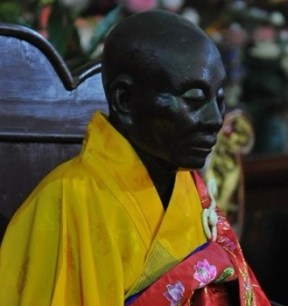
The Fourth Patriarch: “The Abandoning of the Body”

From Masters and Disciples of the Lanka (a Tun-huang MS); translated by D. T. Suzuki

Tao-hsin: I ask for the Master’s compassion. Please instruct me on how to achieve liberation.
Third Patriarch Seng-ts’an: Is there someone who fetters you?
Tao-hsin: There is no such person.
Seng-ts’an: If no one fetters you, why do you seek liberation?

Tao-hsin (580- 651):

The method of abandoning the body consists first in meditating on Emptiness, whereby the mind is emptied. Let the mind together with its world be quietened down to a perfect state of tranquillity; let thought be cast into the mystery of quietude, so that the mind is kept from wandering from one thing to another. When the mind is tranquillized in its deepest abode, its bonds are cut asunder. How unfathomable! How abysmal! The mind in its absolute purity is the Void itself. How almost unconcerned it appears! Like death there is no breathing. It abides in the utmost purity of the Dharmakaya, and is no longer subject to a future becoming.

When a mind is stirred and ignorance is born in it, one cannot escape suffering another form-existence. Therefore, let a man discipline himself first of all in the realization of a perfect state of quietude in his mind and in its world also. This is the way the discipline ought to be carried out.

But in this discipline there is really nothing to take hold of as a definite achievement, and this non-achievement is what is achieved by the discipline, for the Dharma is grasped by non-striving, and non-striving is Truth itself. Therefore, we read in the sutra, “Emptiness, non-striving, desirelessness, formlessness—this is true emancipation!” For this reason the Dharma is non-striving.

The way to abandon the body is to have a deep realization of its provisional nature, when the mind, together with its world, becomes transparent and its operations are illuminated.

Further, according to Chuang-tzu, “Heaven and Earth are one finger, and the ten thousand things are one horse.” But this is not right. The Dharmapada says: “The One is not to be thought of as one. In order to destroy the idea of multiplicity, the One is said to be one, but this is meant for the shallow-minded.” Thus, we can state that Chuang-tzu fails to go beyond oneness.

According to Lao-tzu: “How unfathomable! How abysmal! Within there is essence!”  With Lao-tzu, an outside form is gotten rid of, but he still holds on to a mind within.1 The Avatamsaka states: “Do not cling to dualism, because there is neither one nor two!” The Vimalakirti states: “Mind is neither within nor without nor in-between—this is realization.” For this reason, we know that Lao-tzu still stands on the idea of a mind-essence.

Reflect on your own body and see what it is—empty and devoid of self-nature like a shadow. It is perceived, but there is nothing there to take hold of. Prajna rises in the midst of these shadowy things, unchanging, dwelling nowhere. “Remaining immovable, they enter into contact with the myriad things.”2

Out of the midst of Emptiness there rise the six senses, and the six senses too are of Emptiness, while the six sense-objects are perceived as like a dream or a vision. It is like the eye perceiving its objects—they are not located in the eyes. It is like the mirror on which your features are reflected; they are perfectly perceived in all clarity. That which is reflected is all in space; the mirror itself does not retain a single object that is reflected in it. The human face does not enter the body of the mirror, nor does the mirror enter the human face. When one realizes how the mirror and the face stand with respect to one other, and that from the beginning there is no entering, no leaving, no going, no coming, one comprehends the meaning of Suchness and Emptiness.

* * *

1. Verse 21. I suspect that someone may have used hsin (心), mind, instead of the correct term, ching (清), pure and clear, translated below as ‘essence’ and as ‘spirit’. The words don’t sound alike. (Jonathan Star, 2001, p. 140)

So unclear, so indistinct
Within it there is image
So indistinct, so unclear
Within it there is substance
So deep, so profound
Within it there is essence  (Derek Lin)

*Unfathomable and obscure, indeed,
but at its heart is all spirit,
and spirit is Reality.  (Dwight Goddard)

2. Expert in comprehending the characteristics of phenomena (dharmalaksana), able to understand the capacities of living beings, they towered over the others of the great assembly and had learned to fear nothing. . . . In fame and renown they soared higher than Mount Sumeru; their profound faith was diamond-like in its firmness. (Vimalakirti Sutra)

D. T. Suzuki (1971). Essays in Zen Buddhism: (Third Series). Samuel Weiser, Inc. (p. 28).

Second Patriarch Hui-k’o

Record II of The Long Scroll, Text No. 6.

57.

A certain person asked Master K’o: How can one become a sage?
K’o: All ordinary men and sages are creations of false imagination.
Another question: Since they are false thoughts, how does one cultivate the Way?
K’o: What sort of thing is the Way that you want to cultivate it? Things do not have the attributes of superior or inferior; things do not have the attributes of going or coming

58.

Again he was asked: Will you pacify your disciple’s mind?
K’o: Bring your mind to me and I will pacify it for you.
Again he asked: Just pacify my mind!
K’o: What you are asking is like asking a tailor to cut the cloth for your clothes. Only when the tailor gets your silk can he put his scissors to work. If he hasn’t first seen the silk, how can he cut the garment out of empty space? Since you cannot bring your mind to me, I don’t know what kind of mind I should pacify for you. I cannot pacify empty space.

59.

Another: Administer confession to your disciple.
K’o: Bring your sins here and I will absolve you.
Questioner: Sins lack any attributes of form that can be taken hold of. I don’t know what to bring!
K’o: I have absolved you, so cast it aside.

Comment: If there is a sin, one must go to confession; but since he did not know of any sins, it was unnecessary for him to have his confession heard.

Another: Teach me to cut off the hindrances.
K’o: Where are the hindrances that you want to cut off?
Questioner: I confess I don’t know where they are.
K’o: If you don’t know where they are, they are like empty space. You don’t know what they are like, yet you desire to cut off space.
Another: The sutra says: Cut off every evil, cultivate every good, and you will be able to become a buddha.
K’o: These are imaginations projected by your own mind.

60.

Another question: All the buddhas of the ten directions have cut off hindrances and completed the Buddha-Way.
K’o: You recklessly make such an assertion without any basis.
Another question: How does the Buddha liberate creatures?
K’o: When the image in a mirror liberates creatures, the Buddha will liberate creatures.

61.

Another question: I fear the hells, I go to confession, and I cultivate the Way.
K’o: Where is your I? And what sort of a thing is your I?
Questioner: I don’t know where it is.
K’o: Since you don’t even know where this I is, who is it that falls into a hell? Since you don’t know what sort of a thing it is, it must be an existence born of the imagination. You have a hell precisely because of an existence born of the imagination.

62.

Another question. You have said: This Way is entirely a creation of the imagination. What is creation by imagination?

K’o: The Dharma has no great or small, forms or attributes, high or low. It is just as if there were a great slab of stone in the front of the courtyard of your home. Should you fall asleep on it or sit on it you would not feel apprehensive about it. Suddenly you decide to create an image, so you hire someone to carve an image of the Buddha in it. Your mind, interpreting it as being the Buddha, fears committing a sin and you no longer dare to sit on it. It is the same rock, but this Buddha interpretation was created by your mind.

What sort of thing, then, is the mind? Everything is painted by the brush of your thoughts (manovijnana). You have made yourself apprehensive; you have frightened yourself. In reality, there is neither sin nor merit in the stone; your own mind creates these interpretations. It is like a man who paints the figures of yaksas and ghosts, and who also paints the figures of dragons and tigers. When he sees what he has painted, he becomes frightened. In the paint there is ultimately nothing to be afraid of; it is all created by the discrimination of the brush of his thoughts. How can there be anything that is not created by your imagination?

(Broughton pp. 42-43) (J. 333-338)

Broughton, Jeffrey L. (1999). The Bodhidharma Anthology: The Earliest Records of Zen. University of California Press.

Jorgensen, John A. (1979). The Earliest Text of Ch’an Buddhism: The Long Scroll. The Australian National University.

Bodhidharma: Breakthrough Sermon

A great master says that his breaking through is nobler than his emanation, and this is true. When I flowed forth from God, all creatures declared: There is a God. But this cannot make me blessed, for with this I consider myself a creature. But in my breaking through, where I stand free of my own will, of God’s will, of all His works, and of God himself, then I am above all creatures and am neither God nor creature, but I am that which I was and shall remain for evermore. – Meister Eckhart, Sermon Eighty-Seven

Breakthrough Sermon

translated by Red Pine

If someone is determined to reach enlightenment, what is the most essential method he can practice?

The most essential method, which includes all other methods, is beholding the mind.

But how can one method include all others?

The mind is the root from which all things grow. If you can understand the mind, everything else is included. It’s like the root of a tree. All a tree’s fruit and flowers, branches and leaves depend on its root. If you nourish its root, a tree multiplies. If you cut its root, it dies. Those who understand the mind reach enlightenment with minimal effort. Those who don’t understand the mind practice in vain. Everything good and bad comes from your own mind. To find something beyond the mind is impossible.

But how can beholding the mind be called understanding?

When a great bodhisattva delves deeply into perfect wisdom,[76] he realizes that the four elements (dhatu) and five functions (skandha) are devoid of a self-nature.[76a] And he realizes that the activity of his mind has two aspects: pure and impure.[77] By the mind’s own nature, these two mental states are always present. They are the cause of two kinds of effects depending on conditions: the pure mind delights in good events, the impure mind produces evil events. Those who aren’t affected by impurity are sages. They transcend suffering and experience the bliss of nirvana. All others, trapped by the impure mind and entangled by their own karma, are mortals. They drift through the three realms and suffer countless afflictions, and all because their impure mind obscures their real self.

The Sutra of Ten Stages says, “In the body of mortals is the indestructible buddha nature. Like the sun, its light fills endless space. But once veiled by the dark clouds of the five shadowings,[77a] it’s like a light inside a jar, hidden from view.” And the Nirvana Sutra says, “All mortals have the buddha nature, but it’s covered by darkness from which they cannot escape. Our buddha nature is awareness: to be aware and to make others aware. To realize awareness is liberation.” [78] Everything good has awareness as its root. And from this root of awareness grows the tree of all virtues and the fruit of nirvana. Beholding the mind like this is understanding.

You say that our true buddha nature and all virtues have awareness as their root. But what is the root of ignorance?

The ignorant mind, with its infinite afflictions, passions, and evils, is rooted in the three poisons: greed, anger, and delusion. These three poisoned states of mind themselves include countless evils, like trees that have a single trunk but countless branches and leaves. Yet each poison produces so many more millions of evils that the example of a tree is hardly a fitting comparison.

The three poisons are present in our six sense organs [79] as six kinds of consciousness,[80] or thieves. They’re called thieves because they pass in and out of the gates of the senses, covet limitless possessions, engage in evil, and mask their true identity. And because mortals are misled in body and mind by these poisons or thieves, they become lost in life and death, wander through the six states of existence,[81] and suffer countless afflictions. These afflictions are like rivers that surge for a thousand miles because of the constant flow of small springs. But if someone cuts off their source, rivers dry up. And if someone who seeks liberation can turn the three poisons into the three sets of precepts and the six thieves into the six paramitas, he rids himself of affliction once and for all.

But the three realms and six states of existence are infinitely vast. How can we escape their endless afflictions if all we do is behold the mind?

The karma of the three realms comes from the mind alone. If your mind isn’t within the three realms, it’s beyond them. The three realms correspond to the three poisons: greed corresponds to the realm of desire, anger to the realm of form, and delusion to the formless realm. And because karma created by the poisons can be gentle or heavy, these three realms are further divided into six places known as the six states of existence.

And how does the karma of these six differ?

Mortals who don’t understand true practice [82] and blindly perform good deeds are born into the three higher states of existence within the triple-world. And what are these three higher states? Those who blindly perform the ten good deeds [83] yet foolishly seek happiness are born as devas in the realm of desire (raga-dhatu). Those who blindly observe the five precepts [84] yet foolishly indulge love and hate are born as men in the realm of the Asuras. And those who blindly cling to the phenomenal world, believe false doctrines and pray for blessings are born as Asuras in the realm of delusion (raga-dhatu?). These are the three higher states of existence.

And what are the three lower states? They’re where those who persist in poisoned thoughts and evil deeds are born. Those whose karma from greed is greatest become hungry ghosts. Those whose karma from anger is greatest become sufferers in hell. And those whose karma from delusion is greatest become beasts. These three lower states together with the previous three higher states form the six states of existence. From this you should realize that all karma, painful or otherwise, comes from your own mind. If you can just concentrate your mind and transcend its falsity and evil, the suffering of the triple-world and six states of existence will certainly vanish. And once free from suffering, you’re truly free.

But the Buddha said, “Only after undergoing innumerable hardships for three innumerable kalpas did I achieve enlightenment.” Why do you now say that simply beholding the mind and overcoming the three poisons is liberation?

The words of the Buddha are true. But the three innumerable kalpas refer to the three poisoned states of mind. Within these three poisoned states of mind are innumerable evil thoughts. And every thought lasts a kalpa. Such an infinity is what the Buddha meant by the three innumerable kalpas.

Once your real self becomes obscured by the three poisons, how can you be called liberated until you overcome their countless evil thoughts? People who can transform the three poisons of greed, anger, and delusion into the three gates to liberation [85] are said to pass through the three innumerable kalpas. But people of this final age [86] are the densest of fools. They don’t understand what the Tathagata really meant by the three asankhya kalpas. They say enlightenment is only achieved after endless kalpas and thereby mislead disciples to retreat on the path to buddhahood.

But the great bodhisattvas have achieved enlightenment only by observing the three sets of precepts [87] and practicing the six paramitas. Now you tell disciples merely to behold the mind. How can anyone reach enlightenment without cultivating the rules of discipline?

The three sets of precepts are for overcoming the three poisoned states of mind. When you overcome these poisons, you create three sets of limitless virtue. A set gathers things together — in this case, countless good thoughts throughout your mind. And the six paramitas are for purifying the six senses. What we call paramitas you call means to reach the other shore.88 By purifying your six senses of the dust of sensory phenomena, the paramitas ferry you across the River of Affliction to the Shore of Enlightenment.

According to the sutras, the three sets of precepts are, “I vow to put an end to all evils, I vow to cultivate all virtues, and I vow to liberate all beings.” But now you say they’re only for controlling the three poisoned states of mind. Isn’t this contrary to the meaning of the scriptures?

The sutras of the Buddha are true. But long ago, when that great bodhisattva was cultivating the seed of enlightenment, it was to counter the three poisons that he made his three vows. Practicing morality to counter the poison of greed, he vowed to put an end to all evils. Practicing meditation to counter the poison of anger, he vowed to cultivate all virtues. And practicing wisdom to counter the poison of delusion, he vowed to liberate all beings. Because he persevered in these three pure practices of morality, meditation, and wisdom, he was able to overcome the three poisons and reach enlightenment. By overcoming the three poisons he wiped out everything sinful and thus put an end to evil. By observing the three sets of precepts he did nothing but good and thus cultivated virtue. And by putting an end to evil and cultivating virtue he consummated all practices, benefited himself as well as others, and rescued mortals everywhere. Thus he liberated beings.

You should realize that the practice you cultivate doesn’t exist apart from your mind. If your mind is pure, all buddha lands are pure. The sutras say, “If their minds are impure, beings are impure. If their minds are pure, beings are pure.” And “To reach a buddha land, purify your mind. As your mind becomes pure, buddha lands become pure.” Thus, by overcoming the three poisoned states of mind, the three sets of precepts are automatically fulfilled.

But the sutras say the six paramitas are charity, morality, patience, devotion, meditation, and wisdom. Now you say the paramitas refer to the purification of the senses. What do you mean by this? And why are they called ferries?

Cultivating the paramitas means purifying the six senses by overcoming the six thieves. Casting out the thief of the eye by abandoning the visual world is charity. Keeping out the thief of the ear by not listening to sounds is morality. Humbling the thief of scent-awareness by equating all smells as neutral is patience. Controlling the thief of the mouth by conquering the desire to taste, to praise people and to explain oneself is devotion. Quelling the thief of the body by remaining unmoved by sensations is meditation. And taming the thief of the mind by not yielding to delusions but practicing wakefulness is wisdom. These six paramitas are vehicles. Like boats or rafts, they ferry beings to the other shore. Hence they’re called ferries.

But when Shakyamuni was a bodhisattva, he consumed three bowls of milk and six ladles of gruel [89] prior to attaining enlightenment. If he had to drink milk before he could taste the fruit of buddhahood, how can merely beholding the mind result in liberation?

What you say is true. That is how he attained enlightenment. He had to drink milk before he could become a buddha. But there are two kinds of milk. That which Shakyamuni drank wasn’t ordinary impure milk but pure Dharma-milk. The three bowls were the three sets of precepts. And the six ladles were the six paramitas. When Shakyamuni attained enlightenment, it was because he drank this pure Dharma-milk that he tasted the fruit of buddhahood. To say that the Tathagata drank the worldly concoction of impure, rank-smelling cow’s milk is the height of slander. That which is truly so, the indestructible, passionless Dharma-self, remains forever free of the world’s afflictions. Why would it need impure milk to satisfy its hunger or thirst?

The sutras say, “This ox doesn’t live in the highlands or the lowlands. It doesn’t eat grain or chaff. And it doesn’t graze with cows. The body of this ox is the color of burnished gold.” The ox refers to Vairocana.[90] Owing to his great compassion for all beings, he produces from within his pure dharma-body the sublime dharma-milk of the three sets of precepts and six paramitas to nourish all those who seek liberation. The pure milk of such a truly pure ox not only enabled the Tathagata to achieve buddhahood but also enables any being who drinks it to attain unexcelled, complete enlightenment.

Throughout the sutras the Buddha tells mortals they can achieve enlightenment by performing such meritorious works as building monasteries, casting statues, burning incense, scattering flowers, lighting eternal lamps, practicing all six periods [91] of the day and night, walking around stupas,[92] observing fasts and worshipping. But if beholding the mind includes all other practices, then such works as these would appear redundant.

The sutras of the Buddha contain countless metaphors. Because mortals have shallow minds and don’t understand anything deep, the Buddha used the tangible to represent the sublime. People who seek blessings by concentrating on external works instead of internal cultivation are attempting the impossible.

What you call a monastery we call a sangharama, a place of purity. But whoever denies entry to the three poisons and keeps the gates of his senses pure, his body and mind still, inside and outside clean, builds a monastery.

Casting statues refers to all practices cultivated by those who seek enlightenment. The Tathagata’s sublime form can’t be represented by metal. Those who seek enlightenment regard their bodies as the furnace, the Dharma as the fire, wisdom as the craftsmanship, and the three sets of precepts and six paramitas as the mold. They smelt and refine the true buddha nature within themselves and pour it into the mold formed by the rules of discipline. Acting in perfect accordance with the Buddha’s teaching, they naturally create a perfect likeness. The eternal, sublime body isn’t subject to conditions or decay. If you seek the Truth but don’t learn how to make a true likeness, what will you use in its place?

And burning incense doesn’t mean ordinary incense but the incense of the intangible Dharma, which drives away filth, ignorance, and evil deeds with its perfume. There are five kinds of such dharma incense.[93] First is the incense of morality, which means renouncing evil and cultivating virtue. Second is the incense of meditation, which means deeply believing in the Mahayana with unwavering resolve. Third is the incense of wisdom, which means contemplating the body and mind, inside and out. Fourth is the incense of liberation, which means severing the bonds of ignorance. And fifth is the incense of perfect knowledge, which means being always aware and nowhere obstructed. These five are the most precious kinds of incense and far superior to anything the world has to offer.

When the Buddha was in the world, he told his disciples to light such precious incense with the fire of awareness as an offering to the buddhas of the ten directions. But people today don’t understand the Tathagata’s real meaning. They use an ordinary flame to light material incense of sandalwood or frankincense and pray for some future blessing that never comes.

For scattering flowers the same holds true. This refers to speaking the Dharma, scattering flowers of virtue, in order to benefit others and glorify the real self. These flowers of virtue are those praised by the Buddha. They last forever and never fade. And whoever scatters such flowers reaps infinite blessings. If you think the Tathagata meant for people to harm plants by cutting off their flowers, you’re wrong. Those who observe the precepts don’t injure any of the myriad life forms of heaven and earth. If you hurt something by mistake, you suffer for it. But those who intentionally break the precepts by injuring the living for the sake of future blessings suffer even more. How could they let would-be blessings turn into sorrows?

The eternal lamp represents perfect awareness. Likening the illumination of awareness to that of a lamp, those who seek liberation see their body as the lamp, their mind as its wick, the addition of discipline as its oil, and the power of wisdom as its flame. By lighting this lamp of perfect awareness they dispel all darkness and delusion. And by passing this dharma on to others they’re able to use one lamp to light thousands of lamps. And because these lamps likewise light countless other lamps, their light lasts forever.

Long ago, there was a buddha named Dipamkara,[94] or Lamplighter. This was the meaning of his name. But fools don’t understand the metaphors of the Tathagata. Persisting in delusions and clinging to the tangible, they light lamps of everyday vegetable oil and think that by illuminating the interiors of buildings they’re followingthe Buddha’s teaching. How foolish! The light released by a buddha from one curl [95] between his brows can illuminate countless worlds. An oil lamp is no help. Or do you think otherwise?

Practicing all six periods of the day and night means constantly cultivating enlightenment among the six senses and persevering in every form of awareness. Never relaxing control over the six senses is what’s meant by all six periods. As for walking around stupas, the stupa is your body and mind. When your awareness circles your body and mind without stopping, this is called walking around a stupa. The sages of long ago followed this path to nirvana. But people today don’t understand what this means. Instead of looking inside they insist on looking outside. They use their material bodies to walk around material stupas. And they keep at it day and night, wearing themselves out in vain and coming no closer to their real self.

The same holds true for observing a fast. It’s useless unless you understand what this really means. To fast means to regulate, to regulate your body and mind so that they’re not distracted or disturbed. And to observe means to uphold, to uphold the rules of discipline according to the Dharma. Fasting means guarding against the six attractions [96] on the outside and the three poisons on the inside and striving through contemplation to purify your body and mind.

Fasting also includes five kinds of food. First there’s delight in the Dharma. This is the delight that comes from acting in accordance with the Dharma. Second is harmony in meditation. This is the harmony of body and mind that comes from seeing through subject and object. Third is invocation, the invocation of buddhas with both your mouth and your mind. Fourth is resolution, the resolution to pursue virtue whether walking, standing, sitting, or lying down. And fifth is liberation, the liberation of your mind from worldly contamination. These five are the foods of fasting. Unless a person eats these five pure foods, he’s wrong to think he’s fasting.

Also, once you stop eating the food of delusion, if you touch it again you break your fast. And once you break it, you reap no blessing from it. The world is full of deluded people who don’t see this. They indulge their body and mind in all manner of evil. They give free rein to their passions and have no shame. And when they stop eating ordinary food, they call it fasting. How absurd!

It’s the same with worshipping. You have to understand the meaning and adapt to conditions. Meaning includes action and nonaction. Whoever understands this follows the Dharma. Worship means reverence and humility. It means revering your real self and humbling delusions. If you can wipe out evil desires and harbor good thoughts, even if nothing shows, it’s worship. Such form is its real form.

The Lord [97] wanted worldly people to think of worship as expressing humility and subduing the mind. Thus he told them to prostrate their bodies to show their reverence, to let the external express the internal, to harmonize essence and form. Those who fail to cultivate the inner meaning and concentrate instead on the outward expression never stop indulging in ignorance, hatred, and evil while exhausting themselves to no avail. They can deceive others with posturing, remain shameless before sages and vain before mortals, but they’ll never escape the Wheel, much less achieve any merit.

But the Bathhouse Sutra [98] says, “By contributing to the bathing of monks, people receive limitless blessings.” This would appear to be an instance of external practice achieving merit. How does this relate to beholding the mind?

Here, the bathing of monks doesn’t refer to the washing of anything tangible. When the Lord preached the Bathhouse Sutra, he wanted his disciples to remember the teaching of cleansing. So he used an everyday concern to convey his real meaning, which he couched in his explanation of merit from seven offerings. Of these seven, the first is clear water, the second fire, the third soap, the fourth willow catkins, the fifth pure ashes, the sixth ointment, and the seventh the inner garment.[99] He used these seven to represent seven other things that cleanse and enhance a person by eliminating the delusion and stain of a poisoned mind.

The first of these seven is morality, which washes away excess just as clear water washes away dirt. Second is wisdom, which penetrates subject and object, just as fire warms water. Third is discrimination, which gets rid of evil practices, just as soap gets rid of grime. Fourth is honesty, which purges delusions, just as chewing willow catkins purifies the breath. Fifth is true faith, which resolves all doubts, just as rubbing pure ashes on the body prevents illnesses. Sixth is patience, which overcomes resistance and disgrace, just as ointment softens the skin. And seventh is shame, which redresses evil deeds, just as the inner garment covers up an ugly body. These seven represent the real meaning of the sutra. When he spoke this sutra, the Tathagata was talking to farsighted followers of the Mahayana, not to narrow-minded people of dim vision. It’s not surprising that people nowadays don’t understand.

The bathhouse is the body. When you light the fire of wisdom, you warm the pure water of the precepts and bathe the true buddhanature within you. By upholding these seven practices you add to your virtue. The monks of that age were perceptive. They understood the Buddha’s meaning. They followed his teaching, perfected their virtue, and tasted the fruit of buddhahood. But people nowadays can’t fathom these things. They use ordinary water to wash a physical body and think they’re following the sutra. But they’re mistaken. Our true buddha nature has no shape. And the dust of affliction has no form. How can people use ordinary water to wash an intangible body? It won’t work. When will they wake up? To clean such a body you have to behold it. Once impurities and filth arise from desire, they multiply until they cover you inside and out. But if you try to wash this body of yours, you’ll have to scrub until it’s nearly gone before it’s clean. From this you should realize that washing something external isn’t what the Buddha meant.

The sutras say that someone who wholeheartedly invokes the Buddha is sure to be reborn in the Western Paradise.[100] Since this door leads to buddhahood, why seek liberation in beholding the mind?

If you’re going to invoke the Buddha, you have to do it right. Unless you understand what invoking means, you’ll do it wrong. And if you do it wrong, you’ll never go anywhere. Buddha means awareness, the awareness of body and mind that prevents evil from arising in either. And to invoke means to call to mind, to call constantly to mind the rules of discipline and to follow them with all your might. This is what’s meant by invoking. Invoking has to do with thought and not with language. If you use a trap to catch fish, once you succeed you can forget the trap. And if you use language to find meaning, once you find it you can forget language.

To invoke the Buddha’s name you have to understand the dharma of invoking. If it’s not present in your mind, your mouth chants an empty name. As long as you’re troubled by the three poisons or by thoughts of yourself, your deluded mind will keep you from seeing the Buddha and you’ll only waste your effort. Chanting and invoking are worlds apart. Chanting is done with the mouth. Invoking is done with the mind. And because invoking comes from the mind, it’s called the door to awareness. Chanting is centered in the mouth and appears as sound. If you cling to appearances while searching for meaning, you won’t find a thing. Thus, sages of the past cultivated introspection and not speech.

This mind is the source of all virtues. And this mind is the chief of all powers. The eternal bliss of nirvana comes from the mind at rest. Rebirth in the three realms also comes from the mind. The mind is the door to every world and the mind is the ford to the other shore. Those who know where the door is don’t worry about reaching it. Those who know where the ford is don’t worry about crossing it.

The people I meet nowadays are superficial. They think of merit as something that has form. They squander their wealth and butcher creatures of land and sea. They foolishly concern themselves with erecting statues and stupas, telling people to pile up lumber and bricks, to paint this blue and that green. They strain body and mind, injure themselves and mislead others. And they don’t know enough to be ashamed. How will they ever become enlightened? They see something tangible and instantly become attached. If you talk to them about formlessness, they sit there dumb and confused. Greedy for the small mercies of this world, they remain blind to the great suffering to come. Such disciples wear themselves out in vain. Turning from the true to the false, they talk about nothing but future blessings.

If you can simply concentrate your mind’s inner light and behold its outer illumination, you’ll dispel the three poisons and drive away the six thieves once and for all. And without effort you’ll gain possession of an infinite number of virtues, perfections, and doors to the truth. Quicker than the blink of an eye one sees through the mundane and witnesses the sublime. Realization is now. Why worry about gray hair? But the true door is hidden and can’t be revealed. I have only touched upon beholding the mind.

* * *

The Chinese text used for this translation is a Ch’ing dynasty woodblock edition that incorporates corrections of obvious copyist errors in the standard edition of the continuation to the Ming dynasty Tripitaka. I’ve added several corrections of my own, based mostly on textual variants found in Tunhuang versions, for which see D. T. Suzuki’s Shoshitsu isho ayobi kaisetsu (Lost Works of Bodhidharma). An earlier English translation of the Outline of Practice (from the Transmission of the Lamp) appears in Suzuki’s Manual of Zen Buddhism. Also, in Zen Dawn J. C. Cleary has recently published translations based on Tunhuang editions of the Outline (from the Records of Masters and Students of the Lanka) and the Breakthrough Sermon (On Contemplating Mind).

Notes

76. Perfect wisdom. This is a paraphrase of the opening line of the Heart Sutra, where the bodhisattva is Avalokitesvara and where perfect wisdom, or prajnaparamita, is no wisdom, because perfect wisdom is “gone, gone beyond, gone completely beyond” categories of space and time, being and nonbeing.
76a. Devoid of a self-nature. Does not exist on its own, as the reflection of an animal on the surface of a lake depends on the presence of the animal. But this is only a metaphor: in reality, both the animal and its reflection are illusion.
77. Pure and impure. For an extended discourse on these, see Ashvaghosa’s Awakening of Faith in the Mahayana, where pure and impure are called enlightenment and nonenlightenment.
77a. Five shadowings or coverings (panca-avaranani). Desire for the sensual, ill will, torpor or sloth, restlessness, doubt.
78. Sutra of Ten Stages . . . Nirvana Sutra. When translations of these two sutras first appeared in the early fifth century, they had a profound effect on the development of Buddhism in China. The Sutra of Ten Stages, which details the stages through which a bodhisattva passes on his way to buddhahood, is a version of a chapter by the same title in the Avatamsaka Sutra.

“O good man! For example, the sun and moon are obscured from sight by smoke, dust, clouds, fog, and the Asura. Because of these things, no one can see them. However, though unseen, the sun and moon do not form a bond with the five coverings (avaranani). It is the same with the mind. Through causal relations, the bondage of greed comes about. Beings say that the mind becomes one with greed, but the mind’s nature truly does not become one. If the greedy mind were greedy by nature, and if the non-greedy mind were non-greedy by nature, we could not make the non-greedy mind greedy, nor the greedy mind not greedy. O good man! For this reason the bondage of greed cannot defile the mind. All Buddhas have eternally done away with the greedy mind; this is what we call gaining liberation of mind.” (Mahaparinirvana Sutra, p. 352)

79· Six sense-organs. The eyes, ears, nose, tongue, body and mind.
80. Six kinds of consciousness (the six thieves). Awareness of a sight, awareness of a sound, a scent, a flavor, a sensation, and a thought. The Lankavatara breaks thought into comprehension, discrimination, and memory, for a total of eight forms of consciousness.
81. Six states of existence. The hells, hungry spirits, beasts, human beings, fighting spirits, devas.
82. True practice. Practice that leads directly to enlightenment, as opposed to practice that leads to another stage of practice. Here true practice refers to beholding the mind.
83. Ten good deeds. Avoidance of the ten evil deeds, namely, murder, theft, sexual misconduct, falsehood, slander, crude speech, idle speech, avarice, anger, and preaching false views.
84. Five precepts. Injunctions against murder, theft, sexual misconduct, false speech and intoxication.
85. Three gates to liberation (Skt., vimokṣa; Pāli, vimokka). Meditation upon the signlessness (animitta), desirelessness (appanihita) and emptiness (sunyata) of all things.
86. Final age. The first period of a buddha age lasts 500 years, after which understanding of the correct doctrine begins to decline. The second period lasts 1,000 years, during which time understanding of the doctrine declines even further. The third and final period, the duration of which is indefinite, witnesses the eventual disappearance of a buddha’s message. Another version assigns 500 years to each of the three periods.
87. Three sets of precepts. There are five for lay Buddhists, eight for the more devout members of the laity, and ten for novice monks and nuns. The first five are injunctions against murder, theft, sexual misconduct, false speech and intoxication. To these five are added injunctions against bodily adornment, bodily comfort and overeating (eating after the noon meal). And to these eight are added injunctions against the enjoyment of entertainment and the possession of wealth. These three sets are summarized by the three vows. The vow to avoid evil is made by all believers, the vow to cultivate virtue is made by the more devout lay believers, and the vow to liberate all beings is made by all monks and nuns.
88. Paramitas . . . means to the other shore. The six paramitas begin with charity and proceed through morality and patience, devotion and meditation to wisdom. Likening the paramitas to a boat that ferries people to the other shore, Buddhists see charity as the space below decks without which a boat can’t float, morality as the keel, patience the hull, devotion the mast, meditation the sail, and wisdom the tiller.
89. Milk . . . gruel. After engaging in ascetic practices for a number of years to no avail, Shakyamuni broke his fast by drinking rice cooked with milk and sugar offered by Nandabala, daughter of a cowherd chieftain. After drinking it, he sat down under a tree and resolved not to rise until he had attained enlightenment.
90. Vairocana. The Great Sun Buddha, who embodies the dharma-self or true body of the Buddha. As such, Vairocana is the central figure in the pantheon of five dhyani buddhas, which includes Akshobhya in the East, Ramasambhava in the South, Amitabha in the West, and Amogasiddhi in the North.
91. Six periods: late afternoon (4:00-8:00), evening, midnight, early morning (4:00-8:00), late morning, midday. Midnight is the third, when the bell is struck three times, according to Hui-neng.
92. Stupas. A mound of earth or any structure erected over the remains, relics, or scriptures of a buddha. Walking around stupas is done in a clockwise direction, with the right shoulder always toward the stupa.
93. Five kinds of . . . incense. These correspond to the five artributes of a tathagata’s body.
94. Dipamkara. Shakyamuni met Dipamkara Buddha at the end of the second asankhya kalpa and offered him five blue lotuses. Dipamkara then predicted Shakyamuni’s future buddhahood. Thus Dipamkara appears whenever a buddha preaches the Dharma of the Lotus Sutra.
95. Curl. One of a buddha’s thirty-two auspicious signs is a white lock of hair between his brows that emits rays of light.
96. Six attractions. That to which the six senses become attached.
97. Lord. A translation of bhagavan, one of a buddha’s ten titles. The Chinese translation renders it world-honored one.
98. Bathhouse Sutra. Translated by An Shih-kao in the middle of the second century, this brief sutra recounts the merit gained from providing bathing facilities for monks.
99. Inner garment. One of the three regulation garments of a monk. The inner garment is worn to protect against desire; the seven-patch robe is worn to protect against anger; the twenty-five-patch assembly robe is worn to protect against delusion.
100. Western Paradise. Pure Land. This land is presided over by Amitabha, one of the five dhyani buddhas and the one associated with the West. Wholehearted invocation of Amitabha assures the devotee rebirth in his Pure Land, which is described as millions of miles away and not very far at all. Once reborn there, devotees have lirtle trouble understanding the Dharma and attaining liberation.

Red Pine (1987). The Zen Teaching of Bodhidharma. New York: North Point Press (a division of Farrar, Straus and Giroux). (pp. 77-113)

Bodhidharma’s Sermon on the Mind

48.

Question: What is called the mind of liberation?

The nature of the mind is that it is without a nature, which is [also] the nature of phenomena. Because the mind is formless, it does not exist. Because it functions ceaselessly, it is not nonexistent. And furthermore, because in its functioning it is always empty, it does not exist. Because in its emptiness it is always functioning, it is not nonexistent. Furthermore, being without a self-nature, it does not exist; but being conditionally arisen, it is not nonexistent.

The common people rest on existence, the Hinayanists rest on nonexistnce, and the todhisattvas do not rest on either existence or nonexistence. These are imaginings contrived by one’s own mind. Forms, being non-form, cannot affect forms. Forms, being non-formless, cannot affect the formless.

Furthermore, not seeing the seen and not seeing the unseen is called seeing the Dharma. Not knowing the known and not knowing the unknown is called knowing the Dharma. Such an interpretation is also said to be imagination.

This mind is no-mind, and because the mind is no-mind, it is called the Dharma-mind. Those who practise this nowadays use this to smash all delusions.

The mind is like the sky, which cannot be destroyed, and so it is called the adamantine-mind. The mind does not rest on a support, nor does it rest on a non-support, and so it is called the prajna-mind. The nature of the mind is vast, and its functioning is limitless, so it is called the Mahayana-mind. The nature of the mind is free, without interference or hindrance, and so it is called the bodhi-mind. The mind is everywhere, and is also no place. Since the mind has no attributes, it has no bounds. Since it functions unceasingly, it is not boundless. It is not limited, nor is it limitless; therefore it is called the mind of the highest existence (bhavagra).

“And there are diversities of operations, but it is the same God which worketh all in all.”  1 Corinthians 12:6

The mind that lacks differentiation and lacks non-differentiation, that mind lacks a nature. Lacking differentiation, it lacks a non-nature. Lacking non-differentiation, it lacks differentiation and is undifferentiated; thus it is called the mind as it is. This mind’s changelessness is called differentiation, and its changing in response to things is called non-differentiation; thus it is called the mind as it truly is.

The mind is neither within nor without, nor in-between, nor is it in any place. The mind lacks a resting-place. That is the resting-place of the Dharma, the resting-place of the Dharma-realm, which is also called the Dharma-realm-mind.

The nature of the mind is neither existence nor nonexistence, and it does not change in the past or the present. Therefore it is called the Dharma-realm-nature-mind (Dharmatacitta). Because the mind is without arising or cessation, it is called the nirvana-mind. If one makes such an interpretation, it is imagination, an inversion (of the truth), and one has not realized that one’s own mind is projecting the realms of the senses. This is called the agitated mind. (J. 319-320)

Jorgensen, John A. (1979). The Earliest Text of Ch’an Buddhism: The Long Scroll. The Australian National University.