Meister Eckhart: Sermon Seven

SERMON SEVEN (Pf 7, Q 76, QT 35)

VIDETE QUALEM CHARITATEM DEDIT NOBIS PATER,

UT FILII DEL NOMINEMUR ET SIMUS

(1 John 3:1)

You must know that this is in reality one and the same thing—to know God and to be known by God, to see God and to be seen by God. In knowing and seeing God, we know and see that He makes us know and see. And just as daylight is not different from the fact of illuminating, for it illuminates because it is luminous, so do we know by being known and because He makes us know. Therefore Christ said, “Again you will see me” (John 16:16). That is to say, “By making you see, you know me.” And then follows, “Your heart shall rejoice,” that is, in the vision and knowledge of me, “and your joy no man takes from you” (John 16:22).

St. John says, “See how great is the love that the Father has shown us, that we are called and are the children of God” (1 John 3 : 1-2). He says not only, “we are called,” but “we are.” So I say that just as a man cannot be wise without wisdom, so he cannot be a son without having the nature of God’s son, without having the same being as the son of God has—just as one cannot be wise without wisdom.

And so, if you are the son of God, you can only be so by having the same being of God that the son has. But this is “now hidden from us.” And after that it is written, “Beloved, we are the children of God.” And what do we know? That is what he adds: “and we shall be like Him” (1 John 3:2). That is, the same as He is—the same being, experiencing and understanding, everything that He is, when we see Him as God. So I say, God could not make me the son of God if I had not the nature of God’s son, any more than God could make me wise if I had no wisdom. How are we God’s sons? We do not yet know. It does not yet appear to us. All we know is that he says we shall be like Him. There are certain things that hide this knowledge (that is) in our souls and conceal it from us.

The soul has something in her, a spark of intellect, that never dies; and in this spark, as at the apex of the mind, we place the image of the soul. But there is also in our souls a knowing directed toward ex­ternals, the sensible and rational perception, which operates in images and words to obscure this [spark] from us. How then are we God’s sons? By sharing one nature with Him. But to have any realisation of thus being God’s son, we need to distinguish between the outward and the inward understanding. The inward understanding is that which is based intellectually in the nature of our soul. Yet it is not the soul’s essence but is, rather, rooted there, and is something of the life of the soul. When we say the understanding is the life of the soul, we mean her intellectual life, and that is the life in which man is born as God’s son and to eternal life. This understanding is timeless, without place—without Here and Now. In this life all things are one and all things are common; all things are all in all and all in one.

I will give you an example. In the body, all members are united and one, such that eye belongs to foot and foot to eye. If the foot could speak, it would say that the eye which is in the head was more its own than if it were in the foot, and the eye would say the same in reverse. And so I think that all the grace which is in Mary is more and more truly an angel’s and more in him—that which is in Mary!—than if it were in him or in the saints. For whatever Mary has, a saint has: the grace in Mary is more his and he enjoys it more than if it were in him.

But this interpretation is too gross and carnal, for it depends on bodily imagery, so I will give you another sense, which is more subtle and spiritual. I say that in the heavenly realm, all is in all, and all is one, and all ours. The grace of our Lady exists in me (if I am there), not as welling up and flowing out of Mary, but rather as in me and as my own, and not of foreign origin. And so I say that what one has there, another has, not as from the other or in the other, but in himself, so that the grace that is in one is entirely in another as his own grace. Thus it is that spirit is in spirit. That is why I say that I cannot be the son of God unless I have the very same nature the son of God has. And having this same nature makes us like Him, and we see Him as he is God.

“But it is not yet revealed what we shall be.” And so I say that in this sense there is no likeness and no difference, but rather, wholly without distinction we shall be the same in essence, in substance and in nature, as He is in Himself. But that is “not yet revealed.” It will be revealed “when we see him as he is”: God.

God causes us to know Him, and His being is His knowing, and His making me know is the same as my knowing. Therefore, His knowing is mine, just as what the master teaches is one and the same as what the pupil learns. And since His knowing is mine, and since His substance is His knowing, and His nature and His essence [as well], it follows that His essence and His substance and His nature are mine. And if His substance, His being and His nature are mine, then I am the son of God. “Behold, brethren, what manner of love the Father has bestowed upon us that we should be called and should be the son of God!”

Note how we are the son of God: by having the same essence that the son has.

But, ‘How can one be the son of God, or how can one know it, since God is not like anybody?’

That is true, for Isaiah says, “To whom have you likened Him or what image will you give Him?” (Isa. 40:18). Since it is God’s nature not to be like anyone, we have to come to the state of being nothing in order to enter into the same nature that He is. So when I am able to establish myself in nothing and nothing in myself, uprooting and casting out what is in me, then I can pass into the naked being of God, which is the naked being of the spirit. All that smacks of likeness must be cast out that I may be transplanted into God and become one with Him: one substance, one being, one nature, and the son of God. Once this happens, there is nothing hidden in God that is not revealed, [nothing] that is not mine. Then I shall be wise and mighty and all else [just] as He is, and one and the same with Him. Then Sion will become truly seeing and true Israel, a God-seeing man, from whom nothing in the Godhead is hidden. Then man is directed into God. But so that nothing may be hidden in God that is not revealed to me, there must appear to me nothing like: no image, for no image can reveal to us the Godhead or its essence. Should any image or any likeness remain in you, you would never be one with God. To be one with God there must be in you nothing imagined or imaged forth, so that nothing is covered up in you that is not discovered or cast out.

Observe the nature of want: it comes from nothing. So what comes of nothing must be purged from the soul, for so long as there is such want in you, you are not God’s son. Man laments and is sorrowful solely on account of want. And so for man to become the son of God, all that must be purged and cast out, so that there is no more sorrow and lamentation. A man is not stone or wood, for that is all want and nought. We shall not be like Him until this nothing is expelled, so that we are all in all as God is all in all.

Man has a twofold birth: one into the world, and one out of the world, which is spiritual and into God. Do you want to know if your child is born and if he is naked — [that is to say,] whether you have in fact become God’s son? If you grieve in your heart for anything, even on account of sin, your child is not yet born. If your heart is sore you are not yet a mother, but you are in labour and your time is near. So do not despair if you grieve for yourself or your friend — though it is not yet born, it is near to birth. But the child is fully born when a man’s heart grieves for nothing: then a man has the essence and the nature and the substance and the wisdom and the joy and all that God has. Then the very being of the son of God is ours and in us, and we attain to the very essence of God.

Christ says: “Whoever would follow me, let him deny himself and take up his cross and follow me” (Matt. 16:24, Mark 8:34). That is, cast out all grief so that perpetual joy reigns in your heart — thus is the child born. And then if the child is born in me, the sight of my father and all my friends slain before my eyes would leave my heart untouched. For if my heart were moved thereby, the child would not have been born in me, though its birth might be near.

I declare that God and the angels take such keen delight in every act of a good man that there is no joy like it. And so I say, if this child is born in you, then you have such great joy in every good deed that is done in the world that this joy becomes permanent and never changes. Therefore he says, “Your joy no man takes from you” (John 16:22). If I am fully transported into the divine essence, then God and all that He has is mine. Therefore He says, “I am the Lord thy God” (Exod. 20:2). That is when I have true joy, when neither pain nor sorrow can take it from me, for then I am installed in the divine essence, where sorrow has no place. For we see that in God there is no anger or sadness, but only love and joy. Though He seems sometimes to be wrathful with sinners it is not really wrath, it is love, for it comes from the great divine love: those He loves He chastens, for He is love, which is the Holy Ghost. And so God’s anger springs from love, for His anger is without passion. And so, when you have reached the point where nothing is grievous or hard to you, and where pain is not pain to you, when everything is perfect joy to you, then your child has really been born.

Strive therefore to ensure that your child is not only being born, but is brought to birth, just as in God the son is always being born and is brought to birth. And that this may be our lot, so help us God. Amen.


M. O’C Walshe (2009). The Complete Mystical Works of Meister Eckhart: Translated and Edited by Maurice O’C Walshe. New York: The Crossroad Publishing Company. (download pdf)


1 John 2
28 And now, little children, abide in him; that, when he shall appear, we may have confidence, and not be ashamed before him at his coming.
29 If you know that he is righteous, you know that everyone that does righteousness is born of him.

1 John 3
1 Behold, what manner of love the Father has bestowed upon us, that we should be called the children of God: therefore the world knows us not, because it knew him not.
2 Beloved, now are we the children of God, and it does not yet appear what we shall be: but we know that, when he shall appear, we shall be like him; for we shall see him as he is.
3 And every man that has this hope in him purifies himself, even as he is pure.
4 Whosoever commits sin transgresses also the Law: for sin is the transgression of the Law.
5 And you know that he was manifested to take away our sins; and in him is no sin.
6 Whosoever abides in him sins not: whosoever sins has not seen him, neither known him.
7 Little children, let no man deceive you: he that does righteousness is righteous, even as he is righteous.
8 He that commits sin is of the devil; for the devil sins from the beginning. For this purpose the Son of God was manifested, that he might destroy the works of the devil.
9 Whosoever is born of God does not commit sin; for His nature remains in him; and he cannot sin, because he is born of God.
10 In this the children of God are manifest, and the children of the devil; whosoever does not righteousness is not of God; neither he that loves not his brother.
11 For this is the message that you heard from the beginning, that we should love one another.
14 We know that we have passed from death unto life, because we love our brethren. He that loves not his brother abides in death.  (King James 2000)
Lester Levenson: The Source of All Intelligence

The Source of All Intelligence

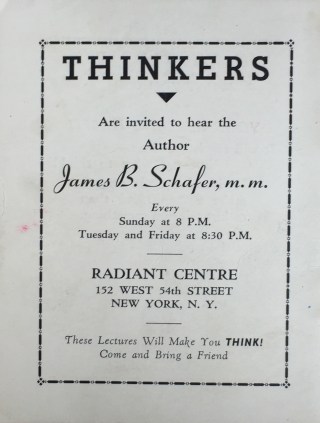
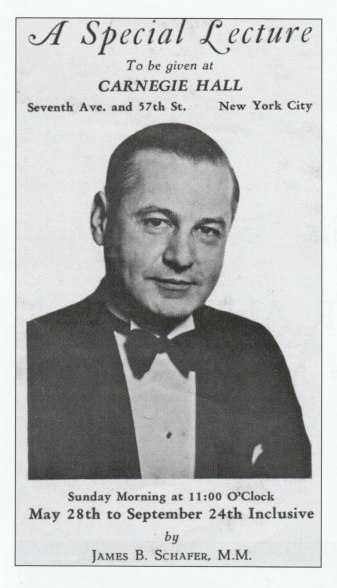
After the three-month period, I attended a metaphysical group just two short blocks away—Dr. Schafer’s group (James B. Schafer, in an auditorium located at 217 W. 57th Street).  And he would call the students up to the front and ask them to give a talk to the group.  And when he— the first times he called me, I told him I didn’t want to go up.  He sort of bypassed me.  And then, after he stopped asking me, I realized, “This is silly.”  The only reason why I wasn’t doing it was that the old tendencies remain, but the effectiveness of them is totally gone.  The compulsiveness is done away with, even though the tendency remains.  It’s like a burnt rope: it looks like a rope, it seems to be a rope, but it has no strength.  If you go to pick up a burnt rope, it just falls apart.  So seeing that, I volunteered to go up and give a talk.  First time in my life.  Here I am, up in front of a group of about sixty people, talking on frequencies and vibrations.  And I got up there and I was so surprised.  I wasn’t nervous.  I was looking at them, they were looking at me, and as I was talking I had a second thing going on in the background—”Gee, this is easy!  I never knew it was this easy!”  And that was my first experience in my lifetime of getting up in front of a group and talking.  And that was probably 1953.

Schafer Carnegie HallIMG_2074

“I realized that I was responsible for everything that was happening to me.”

From No Attachments, No Aversions:

I was beat up when I was a kid for being a Jew.  In high school I was often ostracized and attacked.  In college I joined a Jewish fraternity.  The fellows I played touch football with in a non-Jewish fraternity across the street wouldn’t talk to me if they met me at a college dance.

 While working for Kelvinator as an engineer in 1936, the senior engineer said to me one day, “You know, Lester, before I met you I thought all Jews and niggers were the same.  But now I think the Jews are a little bit better.”

At the Maritime Commission in 1941 I was surprised to meet strong anti-Semitism amongst my fellow engineers.  When I first walked into the the Commission, an elderly engineer said, “Come here.” I walked over to him.  He asked me if I was a Jew.  When I told him, he said, “Well, I hate all Jews.”  When jobs were extremely scarce and I needed work, I was first accepted and then turned down by the Manhattan Project because I was a Jew.  I never was sorry about that one.

I’d hear remarks all the time, everywhere, on the streets; I was never away from it.  This went on all my life until I gained my freedom and realized that I was responsible for everything that was happening to me.  Then it stopped. (pp. 47-49)

Screen Shot 2020-05-23 at 7.47.28 AM

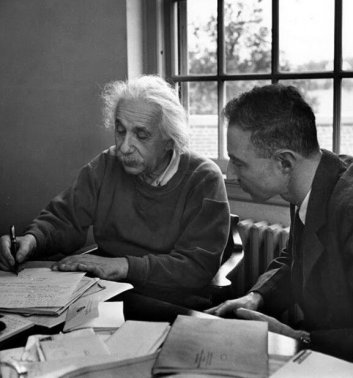
Einstein and Robert Oppenheimer, head of the Manhattan Project, c. 1950

The supersensitivity drops away because your ego drops away, whereas before I was hearing them all the time.  If I heard someone coming out with an anti-Semitic remark, or an anti-any-other remark, I had compassion for them.  I saw them needing, so I just had a feeling of more love for them because they needed it.  The only one they were hurting with their “anti” was themselves; they can’t hurt anyone else with it, unless the other one wants to feel hurt.

“The only real beauty is you yourself”

And once I was on Madison Avenue, or Fifth Avenue—I forget which—where the most beautiful and very best-dressed women of the world go shopping during the daytime.  I looked at them looking in windows on those very expensive shops.  And I looked at them, and I looked at the mannequin, and I looked at them again, and I looked at the mannequin again.  I did it a third time, and I couldn’t see any difference!  And I said, “Holy mackerel, and that’s what I thought was beautiful?  They’re just mannequins!  They’re interested only in the outer skin of their body—dressing it, pampering it, spending untold sums of money on it; and the only real beauty is they themselves, not the outer skin.” So what became beautiful to me was a person of high love, the soul of a person.

Fifth Avenue 1952

And I remember an incident where I was saying with two fellows about a girl I had known, “Gee, isn’t she beautiful!”  I could tell by the way they looked at me there was something wrong.  And I said, “Well, isn’t she?” and they shook their head, “No.”  And I looked again, and I says, “Oh, I see what you mean.”  And she was, in their eyes, or in physical eyes, a homely girl; but she was quite spiritual.  That isn’t the right word—she was high in her capacity to love.  And basically that’s what is behind all beauty: love.  Can you see it?  So my concepts of beauty did a flip-flop.  The ones I thought, “Oh, they’re the most; they’re the greatest” turned out to be like mannequins, and others whom I would have thought horribly homely turned out to be beautiful.

I was so at-home anywhere and everywhere, and Dr. Schafer’s classes where he taught—always the finest.  Everyone was so well dressed and so neat and so proper, that I had the nerve to come in with a beard and my hair not combed and dirty slacks on.  Of course, everyone noticed it, but very properly, no one said a thing to me.  And I sat there, one-hundred percent as ease, in spite of all of them looking kind of dagger-eyed at me.  I did it on purpose to prove to me that I had no reaction, no ego left.

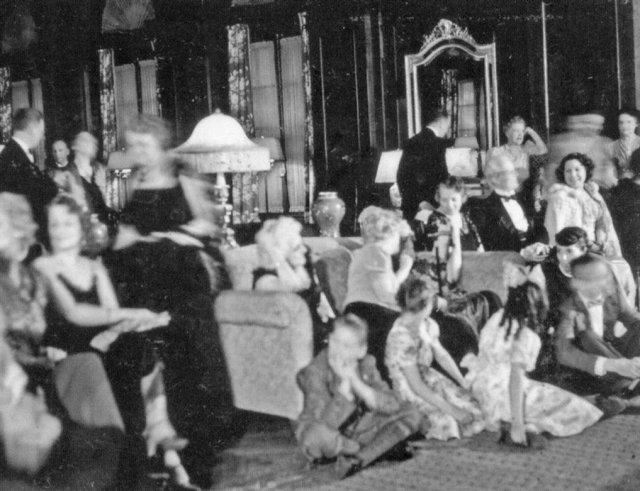
Peace Haven ballroom

This photograph, taken around 1940, shows a well-dressed group of Schafer followers gathered in the ballroom at Oakdale.

“I only know that which I can do”

I always held a maxim back in my mind that “I only know that which I can do,” which is an excellent check upon oneself.  “I only know that which I can do.”  And so I would do it, and test it out, and if I did find any reactivity, if I did find anything not up to perfection, I immediately went to work to correct it until it was the ultimate and that particular thing was achieved.  I did everything to the extreme limit to be sure I had nothing left on it, no more hangups on any particular thing.

The trip to L.A. was for the purpose of proving what I had discovered and knew, and always with that maxim, “I only know that which I can do.”  I believe I went step-by-step from smaller to bigger and bigger things; that’s what I was really doing.  That was a big one, to walk out without any money and go to Los Angeles.  And so I packed my bag, walked out of the apartment, with absolute full confidence that I was on my way to Los Angeles, with no doubt that it would not happen.  And so it did.  And it’s not a test, it’s a proving.  Test implies doubt, and any doubt would stop it from working.  I went out without money because I wanted to prove I could have anything I wanted without money.  Well, you don’t need money to—when you demonstrate things you never think of money.  You never should think of money, because instead of the thing, you will end up with money.  But thinking you need money to do things is a doubt.

From a former student:

“The class was full, so I rented this room to just come here and release,” I said.
“What are you missing?” Lester said.  “You got me here, you’re right above the conference room, and you have a room in the same hotel they were chasing other graduates away.  Somebody up there likes you.”
“And I got it for a great price,” I bragged.
“You know you could have gotten it for free.”
“How’s that?” I asked.
“I used to do that all the time.  There’s nothing out there but your thoughts.  Your consciousness determines everything, so if you believe it is free, it will be.”

I remember one time when he came out to Los Angeles.  He showed me his Southwest Airlines ticket—it had CANCEL written all over it, but he had just used it!  He did things like that all the time. (Seretan, 2008)

Really, higher consciousness determines for lower consciousness; that’s why people serve me.  Yet, it’s true for everyone.  Whenever we think, every molecule in the universe moves to fulfill that thought.  And I knew I was going into that movie.  Most people think negatively and are creating that for themselves.  Most people think with very much limitation and create that for themselves.  But I was thinking—I was knowing I was going into that movie, I was so absolutely convinced that it had to happen.  But there’s only one mind.  There’s only one intelligence, and we are all in it.  And so this man’s mind was turned and tuned in my direction.

If everyone were in harmony, there would be no waiting in line for tickets; there would be no one clamoring around a box office trying to get them.  When everyone’s in harmony, there are enough seats for everyone, and everyone walks right in without needing a ticket.  You don’t even have to pay for it.  Nature provides in superabundance when we get in tune with it.  There would never be such a thing as shortages.  There is unlimited infinite energy available to us, as well as a superabundance of everything we would want to use.  That’s when you’re in tune with nature.  Really, no effort is needed when you’re in tune with nature.  Effort is required when you’re working against nature, when you’re not in tune with it.  This world was put here for our use and play.  The idea of nature needing to be conquered is a very negative idea.  What needs to be conquered is our negative ideas, and then only positive things happen.

Anyone who has the absolute conviction of anything causes that thing to come about.  Anyone who has the absolute conviction that he can be a millionaire can be a millionaire.  This requires there be no subconscious doubts, because the unconscious doubting would get in the way.  When you’re up in tune with the universal mind, which everyone is in, your power of its use, your ability to use it, is greater, really, than others’, and it affects them that way in your direction.  It’s a high state of love.  You’re swimming in a high sea of giddiness in which everything— and you love everyone.  You could even go up and hug and kiss a tree.  And that goes over to other people and causes them to want to love you and do things for you.

Gaining and losing fortunes

I struggled to keep the businesses going, but inwardly I had lost interest.  And I struggled because I knew that was the right thing to do—you don’t take a going business and walk away from it.  I went into it to make money, so I kept struggling.  But at the time I was not aware that, subconsciously, I had lost interest in it because I was not getting what I wanted.  I was seeking happiness.  And when I was terribly involved in building up the business, I was so busy, I didn’t have to bear with my own inner thoughts that I could not stand.  When the business became successful, there was time on my hands; I wasn’t plagued by the problems of it like when I was building it up.

And there was always a relief when those businesses collapsed, I remember.  There was always a relief.  You see, at the time I wasn’t aware of it, of this happening.  It was was only after realization that I became aware that I was the cause of it collapsing.  At the time I thought, “They did it to me.”  I blamed the loss of the Hitching Post (three restaurants serving French-dip sandwiches that he started in 1938) on the war and business having dropped off for a period of time.  I blamed the loss of the lumber business (a large sawmill and planing mill in New Mexico) on the big operators dropping the price of lumber.  But there are ways out of that and I didn’t take them.  I wasn’t really wanting to; I wasn’t interested.  But I wasn’t aware of the fact at the time.

Screen Shot 2020-05-20 at 6.57.29 PM

Exchange Buffet NYC 1920s

“Human love is selfish; divine love is completely selfless”

Love is something we can’t turn on and off [for different people]—either we have it or we don’t.  It’s impossible to love one person and hate another.  We can only truly love people to the degree that we love our enemies—hatred for even one person limits our capacity to love others.

What we usually call love is simply need for that person.  When we say, “I love this person but not the next,” we feel that we need this person, and therefore we’ll be nice to this person so we can get what we want.  But that’s not love.  Human love is selfish; divine love is completely selfless.

When I first knew Virginia (around 1934), she had gotten very sick.  And I dutifully visited her and spent a lot of hours with her when she was in not too attractive a condition.  And she had thrown up on a chair, and I sat down in it.  And she was so horrified and apologetic about it, and I very gallantly said, “Oh, that’s nothing at all.”  I said, “I don’t mind it one bit.”  And I just wiped my pants off and sat down.  That was being nice to her to win her over, and I knew it would, and it did.  So I went back to this incident, and I saw that at the time I was really very annoyed and very uncomfortable, but I acted as though it were nothing only to win her.  And when I saw this selfishness, I resolved, “Uh-uh.  This I dump, this I let go of.”  And I changed the feeling right there and then of wanting to do this just to get her my way, to one of just feeling love for her.

Each time I would see these incidents, I would first recognize that it wasn’t love, and then I would let go of that and I would feel love for the person, which is a nice feeling.  You like and approve of that person the way they are; you accept them just as they are. T hen I knew I had it. T his was good news to me because, like in other things, I was able to carry it to the extreme.  I could love people who were opposing me.

Changing a feeling I had in the past can help me now because when I review it and I see it was non-love, I feel love in that incident right now. S o I’m converting what was non-love to love at this present moment.  When I now review something that was not with a feeling of love, but right now I feel love, I am at this moment increasing my loving.  I use those incidents again and again to turn on love and feel it and learn to love.  In those former incidents I was trying to get love, and not feeling so good as I could feel right now when I feel love.

“The only limitations I have are the ones that I accept”

One can, if one wants to, become a millionaire.  Every person could be a billionaire, or a trillionaire, or a quintillionaire, if that were his consciousness—that this truth that I speak of works.  Your inner conviction does it.  Your thinking does it.  When your unconscious thinking that is negative on a thing is overwhelmed by the conscious thinking to the contrary that you can, then you can.  Right now you’re unaware of what you had for breakfast yesterday.  But when I mention it to you, you start thinking on it, you start looking for it, and those thoughts come up into consciousness.  You remember: I had bacon and eggs, or a rasher of bacon.  Before I asked you that question, you were not conscious of the fact that you had a rasher of bacon for breakfast the day before or a week before; but on my asking you that, you brought it from the unconscious into consciousness.

I always had the idea that a draft would give me a cold, and it used to actually give me colds.  One day thinking on it while I was sitting in a breeze, enjoying it, I said, “Boy, this is the same thing that I call a draft that gives me colds, and here I’m enjoying the thing and not getting a cold.  It was a cool breeze.  And I said, “That’s silly, to hold on to that thought that a draft gives me a cold.”  And after that, I never got a cold again from the draft.  I changed that unconscious thought that drafts give me colds to one that a breeze, a cool breeze, is nice and does not give me a cold.  That actually happened to me.

Thoughts are the only things that damn up the infinite being that we are.  But they don’t necessarily have to: we can have large thoughts.  For instance, “I’m a billionaire,” “I can be a billionaire,” or “I am a billionaire.”  “I can fly like a bird.”  “I can swim like a fish and run like a deer.”  But we’re absolutely convinced in our thinking that we can’t run that fast.  So, our thoughts are our limitations, and even a large thought is limited to the largeness of it—it’s still not infinite.  You can always have more, can’t you?  And more and more and more?  And that’s what would happen in your thinking: you would always have more and more and more and more and more.  First you won your $100,000, then you want a million.  Then you want more millions.  Then you want hundreds of millions.  Then you want billions.  And then hundreds of billions.  And today, we have trillionaires.  And the trillionaires won’t stop—they’ll try to become quadrillionaires.  After they become quadrillionaires, they’ll want to be quintillionaires.  After they become quintillionaires, they’ll want to be septillionaires, octillionaires.  The thoughts determine the amount of the infinity that manifests for us; so, you drop thoughts of limitation and take on thoughts of less limitation.

28 Subhuti, suppose a Bodhisattva, in the practice of giving, filled as many world-systems with the Seven Precious Treasures as there are grains of sand in the Ganges River.  If there is a man with the awareness that all things are empty of self, and if he accomplishes their complete extinction, then this is superior, and the merit accumulated by this Bodhisattva surpasses that of the former. The Diamond Sutra

I was so ill when I started; I had one foot in the grave.  And when I saw that my thinking was the cause of what was happening to me, I immediately saw my body, from my chin down to my toes, as perfect.  And instantly I knew it was perfect—I never even thought of the idea of checking it out.  I knew the lesions and adhesions of my intestines due to perforated ulcers were undone.  I knew everything within me was in perfect running order, and it was.  And as I saw that the source of all intelligence was right behind my mind, that my mind was filtering through bits of it, I allowed more and more of it to come through.  And digging for it is wanting to know, “What am I?” and seeing my Self revealed more and more with less and less limits on it.  I wanted to go all the way on it.  And I began to see that the only limitations I have are the ones that I accept.

So, looking for this unlimited being, that I already had an inkling that I was, I got insights of this tremendous unlimited being that I am.  And I’m seeing that, and right there and then I realize, “Wow—I’m not this limited body that I thought I was.  And I’m not this mind with its limitations that I thought I was.“  And I undid all body limitation, and almost all mind limitation, just by saying, “I am not it.”  Finished, done, period, that’s it.  It was obvious to me that I wasn’t that body and mind that I had thought I was.  I just saw it, that’s all.  And I let go of identifying with this body.  And when I did that, I saw that my beingness was all beingness; that beingness is like one grand ocean.  It’s not chopped up into parts called drops of bodies.  It’s all one ocean.  Which caused me to identify with every being, every person, and even every atom in this universe.  And that’s an experience that’s so tremendous, it’s indescribable.  First you see the universe is in you.  Then you see the universe as you.  Then you know the oneness of this universe.  Then you are finished forever with separation and all the hellishness that’s caused only by separation.  Then you can no more be fooled by the apparent limitations of the world.  You see them as a dream, as an apparency, because you know that your very own beingness has no limits.

And should you choose to express your abilities, you can.  However, you don’t, because of your compassion for others, and the fact that they cannot take it.  You hold it in the background; you hold it away from them rather than impose upon them.  That’s why masters rarely ever show their abilities: they want others to discover that they have all these abilities.  Nothing is impossible when you get into that state.

“Who am I who has this body and mind?”

There’s only one mind, and if we’re in tune with it, everyone fits together perfectly; no one has to be told even what to do.  When I saw that the mind was mine, that the body was mine, I began a question: “Who am I who has this body and mind?”  And what I saw was that I was unlimited beingness; that this beingness was the cause of everything, and yet was not subject to whatever it caused or created.  And this beingness being unlimited, the only limitation was created by the mind limiting itself, or by my limiting the action of my mind.  Beingness is simply existence, is-ness, am-ness; it’s the I that I am. It’s the “I-ness” of me.  And that part is without limitation.

When you discover this, the first thing you recognize is that there’s no need to be a victim of your environment, to be a victim of nature.  That you can consciously create your circumstances to be the way you would like them to be.  And from then on, your consciousness is one of, “I have everything I need.  Everything is in perfect attunement.  Everything is okay.  Everything is good.”  And because of that consciousness, that becomes your world.

Everyone makes his world by his mental conceptions.  Everyone sees the world in accordance with his ideas and conceptions.  If you don’t like the world out there, change your thinking, and your world will change.  Now, of course, your thinking includes your subconscious thinking, the thoughts that are in your mind that you’re not looking at.  Any thought that I’m not looking at at this moment is unconscious.  The moment I look at it, we call it consciousness, or conscious.  So, the unconscious thinking is the stored-up accumulation of all our past thinking that we’re holding in the background, and not looking at it for the moment because we don’t want that.  It’s what looks to us like a tremendous piece of work to hold in consciousness everything from the past, and so we store it in the background and we call it unconscious.

The unconscious thoughts are effective whether we look at them or not at the moment.  And the only way to handle them, change them, is to make them conscious; and then on a conscious plane we can change them.  That’s what I was doing while I was making this tremendous growth.  I was freeing myself from all the former concepts of limitation that I had accumulated, until I felt no more limitation; until I had no more, hardly any more thoughts of limitation—if you let go of all of them, you’d disappear, because the body is a limitation.  The body would disappear—you wouldn’t disappear.  The logs in the dam are the subconscious thoughts, which when they are pulled out, [allow] the infinity behind the dam to flow through you.

Photo credits

James Schafer Carnegie Hall notice and Schafer’s Peace Haven ballroom are from Holliday and Kretz (2010). Images of America: Oakdale. Charleston: Arcadia Publishing.

Lester Levenson: Keys to growth

Five practices to achieve growth

1. You must want freedom more than you want the world.

2. Take all your joy from within by releasing.

3. Make the decision to go free, and then do it.

4. Release directly the fear of dying.

5. From now on, get everything you want by releasing. Be not the doer.

6. Make your behavior that of a master.

(https://youtu.be/UaGiQtbYiio)


SPIRITUAL GROWTH

The best place to grow is right where you are. The best time is now.

The Self

Your effort should be for proper identity. Identify with your Self.

The ego

The whole object of the path is to let go of the ego. What remains is your Self.
**
Growth is transcending your false self, your ego, which is no more than an accumulation of habits.
**
Whenever there is an emotional reaction, there’s ego.
**
Whenever there is effort, there’s ego.
**
If you aren’t making progress it’s because you are holding on to ego. Return to releasing.
**
No matter how far we have advanced on the path, the ego is always a treacherous companion that can take us off the path.

Happiness

Happiness is what tells us we are going in the right direction.
**
There is no happiness except that of experiencing your Self. When you see that, it makes the path very direct. You stop chasing the rainbow and you go for the happiness where you know it is, right within you.
**
The first teacher is misery; it is usually the first thing that causes us to seek the way out. We start on the path in order to escape misery, but then we experience the Self and we keep going because we have found pure happiness.
**
It’s actually a path of taking on more and more of your natural state of being infinite. You give up limitation, you give up misery, but you never give up anything worthwhile, you never give up anything good.

Challenges

Everything that happens can teach us something. There is no event that we can’t learn from.
**
Adversity helps you grow more quickly, so welcome it.
**
Everyone can be our teacher. If we react to praise or approval, that is the ego. If we’re depressed by criticism or disapproval, that is ego. When we are our Self, there is no reaction.
**
Every experience that causes pain is a blessing in disguise. Change your wrong thinking and you will come out stronger.

Conviction

It is necessary to do away with doubts. If any doubts arise, release them just as you release other feelings.
**
The moment we decide to be the Self—really decide—it is so!
**
We should expect to go all the way. Every one of us is born with the ability to do it in this lifetime.
**
Whatever your expectations are, raise them higher. Expect no less than infinity.
**
You will move as quickly as you expect to. To move more rapidly, expect it!
**
Every impossible, no matter how impossible, becomes immediately possible when we are completely released on it. And you know you are completely released when you just don’t give a damn.

Gains

Every gain is yours forever.
**
Every gain is an eternal gain. Every step forward you make now is forever.
**
We climb a ladder and each time we get up to another rung we forget about the rungs below. Then, when we get to the top, we kick the ladder away.

Focus only on yourself

Focus only on yourself, never on others.
**
You can’t help other people any more than you can help yourself; therefore, the best way to help others is to help yourself.
**
The moment we begin to concern ourselves with what others are doing, we turn away from what we are doing.
**
Giving advice is the ego playing God.

Knowledge

Knowledge has to be experienced.
**
It takes more than faith: it takes knowledge. You start with faith, but you must convert it to knowledge. You must experience it first-hand, and then you know it.
**
Studying the illusion helps make it real. If you want to know the truth, don’t study the opposite.
**
Don’t try to complicate it; it’s the simplest thing in the world.
**
It would be so fast if people would, with constant, intense effort ask: ‘What am I?’ When you get the answer to ‘What am I?’ then you have mastery over your body and mind.
**

You may see fully who you are and not be able to maintain it. What happens is that, being the infinite Self, we can get a glimpse of the infinite, hold it for a while, and then suddenly feel as though we’ve lost it. The reason for that is that the mind has not been eliminated. The subconscious thoughts of limitation are submerged for the moment. You may go completely into your Self and let go of the mind temporarily—you haven’t eliminated the mind, you just momentarily let go of it. So there you are, for the moment, totally the infinite Self. However, the mind that has been submerged reemerges, and then the ego takes over and you just can’t understand what happened to you, what brought you back into the heaviness of the world again. What is required is that we re-establish that state of the Self again and again until it becomes permanent. Each time we do it we scorch more of the mind until finally we have scorched the entire mind. Then we are permanently established in the Self. Then you sit back and the mind is out there and the body is out there and you are not the mind, you are not the body. As long as you know you are not the mind and the body, both of them can go on to their heart’s content, and you know that they cannot touch you.

* * *


Lester Levenson: The Ultimate Freedom

Why don’t we, who are all infinite beings, who have all the power there is in the universe behind us, know that we are that way? Why don’t you know that you’re infinite? You’ve heard it again and again and again. You’re inherently totally free, perfect, all-glorious, all-everything. You’ve heard it, some of you, for years. Why don’t you see it?

Isn’t it ridiculous? Isn’t it stupid? Why do infinite beings like you come to hear another being talk to you? Because in the first place you do not believe that you are; you will not accept that you are. You think, “Yes, it sounds nice, but . . .”  There’s always a “but,” “but,” “but,” “but” going on, and this “but” is butting you down all the time. If you only wouldn’t “but” it, if you would only accept it, from that moment on you would put all your effort, all your energy, into seeing this terrific being that you are.

I say you don’t want it, you tell me you do. And this is the important point: you don’t want it. And until you face up to this, until you confront it, you can go on forever and ever and a year more saying, “Oh, this is what I want; I’m on the path; I’m seeking freedom.” And you can do this lifetime in and lifetime out forever, until you will actually accept the concept intellectually that, “I am infinite, and therefore it is ridiculous and stupid to live the way people live in this world.”

You happen to be in the most hellish hell there is in the universe — and fortunately so, at the same time. We are living in almost the most limited state possible unto beings anywhere in the universe. We could go down lower — we could become animals, and animals are beings who also eventually discover their limitlessness.

Earth realized that it was by nature alien and unlike to heaven, and so it fled from heaven to the lowest place. And that is why the earth remains motionless, so as not to approach near to heaven. And the celestial nature grew aware that the earth had fled and occupied the lowest place, and that is how the heavens came to empty themselves out in fruitful fashion over the earth. – Meister Eckhart, Sermon Sixty

But isn’t it stupidly stupid to live a life with the extremest of limitations if you believe that your natural state is infinite? This is why I say you don’t really believe that there are no bounds on you, and you prefer to be an extremely limited physical body, to be cherished, to be– well, I don’t want to get you women angry with me, but I was going to tell you what you do. You know what you do all the time, and the men are not far behind you — they’re very vain. We put on nice clothes, and we dress ourselves, we scrub the body, and we paint it in the morning, and — men do these things too — and we put the less-liked part of it, and we take it off to work. Why? So you can maintain that extremely limited state of needing food and clothing in order to survive.

Working is only a concept of limitation:“I must work in order to live.” If we had the conviction that “I must sleep eight hours a day in order to live and survive,” that’s the way it would be. You would just sleep and everything would come your way. Because whether you like it or not, you’re unlimited beings. Whatever the mind holds becomes so. The mind is only a creator. The only creator in the universe is you. You think, things happen. And you’re “happening” everything that you’re meeting with every day. You have established this extremely limited state of beingness called a physical body, and you’re holding on to it for dear life.

I’m trying to point out to you that you really don’t want to be this unlimited being. You really don’t want to be totally free. You want to have this limitation, and you want the limitation to be nice, delightful, entertaining. And it just can’t be. And you struggle your entire life trying to make it so. And you die, and you have a vacation on the other side, where you’re far better able to think and immediately have things happen. And then you come back into a physical body, and you keep working through this physical body until you are able to free yourself from the physical body while you are in the physical body. You can never get free of it anywhere else but from within it.

So the thing to do is to recognize how much you don’t want this state of freedom. It’s the first thing you must do — you’ve got to confront it. Because if you really wanted it, it would take you weeks, maybe months, to become totally free, to become omnipotent, omniscient, omnipresent.

So, I’ve answered the question. The reason why you don’t get it is that you don’t want it. All right, now you’re going to say to me, “But I do want it.” And I’ll say, “Yes, you tell me that, but you don’t show me that.” You say you want to be totally free; you don’t want to be this limited vehicle, and the next moment [you] procede to be this limited vehicle — the next moment and every moment. It’s very rare that you don’t think, “I am this body.” And being this body confines you to it. Change the temperature 40 degrees, it dies. Give it a chemical called a poison, it dies. Don’t give it oxygen, it dies. Why do we want to be this terribly limited thing? You’ve gotta confront these things before you’ll ever let go of it.

Are there any questions on this point? I think it’s a very powerful point. If you will get to see what I’m presenting to you, it will only be a matter of weeks or months before you can and will be what you really are: totally free, limitless.

Question: Isn’t it fear, fear of the unknown that holds us? Or is it a feeling that we don’t deserve it? An old childish feeling that we don’t deserve this?

Okay, asking me, I would say it’s a conviction that, “I am a body” that does it. And therefore, if I am a body, anything can hurt it, and therefore I am very fearful. Somebody might hit me with a car, or I might eat the wrong food, or a little cool breeze might come on me and do away with me. It’s the conviction that you’re the body that makes you fearful.

Now, beingness has no form, no action. It’s static; it’s changeless. And yet this is the thing you’re holding on to when you say “survival”: it’s the “I” continuing. That beingness is the infinity. But when it tries to be a limited vehicle and keeps its attention on the limited vehicle, it thinks it’s that limited vehicle all the time. And this is what we’re doing. We’re looking at this body every moment, saying that this body is “I”. It’s very simple. And what I’m suggesting is, let it go and concentrate on discovering your Self. If you would put your attention only on your Self, you would very quickly discover it. Weeks, months, that’s all. Anyone can do it. And the reason why we don’t do it is because we don’t believe it, we don’t accept it, we hear it, and we say, “Yeah, yeah,” and the next moment we go all-out in being a very limited vehicle called the body.

To help you not fear so much, I can tell you that you don’t lose the body after realization. Christ had a body — Jesus walked around. He had full realization. In fact, he had it before he was born. When you get realization, you don’t lose the body. You lose your concepts of limitation of being only a body. In place of it you first see that you are every body, then you see that you are every thing, then every atom, and then in the ultimate you see that you are all beingness, and that all energy and matter was an illusion, a fiction that you created and set up. And after that, you look at your own body the same way you look at other bodies — objectively. And the body can never again disturb you. It can never again disturb the deep, wonderful, profound peace that you are.

So you don’t disappear upon realizing who and what you are. You don’t lose a body. First, you gain every other body in the universe. So I’m trying to bait you now — since you love the body so much, be a million bodies! And when you are a million bodies, you are close to seeing your ultimate state of pure beingness. But I hope I’m leaving you with a provocation. I’m trying to provoke you into looking at yourself and recognizing that you really don’t want this infinite being that you are, that you really want to play as though you are a limited body. And therefore, you’re not quickly discovering who and what you are.

If there are any questions, I’d be very happy to help you if I can.

Question: How did you arrive at the fact that we have to gain realization in the body? Why can’t we just die and be [Self-]realized?

Because as long as you are a body, you have very strong convictions that you are a body, and you’re holding it in your mind, and you’ll always be a body again and again and again until you let go of the desire to be a body. So, it’s while you are in the physical body that you have to let go of all desire to be a physical body. Now, that word “desire” is a very powerful word. The only reason why we have bodies is because we desire them. And the only reason why we are limited in any way is because we desire limitations. Become desireless and you are unlimited.

Question: Is it all that we can conceive? Do we conceive we have to have a body because we always had one, and so it goes on and on?

It’s a matter of choice. Whether you face it or not, you’ve chosen to be a body. If you will dig within you, you will discover this.

The real culprit is the thing called the unconscious mind. The unconscious mind is a storage closet of thoughts. We create thoughts, we put them back in the subconscious, and then we act as though they are not there. Every subconscious thought is just as active as any conscious thought is. But we have created this mechanism of subconscious thinking. And the subconscious thoughts are only the conscious thoughts that we’re not looking at at this moment. And right now there are millions of thoughts going on in your mind. You bring to consciousness a few of them at a time, but all those millions back there are active. And this is the greatest difficulty. It was a very handy mechanism in the beginning — it was an automatic pilot. When we became more and more involved with thoughts, we put them on automatic and stopped looking at them. And we are now running on automatic, called the subconscious mind. And this is your greatest difficulty. If you could make the subconscious conscious right now, you would be [Self-]realized, because you would see all this limitation that you set in motion in the past that is now continuing invisible to you all. And by making it visible, naturally you’re going to drop all the limitation.

Keep your attention focused on you. If you would do this only for weeks or months, you would get full [Self-]realization. I say “only,” which means not stopping it and looking at, “I am a body with problems.” It would be very quick.

Question: Are there degrees of Self-realization?

No. There are degrees of letting go of self-imposed limitations. You see, you’re Self-realized here and now, holding on to concepts of “I am not realized.” So, there is no growth into the unlimited state; that is. there is an apparent growth of letting go of the self-imposed limitations.

You’ll never ever be satisfied living life in the world — or in any other world, or in the heavens. There are heavens on top of heavens on top of heavens. We happen to be in the hell-realm of the heavens. And you’ll never, ever be satisfied until you go to the ultimate. Until you recognize it.

Question: How can we know we’re [Self-]realized when we are?

By being it you’ll know it. When you’re Self-realized, you see no otherness: there is only “I all alone.” It’s a point of view that you will have that will be just that way, even though that apparency of a body will be moving around on an apparent Earth, talking to apparent other bodies. But you’ll know it as an apparency, as an illusion. And you will see only oneness. But, again, it has to be experienced. You can experience beingness.

Question: Doesn’t it get boring after awhile?

No, it’s what everyone wants more than anything else in the world. It is the most satisfying; it’s the greatest satiation possible. You’re looking for it all the time and you’re asking me, “Will it be boring” — you’re seeking it in everything you do. Your every act is seeking this. You’d be surprised how simple everything is that seems to be complicated, once you see the truth. If we wanted the ultimate truth as much as we want to be a body, we would have it in a matter of days. That’s how simple it is.

 
Walshe, Maurice O’C. (2009). The Complete Mystical Works of Meister Eckhart. New York: The Crossroad Publishing Company. (download)


Lester Levenson: Identify with what you really are

Man is the dwarf of himself. Once he was permeated and dissolved by spirit. He filled nature with his overflowing currents. Out from him sprang the sun and moon—from man, the sun; from woman, the moon. The laws of his mind, the periods of his actions, externalized themselves into day and night, into the year and the seasons. But, having made for himself this huge shell, his waters retired; he no longer fills the veins and capillaries; he is shrunk to a drop. He sees that the structure still fits him, but fits him colossally. Say, rather, once it fitted him, now it corresponds to him from afar and on high. He adores timidly his own work. Now is man the follower of the sun, and woman the follower of the moon. Yet sometimes he starts in his slumber and wonders at himself and his house, and muses strangely at the resemblance betwixt him and it. He perceives that if his law is still paramount, if still he have elemental power, if his word is sterling yet in nature, it is not conscious power. – Ralph Waldo Emerson, Nature (Chapter VIII)
[Beginning of recording] . . . in a way that will help you identify better with that which you really are, and with a lot of helpful hints on how to identify with the real you: the you that never, ever changes; the you that is whole, complete, perfect; the you that you’re trying to get to in everything you’re doing; the you that you’re looking for where it isn’t—externally. One reason why I say it’s easy is because you’re trying to find you. How difficult is that? Also, at every moment you’re experiencing the real you, plus at every moment you’re looking away from it. But you can’t help but experience the real you: when you say “I,” that’s it. “I am.” It’s the beingness that you are that is you. How many of you expect to have these carcasses a thousand years from now? A hundred years from now? Even fifty years from now? But we should look toward the part that we really are, bring it out, identify with it, make it part of our conscious living. “I am I.” Get the sense of only “I, I, I, I.” “I am.” “I am what I am.” Are you? You say yes. Okay, that’s it. Just be that only, and you’re in the ultimate state that you are striving for all the time with misery. Misery is moving away from that state. The only happiness there is, is being in your beingness. What you’ve heard me say is that you’re just quieting the mind by satisfying the desire, and when the mind is quiet, you’re just being, and that’s the happiness you feel. That’s the only happiness there is. How many have already discovered that? That there’s only one single happiness, that it’s when you’re being your beingness? Okay, that’s a big assist because it should alleviate, do away with all that effort, looking for it out there in a million different directions. Now, that doesn’t stop you from doing what you’re doing out there. It doesn’t matter what you do. What matters is your attitude toward it, your understanding of it. But it sure makes life easier when you identify with your beingness. Try to get yourself placed on the scale of where you are. It’s good to see yourself objectively, which you’re probably discovering with the TV. There’s a double benefit you get from the skits. One is that when you start, all your garbage, your emotions come up for releasing. And then when you watch it, it’s entirely different, isn’t it, when you watch it? Because the first part is very subjective: it’s me with all my garbage. And it’s not what it looks like objectively. We don’t see ourselves the way we really are, so when we come back and look at it, most of us want to hide, don’t we? “That’s not me—I didn’t do that.” But when you see yourself objectively, it helps you move into the points of garbage you are very much avoiding. So when you identify where you are, and you see it objectively, you can say, “Boy, I’m on the first step” or “I’m on the tenth step. I’ve got to move.” So, identifying is part of seeing yourself objectively. And there are three parts that you think you are. [chart]

IDENTIFY WHERE YOU ARE:

1. YOU = YOUR BEINGNESS

2. YOUR MIND = PROGRAMS AND THEIR THOUGHTS

3. YOUR BODY AND WORLD

You are. That’s your beingness; that’s the real part of you, which sets up your mind and then develops all of these programs over the ages. And the programs motivate the thinking. The programs are your feelings. I don’t know whether any part of the world of psychology and psychiatry today accepts feelings as programs. They’re so blinded as to what they are, I think they accept them as being natural and right. Just adjust them a little bit so that things get a little better. But feelings are simply programs, subconscious automated programs, of how we react to the external world. And every one of them has been put in as a pro-survival program, in order to keep the body surviving.
Screen Shot 2020-08-09 at 3.48.57 PM

Is this any way to live?

How many of you have seen that, that all these feelings are survival programs? And that’s great [that you see that]. You get to see how silly it is when you’re trying to survive a situation that you are eternal in. And that’s what you’re doing. You’ve got no choice: you’re eternal. And all this struggle trying to survive. But wherein is the error? What are you trying to [keep alive]? The carcass. As I used to say, if you’re driving around in a car, it’s your case; it’s got you closed in there. So has this “car-case.” So, in your beingness, you create your mind and start programming everything, and you think you are the body, and you think the world is external to you—after you have created it. You [forget] that you created this whole thing, [that] it’s all created here in your mind. Change the picture mentally and it instantly changes out there—called the miracle. I believe most of you have experienced instantaneous changes out there. How many have experienced– what am I talking for? You know it! (laughter)
But there’s nothing out there but the sum-total thinkingness, most of which is subconscious, and therein lies the problem. Subconscious means, simply, we do not want to look at it. The mind is a tremendous mystery to the world because they don’t understand what it is. They can’t see the simplicity of it. It’s the sum-total of all of your feelings and thoughts, that’s all. How simple it is. It’s a collection of your feelings and thoughts. And everything you experience is via the mind. [If you become] unconscious, the mind’s out of the way–there’s no experiencing. So, try to identify where you are. Most of the time, are you identifying with your body and the world? The answer is yes—I wouldn’t let you answer that one. (laughter) But you can make it otherwise. You continue in what you are doing, but shift your identity from being the body, just to being. Identify with your beingness, and you just sit back and you watch the world go by. You get into the state of witnessing. You don’t even feel yourself moving, because you cannot—you’re omnipresent. When you identify with your beingness, you discover that you’re everywhere present in the entire universe. And should you choose, you could take a look anywhere in the universe without moving, because you’re there. You don’t even have to do astral travel. You’re omnipresent. Astral travel is in the mind; astral body and mind are almost one and the same thing. So, identify where you are. Make a decision to cut the journey short; go free. Why be in agony when you can be free? So, the real you is the beingness. The ego-you is two and three: your mind and your body. And the three states that you identify with are beingness, doingness and havingness.

YOUR THREE STATES:

1. Beingness is your beingness only

2. Doingness is your position in the world

3. Havingness is your possessions

And with this you can relate to the chart of emotions. The apathy (discouragement), grief and fear (are) down in havingness only. When you’re down there, you think that your welfare depends on how much you can have, and you spend all your time trying to make and have. When you move up into lust, anger, pride, courageousness, you move into doingness. Instead of thinking that your welfare lies in having, you feel you’ve got to be a doer. Of course, that’s an advanced state. Only five percent of us are doers; ninety-five percent of us are wanting to have. And we’re down so low that we put ourselves in the state of being a slave. We must have a job. Someone must tell us what to do and give us the food that we eat and the money to get our lodgings. The only reason why people work in jobs is that we have a slave consciousness; we’re down in havingness. Apathy (discouragement), grief and fear: that’s where most people are riding the majority of the time. Move up into courageousness, pride, anger and lust—then you get to be a doer, which is a much freer state than being a slave. Now, when you get into the state of “I can do,” you’ve got enough wish and will to move to the top, because you discover that when you’re just quiet and being, that’s the nicest thing there is. And with the doingness energy, you’ll work harder to drop the remaining limitations, the AGFLAP, so that you can remain and just be all the time. Now, that sense of beingness is not related to the world; rather, it’s related to how you look at the world. You watch the world go by. You watch yourself. You watch your own body moving around like you now watch other bodies. You’ll see your body objective to you as you see other bodies objective to you. So, try to move up to constantly identifying with your beingness. Hold “I am” or “I, I, I, I” only. “I am my beingness.” “I am.” “I am my am-ness.” And then when you get to be a doer, when you get to be the doer, then try to see that you’re not the doer, that all that is objective to you. Try to take the attitude, “I am not the doer.” Now what happens there is, you let go of the ego-sense of doing and shift into allowing the higher power, or whatever you call it, to do it. In religion they say, “Let go and let God.” When you let go of your ego-sense, you automatically move into your beingness. And that takes care of everything with no effort. And your life becomes totally effortless. And start from taking all your happiness from you. Recognize that every joy you have is that nice quiet place of just being, where your desires are out of the way. Even though you’re taking pleasure from the world, try to recognize that that pleasure is you being you: your mind is quiet.

1. Identify with everyone as being you

2. Identify with every atom as being you

3. Real knowing means being

Now, on the way, we should identify with everyone as being us. See everyone as you. And that’s what happens when you see that you are beingness, and that your beingness is all beingness, so then it includes everyone. So you see other people as you. Then try to identify with everything out there, every atom, as you, because it’s your making. And when you identify with it, you’ll get to see that you created everything you’re experiencing. It’s all in your mind, all that you’re experiencing. It’s all in your creative mechanism. The mind is only creative—it creates whatever thoughts we hold in mind.
And in the end, knowing means being.  You can’t get to know yourself.  That’s two things.  I knowing myself?  I AM myself.  So the ultimate knowing drops away into being.  All knowledge drops away into being.  You let go of all the accumulation that you spent lifetimes accumulating in the way of knowledge, because it’s all lesser knowledge than omniscience. It’s all limited knowledge, limited by the mind. And you let it go, and you discover your omniscience, your all-knowingness, after which you don’t have to work hard thinking. There’s no more thinking: you’re knowing. And in knowingness there’s no thinkingness.

1. See nothing out there but your sum-total thinkingness

2. There is in actuality nothing out there but your beingness

3. No objectivity, only subjectivity

So, see nothing out there but your sum-total thinkingness. By the way, I think it would be good if you would write this down, to be used in the future as a reminder, as a refresher. Write it down; you can use this in the future. This is stuff I believe you don’t read in books. Or do you read it in books? They’ll give it to you in one sentence, but not broken down this way. So, it’s good to have it where you can keep looking at it so you become It, with a capital I. This (pointing at number one above) is taking responsibility for everything that happens to you. What did I do to cause this awful thing? Develop that habit, and your initiating thoughts will start coming up and you’ll release them. So that negative happenings out there will stop. The less negative happenings, the more positive happenings, the quieter you life is, the easier it is to go on. If you’re constantly being plagued by death facing you, it’s difficult to release. But if your life is easy, you’re in a better place to release. You’re not so fearful of your programs anymore. You’ll be able to allow up the bottom program of the fear of dying, the fear of living, and you’ll release it. And when you continue this, see nothing but your sum-total thinkingness, then you discover there is in actuality nothing out there but my beingness. Which reminds me of Vivakananda. He said when you get to the end of the line, you discover that there never was anything but “I all alone.” I, my beingness, is the totality of all beingness, and that’s the only real thing there is. Your beingness never ever changes. Your beingness is eternal. And because it never changes, it’s the only truth. If something changes, then it was not true the moment before. For a thing to be true it has to remain as it is. And the only thing you will ever experience that does not change is your beingness, which you are right now. Identify and move toward your beingness. And then you reach the point where you begin to see no objectivity. Nothing is apart from me. There’s nothing out there but my sum-total thinkingness. “You are me.” “Every atom in the universe is me” is what you will see as you stay, as you identify with your beingness. Here we’re trying to scratch for little pieces of it, and the totality of it is ours—it’s our creation.

1. Totally quiet the mind

2. Be intuitive only

3. Do not identify with your body and mind

NO ATTACHMENTS AND NO AVERSIONS AND YOU WILL HAVE EVERYTHING. So we work and work, and release and release, until there are no thoughts. Now every one of you experiences moments when there are no thoughts. And it’s a tremendous state. But as long as there’s a piece of garbage left, it comes into play and pulls you away from that nice quiet place. And some of us think it’s the noise out there that’s real, not the beingness, and we move away from rather than try to stay in the state of beingness. And when you get there, you’ll be intuitive only. You’ll operate in the world without thinking. You’ll be offensive to no one. You’ll have answers for everyone. You can talk to people on their subject and help them. And as you’re doing it, you’re watching your body talking and answering their questions, and you’re listening to it just like they are. Sometimes you say, “Wow, that sounds good.” So, do not identify with your body and mind. What’s left? Your beingness, your is-ness, your are-ness, your am-ness, your existence-ness. That’s the part of you that’s real, whole, complete, perfect, eternal. That’s the part of you you’re struggling to get to in everything you’re doing. You’ll never rest until you get there. Summed up: Have no attachments and no aversions, and you’ll have everything. You’ll have the all. The universe will be yours. Why? It’s your universe—you created it. It was yours in the first place. And this is a little bait. Because you are wanting so many things, I’m telling you that you can have a piece of real estate, you can have the whole world, you can have all the other worlds, you can have the omniverse—if you release. Because it’s your creation. You could duplicate it and make two omniverses. But of course, when you get there, why do you want to carry that load on your back? You don’t. You let it be. And you just remain, identifying with your beingness, which is the greatest thing there is, barring none.

WORDS INDICATING THE FREE STATE

1. Imperturbability

2. Desirelessness

3. Effortlessness

4. Actionlessness

5. Witnessing

Here are words indicating the free state. This can help you in setting your goals. The word I like best is imperturbability: the place where nothing can ever disturb you again, the place no person can disturb you.
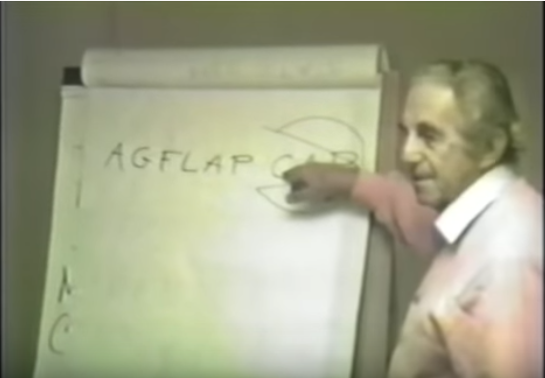
You just look at the other one and you allow the other one to be and want what the other one wants. Even if they want to kill you, how can they disturb you? You’re eternal. The greatest disturber of everything, the cause of all turbulence in the mind, perturbations, masturbations, everything, is desire. It just spins us into this tremendous swirl of what we’re into. Aim for desirelessness; aim to release all of your desires. Try to move towards less and less effort. Now, of course you’ve got to move up out of the havingness state into the doingness state before you try to make things effortless. But when you let go and identify with your beingness, things become effortless. And as most of you have heard me say, every impossible, no matter how impossible, becomes immediately possible when we become completely released on it. And you know you are completely released when you just don’t give a damn. (Asked to repeat) Every impossible, no matter how impossible, becomes immediately possible when we are completely released on it. And you know you are completely released when you just don’t give a damn. The sense of actionlessness, of not being the doer—work toward that. And toward witnessing everything that’s happening. Sit back and be the witness of it. But when you reach the top, all these things are in place; that’s the way you will be. Those are the five words that I like best for the top state. Pac-Man And so to close on a sense of humor, which most of you have seen, apathy, grief, fear, lust, anger, pride; [and on the other side] courageousness, acceptance and peace. We must get rid of the AGFLAP in order to CAP it. And coming from this side, CAP spells PAC. And this is the Pac-Man. The CAP is the Pac-Man that gobbles up the AGFLAP. But you need to get up here to gobble that up completely. It’s from the high points that you reach down into the suppressed fear of dying, allow it up so you can let it out. Okay, that’s the end of my talk for today. Be your Self—you’ve got no choice. No matter how much you try otherwise, you’ll always end up eventually just being your Self only.  So why not now?  Why take time? END Recorded during a nine-day seminar in late October, early November of 1984. (“The Free State”)

Adi Shankara

Adi Shankara (788-820)

In this treatise, the sage Adi Shankara corrects certain monastic disciplines by taking accepted names and giving them an entirely different definition.  This kept intact the structure of the discipline, e.g., “the fifteen steps,” while introducing new practices.  He begins by stating that control of the senses does not mean blocking out the world, but seeing it all as Brahman: this is known as the Middle Way in Buddhism.  He then explains that real renunciation is not to give up material comforts but to perceive the illusory universe as the all-conscious Atman.  Likewise, the real silence is not attained by vows of silence, the true posture and equipoise are not attained by contorting the body, directing one’s vision does not mean crossing the eyes, and correct breathing is not holding the breath.  This last instruction is a repudiation of Kriya Yoga, which was brought to the West by Yogananda.

100. Now, for the attainment of the aforesaid (knowledge), I shall expound the fifteen steps by the aid of which one should practice profound meditation at all times.

101. The Atman that is absolute existence and knowledge cannot be realized without constant practice; therefore one seeking after knowledge should long meditate upon Brahman for the attainment of the desired goal.

102-103. The steps, in order, are as follows: control of the senses, control of the mind, renunciation, silence, space, time, posture, the restraining root (Mulabandha), equipoise of the body, firmness of vision, control of the vital forces, withdrawal of the mind, concentration, self-contemplation and complete absorption.

104. The restraint of all the senses by means of such knowledge as “All this is Brahman” is rightly called Yama, which should be practiced again and again.

105. The continuous flow of only one kind of thought to the exclusion of all other thoughts is called Niyama, which is verily the supreme bliss and is regularly practiced by the wise.

106. The abandonment of the illusory universe by perceiving it as the all-conscious Atman is the real renunciation honored by the great, since it is of the nature of immediate liberation.

107. The wise should always be one with that silence from which words, together with the mind, turn back without reaching it, but which is attainable by the Yogins.

108-109. Who can describe That from which words turn away? Or if the phenomenal world were to be described, even that is beyond words. This, to give an alternate definition, may also be called “silence known among the sages as present from the beginning.” The observance of silence by restraining speech, on the other hand, is ordained by the teachers of Brahman for the ignorant.

110. That oneness is known as “space,” wherein the universe does not exist in the beginning, end or middle, but whereby the universe is pervaded at all times.

111. The non-dual that is bliss indivisible is denoted by the word “time,” since it brings into existence, in the twinkling of an eye, all beings from Brahman downwards.

112. One should know as true posture (Asana) that in which the meditation on Brahman flows spontaneously and unceasingly, and not any other that destroys one’s happiness.1

113. That which is known as the origin of all beings and the support of the whole universe, which is immutable, and in which the enlightened are completely merged, that alone is known as Siddhasana (eternal Brahman).

114. That which is the root of all existence, and on which the restraint of the mind is based, is called the Restraining Root (Mulabandha), which should always be adopted since it is fit for Raja-yogins.

115. Absorption in the uniform and ever-balanced Brahman brings about true balance and equipoise of the limbs and body (Dehasamya). Without this, mere straightening and stretching of the body like a dried-up tree is no equipoise at all.2

116. Converting the ordinary view into one of knowledge, one should view the world as Brahman itself. That is the noblest view; it is not to focus the eyes on the spot where the nose begins.

117. Or, one should direct one’s vision to That alone, where all distinction of seer, sight, and that which is seen ceases; do not direct it to the spot where the nose begins.

118. The restraint of all changing states of the mind by regarding all mental states, like the Citta (the mind), as Brahman alone, is called Pranayama (breath suppression).

119-120. The negation of the phenomenal world is known as Rechaka (breathing out); the thought, “I am verily Brahman,” is called Puraka (breathing in); and the holding of that thought thereafter is called Kumbhaka (holding the breath). This is the real course of Pranayama for the enlightened, whereas the ignorant only torture the nose (by holding the breath).

121. The absorption of the mind in the Supreme Consciousness by realizing Atman in all objects is known as Pratyahara (withdrawal of the mind), which should be practiced by the seekers after liberation.

122. The steadiness of the mind through realization of Brahman wherever the mind goes is known as the supreme Dharana (concentration).

123. Remaining independent of everything as a result of the unassailable thought, “I am verily Brahman,” is known by the word Dhyana (meditation), and is productive of supreme bliss.

124. The complete forgetting of all thought by first making it immutable and then identifying it with Brahman is called Samadhi (concentration), known also as Prajna.

125. The aspirant should carefully practice this (meditation) that reveals his natural bliss until, being under his full control, it arises spontaneously in an instant whenever called into action.

126. Then he, the best among Yogis for having attained perfection, becomes free from all practices. The real nature of such a man never becomes an object of the mind or speech.

127-128. While practicing Samadhi (concentration) there appear unavoidably many obstacles, such as lack of inquiry, idleness, desire for sense-pleasure, sleep, dullness, distraction, tasting of joy, and the sense of blankness. One desiring the knowledge of Brahman should slowly get rid of these many obstacles.

129. While meditating on an object the mind identifies itself with that object, and while meditating on a void it becomes blank, whereas by meditating on Brahman it attains to perfection. Therefore one should constantly meditate on perfection.

130. Those who give up this supremely purifying thought of Brahman live in vain and are on the same level with beasts.

131. Blessed indeed are those virtuous persons who at first have this consciousness of Brahman and then develop it more and more. They are respected everywhere.

132. Only those in whom this consciousness, being ever present, grows into maturity attain to the state of ever-present Brahman, and not others who merely deal with words.

133. Also, those persons who are only clever in talking about Brahman but have no realization, who are very much attached to worldly pleasures, are born and die again and again in consequence of their ignorance.

134. The aspirants after Brahman should not remain a single moment without the thought of Brahman.

135. The nature of the cause inheres in the effect and not vice versa; so through reasoning it is found that in the absence of the effect, the cause as such also disappears. [When the illusory world disappears, one’s mind also disappears, since the world and one’s mind are one and the same thing.]

136. Then that pure Reality which is beyond speech alone remains.

137. In this way alone there arises in the pure-minded a state of awareness, which is afterwards merged into Brahman.

138. One should first look for the cause [the mind] by the negative method [emptiness] and then find it by the positive method [phenomena], as ever inherent in the effect.

139. One should verily see the cause in the effect [i.e., see one’s mind in all phenomena], and then dismiss the effect altogether. What then remains, the sage himself becomes.

140. A person who meditates upon a thing with great assiduity and firm conviction becomes that very thing.

141. The wise should always think with great care of the invisible, the visible and everything else as his own Self, which is Consciousness itself.

142. Having reduced the visible to the invisible, the wise one should think of the universe as one with Brahman. Thus alone will he abide in eternal felicity with mind full of consciousness and bliss.

1. In this section (112-120) Shankara redefines the practices of Asana and Pranayama (postures and breath suppression) so that the focus is on the cultivation of the mind, not on the body. “True Posture” is not a physical posture at all, but a mental state of uninterrupted samadhi, or absorption.

2. “True balance and equipoise of the limbs” is achieved by absorption in Brahman.

Lester Levenson: Letting go of ego

Letting go of ego, Part 1

Recorded on May 19, 1966

I guess the best way to start is with an overall picture of our direction, in such a way that it embraces those who have been here for some time and those who are here for the first time. I think all the questions that the philosophers ask and try to get the answer to, that the psychologists ask, but even the field of medicine asks, and the world of religion, are really asking the very same thing, approaching it from different angles. Everyone is seeking the answers. And if we sift out what is it that we’re all seeking, we put different names to it. Some people call it spiritual, some truth, some philosophy, wisdom, understanding. But the basic thing that everyone is seeking is very simple: it’s happiness. But it’s the ultimate happiness. It’s nothing mystical and nothing far and nothing complex. Every being is seeking pure and simple happiness so that there is no more sorrow.

So, the word I like best for our path is “the ultimate happiness.” The ultimate happiness, of course, is the ultimate truth of our beingness, the truth of the universe. And it turns out that there is only one ultimate truth. So, all of us are seeking this continuous happiness with never a taint of sorrow. Most people in the world, of course, are making the error of seeking it where it is not, and therefore not attaining it and becoming extremely frustrated, because the more they try to get it where they think it is, the more they discover that it isn’t there. In place of the happiness, they’re finding more and more discontent, more and more misery. We never had so much materially as we have now, and I don’t think we’ve ever been so unhappy—at least in the past fifty years we haven’t—as we are today.

So, in seeking this ultimate happiness, one most important thing is necessary, and that is to have pointed out to us what this happiness is and how to get it. Now, as I said, it’s very simple. Truth, happiness, God, is simple. If it’s not simple, it’s not godly, it’s not truth, it’s not happiness; it’s an artificial complexity set up by man’s ignorance. So, again I say this whole direction we’re in is very simple.

Now the number-one thing preventing us from seeing what this ultimate happiness is, is our sense of egoity. So, opposed to this ultimate happiness, and the only thing stopping us from having this constant happiness with no sorrow, is the sense of separation: I am an individual separate from the all. Once we take on the sense of separation we seem to develop it more and more, and we keep pulling away from that ultimate happiness, the ultimate state, which in the beginning we were all in. And more and more we begin to believe that we are a limited mind, a limited body—so limited that we need a thing called oxygen to survive, or food, and so forth and so on.

This ultimate happiness that is the goal is something that never, ever really leaves us: it’s right within us all the time. But we cover it over with concepts of limitation, of being separate. And the more we do it, the more concepts we build up, until we get to the point where we are today—extremely overloaded with concepts of limitations.

How, then, do I seek thee, O Lord? For when I seek thee, my God, I seek a happy life. How, then, do I seek a happy life, since happiness is not mine till I can rightly say: “It is enough. This is it.” How do I seek it? Is it by remembering, as though I had forgotten it and still knew that I had forgotten it? Do I seek it in longing to learn of it as though it were something unknown, which either I had never known or had so completely forgotten as not even to remember that I had forgotten it? Is not the happy life the thing that all desire, and is there anyone who does not desire it at all? But where would they have gotten the knowledge of it, that they should so desire it? Where have they seen it that they should so love it? It is somehow true that we have it, but how I do not know. – St. Augustine (Confessions, ch. xx)

Now this ultimate joy that we are seeking is our natural state; it’s the natural state of all mankind. To get this ultimate happiness which is our natural state, all we need to do is to let go of the obstructions that we have set in the way of seeing what this happiness is. We have built up endless concepts of limitation over this unlimited being that we are naturally.

So, the simplicity of the direction is this: we are that natural unlimited being, possessing right now that unlimited joy, but covering it over with a sense of limitation called the ego. We need to rediscover what I just said. We need to rediscover it. It’s there. It’s there all the time. Well, how do we rediscover it? First we need someone to tell us that the direction is this way; someone must point out the direction. Secondly, we must look in that direction, and we must discover it for ourselves. No one can give it to us: we must see it. We must see it through our own mind’s eye. And when we do, we recognize that which we always were: an unlimited being with unlimited joy.

Now, the direction must be inwardly: it is not outwardly. Everything out there, we discover, is something that we have dreamed up, and then put a tag on it as being real. This world, this universe, we have dreamed it; and through accepting this dream for so long we think it’s real. So what we need to do is to turn our attention inwardly, to re-examine, rediscover what is the truth of everything. And as we do that we begin to see the falsity or the illusion of the world. And by getting concentrated in the inward direction, we see this infinite being that we are.

So, the path resolves itself into two things: one, seeing this infinite being that we are, and two, seeing the limitations we have superimposed over it and letting go of them.

Letting go of ego, Part 2

So,  to repeat what I said, to attain this unlimited happiness, the direction is pointed out to us. We must take it by going inwardly and rediscovering this wonderful, unlimited, ever-joyful being that we are.

The time it takes us to do this is determined by one thing only: the intensity of our desire for it. If we are convinced that our joys lie in the world, we will never, ever attain this happiness; we will always be with much misery. But when we accept, and then begin to prove, that the joys are just our natural state, are not attached to anything out there, then our life begins to become more joyful, and we can, with more conviction, take the right direction. It seems that at first the thing that drives us in this direction is the thing called misery. We go so far in the wrong direction that we just can’t stand it anymore, and because of the misery we are driven to seeking happiness elsewhere than in the world. When we begin to receive the fruits of our search and we begin to feel these joys that we have never experienced before, then the mere joy of the path is what will give us the intensity of the drive in the right direction.

We also discover that this path cannot be a part-time thing if we really want to make it. We have spent so many centuries, so much time, going in the wrong direction that it takes a superhuman effort now to redirect us into the right direction.

So, again, the whole thing is simple. We are that infinite unlimited joy we are seeking. We are that God that we are seeking. We must turn within and discover that. When we do, we know it and we hold on to it. Then we go through the process of continuing the elimination of all the concepts of limitation, all the ego-concepts, until we are fully established in that high exalted state of beingness.

I believe the only reason why I should be here is to help, that if I can’t help, there’s no reason for my being here. I believe every one of us has been with the path for quite some time. I wouldn’t like to be in the position where I’m talking about the subject. Talking about the subject is an obstacle on the path. What should happen here is that each one moves forward, and very definitely moves ahead. If that doesn’t happen, I see no reason for my being here, because we can all read. Almost everything I’ll say you can read it in books found somewhere. There’s nothing new on the subject of truth. It’s eternal; it always was, it always will be the same. So the thing that’s different—or I hope is different—is that there is something effected here, that something will happen to give us more realization than we had before we came here.

I believe the general approach to the subject that I have is called advaita, or in English, non-duality, which can also be translated as oneness. And that there’s only one singular method of growth: that that one method of growth is letting go of our ego. Now, egoity is the sense of separation: I am an individual. And once I become an individual I am separate from the whole, or the all. This sense of egoity is what starts all our trouble, all our delusion. So we must get back to the place where we again see that we are the only One, with a capital ‘O’. In truth there’s no such thing as growing into full realization. And that is because we are now, we always have been, we always will be that infinite being called God or the Self. That’s one thing we cannot get away from: we are That. “I am what I am.” That’s the changeless part of us. We cover that over with a sense of being a separate individual.

So, growth consists only of letting go of our ego. And I hope that through these meetings we do that more—more so than we have done before. We are that infinite being here and now. We are blinding ourselves to it by saying, “I, the infinite being, am a limited ego”; “I, the infinite being, am separate from the infinity.” We must change those concepts, let go of them. I hope to bring out ways and means of sensing the ego operating in us, ways and means that we can use to point out to ourselves when we are being ego-motivated. And each and every time that we are, if we let go of it, we are letting go of a bit of ego. If we keep this going from here until the end, we eventually get to the place where there is no more ego left. And where the ego is not, there God is. There the infinite Self is left in its pure, pristine beingness. So all that we do is remove the cover.

If we lose our sense of egoity in the state we are in now, we save ourselves millions of years of growing on the higher planes. To be in a higher astral realm, or a causal realm, or the highest of realms, we still need a sense of separation, a sense of egoity. We need a sense of a higher body. And one of the greatest, most wonderful things about the state we are in now is that it allows us to go all the way back home, right to the very top. Even the gods, the angels, cannot do what we can do. We can go all the way by completely losing the sense of being an ego.

Letting go of ego, Part 3

I try to bring out the very highest of teachings; I like to start from the top. If we ever expect to know the truth, we must start with the truth and reason from there. We can’t get to the truth from the falsity, the lie, the reality of the world as most people see it. If we try to grow from this world up to the truth, it just won’t work, because we’re starting with the lie and trying to reason from there. We must start reasoning with the truth. Now the truth is the absolute One, the changeless. That which never changes is true. If it changes, it wasn’t true in the first place—it changed. So we define truth as that which never changes. So, if we reason, we should start with the one infinity, as being the all, and reason from there.

Now, as we go on, I believe the various methods of seeing our ego will come out. And the general method we have used has not been my talking as much as my answering questions. And if I answer a question I always try to answer by letting the answer come from within.

Neither be you called teachers (καθηγηται); for the One is your teacher, even of the Annointed One. (Matthew 23: 8-10)

And if I do that it will bring out the ego behind the questioner. Or, sometimes we’ll put the question right into the Self. And very often the answer is put in such a way as to provoke thinking rather than answer the question. Unfortunately we all know that questions can’t really be answered for us, that each one must answer the question himself or herself. So my method of answering questions very often might seem kind of odd, in that it’s not direct: it’s roundabout. Or it’s provoking. But the purpose is to make obvious to the one asking the ego-motivation, or the ego, so that he may see it, and if he chooses, let go of it.

When I come in, I sit down, I just know, I have a conviction, that “Thou art That.” And to the degree that I have this conviction, to that degree I help you to be in that mood, in that state. Now when we are in that state, we should recognize it. We should get to know that that is a very high state. And we shouldn’t try to relate that to our ego-world—it just doesn’t relate to it. It’s a calmness, it’s a peace, it’s a very delightful state, and there’s no sense of doing-ness, of having-ness when we are in that state. It’s just beingness. But that is the experiencing that we need to establish more and more until that is full and complete and only. And that’s what’s called full realization.

Another point about our teaching is that we like to get all the mystery out of it because it is basically so simple. “Thou art That”; “Stop trying to be not That” is the basic teaching. If we can recognize that state for what it is, we will get to the place where that remains, and then we automatically do, have, talk, and so forth. And we no more associate ourselves with the doing-ness, having-ness, and so forth.

But the silent teachings are the most effective of teachings. And this is the teaching that all the gurus give. This is one reason why they’re mostly not in body. Because when they are in body, most of us attribute egoity to them, because they have a body to us and they eat and they sleep and so forth. When they don’t have a body, we give them more credit that is due them. And they try to teach us via the silent method. And to the degree that we can accept it, to that degree we receive it from them

It’s the stilling of the whirlpools of thought; it’s quieting thought. When there is no more thought, that is called realization. All thought is motivated by the ego. When there is no more ego, there’s no more thought. It’s the ego that, being separate from the all, thinks it needs things. When we are the all, there’s nothing we need. If there’s a desire, there’s something we don’t have: that’s the ego. So, it’s the ego we need to let go of.

END

Meister Eckhart: Sermon Two

Sermon Two

(Pf 2, Q 102, QT 58 )

UBI EST QUI NATUS EST REX JUDAEORUM?
(Matthew 2:2)

“Where is he who is born King of the Jews?” Now observe, as regards this birth, where it takes place: “Where is he who is born?” Now I say as I have often said before, that this eternal birth occurs in the soul precisely as it does in eternity, no more and no less, for it is one birth, and this birth occurs in the essence and ground of the soul.

Now certain questions arise.  First of all, since God is in all things as Mind, and is more truly in them than they are in themselves, and more naturally, and since wherever God is He must needs work, knowing Himself and speaking His Word, in what special respects, then, is the soul better suited for this divine operation than are other creations* of Mind, in which God also is?  Pay attention to the explanation.

God is in all things as being, as activity, as power.  But He is procreative in the soul alone, for though every creation is an imprint of God, by nature the soul is patterned after God Himself.  This pattern must be adorned and perfected by divine conception, and no creation but the soul alone is receptive to this [adorning], this birth.  Indeed, such perfection as enters the soul, whether it be divine undivided light, grace or bliss, must needs enter the soul through this birth, and in no other way.  Just await this birth within you and you shall experience all good and all comfort, all happiness, all being and all truth.  If you miss it, you will miss all good and blessedness.  Whatever comes to you by this will bring you pure being and stability; but whatever you seek or cleave to outside of this will perish.  Take it however you will and wherever you will, all will perish.  This alone gives being—all else perishes.  But in this birth you will share in the divine inflowing and all its gifts.  This cannot be received by creatures in which God’s image is not found, for it is the soul that is especially designed for this eternal birth.  Therefore, it happens exclusively in the soul, begotten of the Father in its ground and inmost recess, into which no image ever shone or power peeped.1

The second question is: since this work of birth occurs in the essence and ground of the soul, then it happens just as much in a sinner as in a saint.  Therefore, what grace or good is there in it for me?  For the ground of nature is the same in both—in fact even those in hell retain their nobility of nature eternally.

Now note the answer: it is a property of this birth that it always comes with fresh light.  It always brings a great light to the soul, for it is the nature of good to diffuse itself wherever it is.  In this birth, God streams into the soul in such abundance of light, so flooding the essence and ground of the soul, that it runs over and floods into the powers and into the outward man. . . .  The superfluity of light in the ground of the soul wells over into the body, which is filled with radiance.  No sinner can receive this light, nor is he worthy of it, being full of sin and wickedness, which is called darkness.  Therefore it says, “The darkness shall neither receive nor comprehend the light” (John 1 : 5 ).  That is because the paths by which the light would enter are choked and obstructed with guile and darkness.  For light and darkness cannot co-exist, nor God and creatures: if God is to enter, the creatures must simultaneously go out.  A man is fully aware of this light.  Directly he turns to God, a light begins to gleam and glow within him,2 giving him to understand what to do and what to leave undone, with much true guidance in regard to things of which he knew or understood nothing before.

‘How do you come by this knowledge?’

Just pay attention. Your heart is often moved and turned away from the world. How could that be but by this illumination? It is so charming and delightful that you become weary of all things that are not God or God’s. It draws you to God and you become aware of many a prompting to do good, though ignorant of whence it comes. This inward inclination is in no way due to creatures or their bidding, for what creatures direct or effect always comes from without. But by this work it is only the ground that is stirred, and the freer you keep yourself the more light, truth, and discernment you will find. Thus no man ever went astray for any other reason than that he first departed from this, and then sought too much to cling to outward things. Finally they go out so far that they never get back home or find their way in again; thus they have not found the truth, for truth is within, in the ground, and not without.

So he who would see light to discern all truth, let him focus on and become aware of this birth within, in the ground. Then all his powers will be illuminated, and the outer man as well. For as soon as God inwardly stirs the ground with truth, its light darts into his powers, and that man knows at times more than anyone could teach him. As the prophet says, “I have gained greater understanding than have all who ever taught me.”3 You see then, because this light cannot shine or illuminate in sinners, that is the reason this birth cannot possibly occur in them. This birth cannot coexist with the darkness of sin, even though it takes place not in the powers, but in the essence and ground of the soul.

The question arises: ‘Since God the Father gives birth only in the essence and ground of the soul and not in the powers, what concern is it of theirs? How do they help just by being idle and taking a rest? What is the use, since this birth does not take place in the powers?’ A good question. Listen well to the explanation.

Every creative act works toward some end. That end comes first in the intention but last in the execution [i.e., we begin by envisioning the end product]. Thus, too, God in all His works has a most blessed end in view—namely, Himself.

It is to bring the soul and all her powers into that end, Himself, that all God’s works are wrought. The Father begets His Son in the soul so that all the powers of the soul shall come to this. He waylays everything that the soul contains, inviting all to this feast at His court; but if the soul is scattered among her powers and dissipated in the action of each—the power of sight in the eye, the power of hearing in the ear, the power of tasting in the tongue—then her inward action is enfeebled, for a scattered power is incomplete. So, for her inward work to be effective, she must recall all her powers and gather them in from their dispersion to a single inward activity.

St. Augustine says the soul prefers to be where she loves to be than where she gives life to the body. For example, there was once a pagan master4 who was devoted to an art, that of mathematics, to which he had devoted all his powers. He was sitting by the embers, making calculations and practicing this art, when a man came along who drew a sword and, not knowing that it was the master, said, ‘Quick, tell me your name or I’ll kill you! ‘ The master was too absorbed to see or hear the foe or to catch what he said. He was unable to utter a word, even to say, ‘My name is so-and-so.’ And so the enemy, having cried out several times and got no answer, cut off his head. And this was to acquire a mere natural science! How much more, then, should we withdraw from all things in order to concentrate all our powers on perceiving and knowing the one infinite, uncreated, eternal truth! To this end, then, assemble all your powers, all your senses, your entire mind and memory; direct them into the ground where your treasure lies buried. But if this is to happen, realize that you must drop all other works. You must come to an unknowing if you would find it.

The question arises: ‘Would it not be more valuable for each power to keep to its own task, none hindering the others in their work, nor God in His? Might there not be in me a manner of creaturely knowing that is not a hindrance, just as God knows all things without hindrance, and so too the blessed in heaven?’ That is a good question: note the explanation.

The blessed see God in a single image, and in that image, they discern all things. God, too, sees Himself thus, perceiving all things in Himself. He need not turn from one thing to another, as we do. Suppose in this life we always had a mirror before us, in which we saw all things at a glance and recognized them in a single image; then neither action nor knowledge would be any hindrance to us. But we have to turn from one thing to another, and so we can only attend to one thing at the expense of another. For the soul is so firmly attached to the powers that she has to flow with them wherever they flow, because in every task they perform the soul must be present and attentive, or they could not work at all. If she is dissipated by attending to outward acts, this is bound to weaken her inward work. For at this birth God needs and must have a vacant free and unencumbered soul, containing nothing but Himself alone, and which looks to nothing and nobody but Him. As to this, Christ says, “Whoever loves anything but me, whoever loves father and mother or many other things is not worthy of me. I did not come upon earth to bring peace but a sword, to cut away all things, to part you from sister, brother, mother, child, and friend that in truth are your foes” (Matt. 10 : 34 -36; cf. 19 : 28 ). For whatever is familiar to you is your foe. If your eye wanted to see all things, and your ear to hear all things and your heart to remember all things, then indeed your soul would be dissipated in all these things.

Accordingly a master says: ‘To achieve an interior act a man must collect all his powers as if into a corner of his soul where, hiding away from all images and forms, he can get to work.’ Here, he must come to a forgetting and an unknowing. There must be a stillness and a silence for this Word to make itself heard. We cannot serve this Word better than in stillness and in silence: there we can hear it, and there too we will understand it aright in the unknowing. To him who knows nothing it appears and reveals itself.

Another question arises. You might say, ‘Sir, you place all our salvation in ignorance. That sounds like a lack. God made man to know, as the prophet says: “Lord, make them know!” (Tob. 13:4). Where there is ignorance there is a lack, something is lacking; a man is brutish, an ape, a fool, and remains so long as he is ignorant.’ Ah, but here we must come to a transformed knowledge, and this unknowing must not come from ignorance, but rather from knowing we must get to this unknowing.6 Then we shall become knowing with divine knowing, and our unknowing will be ennobled and adorned with supernatural knowing. And through holding ourselves passive in this we are more perfect than if we were active. . . .

But our bliss lies not in our activity, but in being passive to God.  For just as God is more excellent than creatures, by so much is God’s work more excellent than mine.  It was from His immeasurable love that God set our happiness in suffering (7), for we are acted upon more than we act, and receive incomparably more than we give; and each gift that we receive prepares us to receive yet another gift, indeed a greater one.  Therefore some teachers say that it is in this respect that the soul is commensurate with God, for just as God is boundless in giving, so too the soul is boundless in receiving or conceiving.  And just as God is omnipotent to act, so too the soul is no less deep to suffer (it), and thus she is transformed with God and in God.  God must act and the soul must suffer (it).  He must know and love Himself in her.  She must know with His knowledge and love with His love, and thus she is far more with what is His than with her own, and so, too, her bliss is more dependent on His action than on her own.

The pupils of Dionysius asked him why Timothy surpassed them all in perfection.  Dionysius replied: “Timothy is a God-suffering man.  Whoever is expert at this could surpass all men.”

In this way your unknowing is not a lack but your chief perfection, and your suffering your highest activity. And so in this way you must cast aside all your deeds and silence your faculties, if you really wish to experience this birth in you. If you would find the newborn king, you must go beyond and abandon all else that you might find. That we may go beyond and cast behind us all things unpleasing to the newborn king, may He help us who became a human child in order that we might become the children of God. Amen.

Notes
1 . ‘Powers’: human capabilities in thought, perception and action.
2. Cf. Sermon 1 , notes 1 4 and 1 5 .
3. Cf. Eccles. 1 : 1 6 (Q).
4. Archimedes (212 BCE). A Roman soldier found him at his home in Syracuse as he was making geometrical drawings in the dirt, and unsuccessfully attempted to get his attention before killing him.
5 . I.e., those in heaven, not the ‘saints,’ as Miss Evans translates.
6. This is, as Quint points out, the same as the Docta ignorantia of Nicholas
Cusanus ( 1401-64).
7. MHG ‘Iiden’ means both ‘suffering’ (i.e. allowing things to happen) and ‘passivity.’
8. In gate (dative), not, as Miss Evans translates, ‘into God.’

M. O’C. Walshe (1987). Meister Eckhart: Sermons and Treatises Volume I. UK: Element Books Limited (pp. 15-23)

Padmasambhava: Stages of the mystic path

Padmasambhava was an Indian master of the tantric sect who was brought to Tibet in the eighth century by King Trisong Detsen (742 to 797). The king was attempting to build a Buddhist monastery but had met with much resistance; he brought Padmasambhava to assist him, and Samye Gompa was completed. The subject of many myths and legends, little is known about him historically, apart from the fact that he eventually left Tibet.

Padmasambhava’s main consort was said to be Yeshe Tsogyal, another semi-legendary figure who was an important realized teacher in her own right. She received Dzogchen teachings directly from Padmasambhava and a number of important texts are attributed to her.

According to Alexandra David-Neel (1937), Padmasambhava’s reputation for licentiousness may have been no more than wishful hagiography: “Padmasambhava belonged to the degenerate sect of tantric Buddhism. Yet, nothing proves he was naturally intemperate, as some of his followers wish to make us believe to justify their drunkenness.” (p. 13)

Stages of the mystic path

1. To read a large number of books on the various religions and philosophies. To listen to many learned doctors professing different doctrines. To experiment oneself with a number of methods.

2. To choose a doctrine among the many one has studied and discard the other ones, as the eagle carries off only one sheep from the flock.

3. To remain in a lowly condition, humble in one’s demeanour, not seeking to be conspicuous or important in the eyes of the world, but behind apparent insignificance, to let one’s mind soar high above all worldly power and glory.

4. To be indifferent to all. Behaving like the dog or the pig that eat what chance brings them. Not having any preference among the things which one encounters. Abstaining from any effort to seize or avoid anything. Accepting with equal indifference whatever comes: riches or poverty, praise or contempt; giving up discrimination between virtue and vice, honourable and shameful, good and evil. Feeling neither grief nor shame for one may have done, and feeling neither elation nor pride on account of what one has accomplished.

5. To view with perfect equanimity and detachment the conflicting opinions and the various manifestations of the activity of beings. To understand that such is the nature of things, the inevitable mode of action of each entity and to remain always serene. To look at the world as a man standing on the highest mountain of the country looks at the valleys and the lesser summits spread out below him.214

6. It is said that the sixth stage cannot be described in words. It corresponds to the realization of the Void, which in Lamaist terminology means the inexpressible reality.215

214. Compare Dhammapada: “When the learned man drives away vanity by earnestness, he, the wise one, climbing the terraced heights of wisdom, looks down upon the ignorant. Free from sorrow, he looks upon the sorrowing crowd, as one that stands on a mountain looks down upon them that stand upon the plain.” The Dhammapada is a work belonging to the Buddhist canonic scriptures in the Pali language.
215. In a general way, one must understand here, the realization of the non-existence of a permanent ego, according to the Tibetan current fomula: “The person is devoid of self: all things are devoid of self.” (David-Neel, pp. 164-165)

Confucius said, “At fifteen my mind was set on learning. At thirty my character had been formed. At forty I had no more perplexities. At fifty I knew the Mandate of Heaven (T’ien-ming). At sixty I was at ease with whatever I heard. At seventy I could follow my heart’s desire without transgressing moral principles.” (Wing-Tsit Chan)

David-Neel, Alexandra (1937). Magic and Mystery in Tibet. London: Penguin Books. (https://www.theosophy.world/sites/default/files/ebooks/magic-and-mystery-in-tibet1931.pdf)

Wing-Tsit Chan (1963). A Source Book in Chinese Philosophy. Princeton, New Jersey: Princeton University Press.
https://www.academia.edu/10087772/A_source_book_in_chinese_philosophy_wing_tsit_chan

Meister Eckhart: Sermon Fifty Seven

This sermon touches on a number of subjects: the renunciation of the self, loving others as oneself, and the oneness of everything in God. It is the source of several splendid Eckhart quotes.

Man’s ultimate and dearest leave-taking is if he takes leave of God for God. He gives up all that he might get from God together with every idea of God.

Now all things are equal in God and are God Himself. Here God delights so in this likeness that He pours out His whole nature and being in this equality in Himself. He rejoices in it, just as if one were to turn a horse loose in a green meadow that was completely smooth and level. And it would be the horse’s nature to let himself go with all his strength in galloping about the meadow—he would enjoy it for it is his nature.

The eye with which I see God is the same eye with which God sees me. My eye and God’s eye are one eye, one seeing, one knowing and one love.

That man who is established thus in God’s love must be dead to self and all created things, paying as little regard to himself as to one who is a thousand miles away.

A man who completely gave up self for a single instant, to him all would be given. But if a man gave up self for twenty years and then took it back for a single instant, it would be as if he had never given it up.

QUI AUDIT ME NON CONFUNDETUR

(ECCL. 24:30)1

The text that I have quoted in Latin is declared by the eternal wisdom of the Father and it says: “Whoever hears me is not ashamed.” If he is ashamed of anything, he is ashamed of being ashamed.2 “He that works in me does not sin. He that expounds me shall have eternal life”. Of these three sayings that I have quoted, each would be enough for a sermon. I will speak first of the words of the eternal wisdom: “Whoever hears me is not ashamed.”

Whoever would hear the eternal wisdom of the Father, he must be within, and at home, and must be one: then he can hear the eternal wisdom of the Father. There are three things that prevent us from hearing the eternal Word. The first is corporeality, the second is multiplicity, the third is temporality. If a man transcended these three things, he would dwell in eternity, he would dwell in the spirit, he would dwell in unity and in the desert—and there he would hear the eternal Word.

Now our Lord says: “No one hears my word or my teaching unless he has renounced self” (Luke 14:26).3 For to hear the word of God demands absolute self-surrender. The hearer is the same as the heard in the eternal Word. All that the eternal Father teaches is His being and His nature and His entire Godhead, which He divulges to us altogether in His son and teaches us that we are that same son. A man who went out of self so far that he was the only-begotten son would gain all that the only-begotten son possesses.4 Whatever God performs and whatever He teaches, all that He performs and teaches in His only-begotten son. God performs all His works that we may become the only-begotten son. When God sees that we are the only-begotten son, He is in such haste to get to us, and hurries as much as if His divine being would be shattered and destroyed in itself, that He may reveal to us the depth of His Godhead and the plenitude of His being and His nature. God then hastens to make it our own just as it is His own. Here God has delight and joy in abundance. That man stands in God’s awareness and in God’s love and becomes none other than what God is Himself.

If you love yourself, you love all men as yourself. As long as you love anyone less than yourself, you will not really succeed in loving yourself; but if you love all alike as yourself, you will love them as one person, and that person is both God and man. Thus he is a just and righteous person who, loving himself, loves all others equally.5 Now some people say: I love my friend, who is good to me, better than any other man. It is not right thus, it is imperfect; but it must be tolerated, just as some people sail across the sea with half a wind and still arrive. So it is with people who love one person better than another: it is natural. If I truly loved him as myself, then whatever happened to him for good or ill, whether it were life or death, I would be as glad for it to happen to me as to him, and that would be real friendship.

Man’s ultimate and dearest leave-taking is if he takes leave of God for God. He gives up all that he might get from God together with every idea of God. In parting with these, he parts with God for God’s sake. And yet God remains to him as God is in His own nature—not as He is conceived by anyone to be, nor yet as something yet to be attained, but more as an is-ness, as God really is. Then he neither gives to God nor receives anything from Him, for he and God are a unit—that is, pure unity. Here man is true man, for whom there can be no suffering, any more than the divine essence can suffer.

As I have said before, there is something in the soul that is so closely akin to God that it is already one with Him and need never be united to Him. It stands alone; it has nothing in common with anything, and nothing created has anything in common with it. All created things are nothing, but that something is apart from and alien to all creation. If one were wholly this he would be uncreated and unlike any creature. If any corporeal or perishable thing were taken into that unity, it, too, would be like the essence of that unity. If I should find myself in this essence, even for a moment, I should have as little regard for my self as for a dung-worm.

God gives to all things equally, and as they flow forth from God they are equal: angels, men and all creatures proceed alike from God in their first emanation. To take things in their primal emanation would be to take them all alike. If they are alike in time, then in God in eternity they are much more alike. If you could take a midge into God, it would be far nobler in God than the highest angel in himself.

Now all things are equal in God and are God Himself. Here God delights so in this likeness that He pours out His whole nature and being in this equality in Himself. He rejoices in it, just as if one were to turn a horse loose in a green meadow that was completely smooth and level. And it would be the horse’s nature to let himself go with all his strength in galloping about the meadow—he would enjoy it for it is his nature. In just the same way God finds joy and satisfaction when He finds likeness. He rejoices, pouring out all His nature and His being into His likeness, for He is Himself this likeness.

A question arises about the angels. Do those angels who dwell here with us to serve and guard us suffer a diminution of their joys in comparison with those that abide in eternity? Is it in any sense a drawback to them to be engaged in serving and protecting us? I reply, No, not at all. Their joy is no less, and so too their equality, for the angel’s work is God’s will and God’s will is the angel’s work, and accordingly such an angel is not hindered in his joy, his likeness or his work. If God should tell an angel to fly to a tree and pick off the caterpillars, the angel would be ready to pick them off; being God’s will it would be his happiness.

A man who is established thus in God’s will wants nothing but what is God’s will and what is God. If he were sick he would not want to be well. To him all pain is pleasure, all multiplicity is bare simplicity, if he is truly established in the will of God. Even though it meant the pains of hell it would be joy and happiness to him. He is free and has left self behind, and must be free of whatever is to come in to him. If my eye is to perceive colour, it must be free of all colour. If I see a blue or white colour, the sight of my eye which sees the colour, the very thing that sees, is the same as that which is seen by the eye. The eye with which I see God is the same eye with which God sees me. My eye and God’s eye are one eye, one seeing, one knowing and one love.

That man who is established thus in God’s love must be dead to self and all created things, paying as little regard to himself as to one who is a thousand miles away. That man abides in likeness and abides in unity in full equality, and no unlikeness enters into him. This man must have given up self and all this world. If there were a man who possessed all the world, and he gave it up as freely as he received it for God’s sake, then our Lord would give him back all this world and eternal life as well. And if there were another man who possessed nothing but good will, and he thought: “Lord, were this whole world mine, and if I had another world and yet another” (or as many more as you please); if he were to pray: “Lord, I will give up these and myself as freely as I received them from you,” then God would give that man just as much as if he had given it away with his own hand. Still another man who had nothing physical or spiritual to renounce or give up, he it is who would give up the most. A man who completely gave up self for a single instant, to him all would be given. But if a man gave up self for twenty years and then took it back for a single instant, it would be as if he had never given it up. One who has given up self and keeps giving up self, and never casts a glance at what he has given up but remains firm, unmoved in himself and unchangeable, he alone has left self behind.

That we may thus remain firm and unchangeable as the eternal Father, so help us God and eternal wisdom. Amen.

1. Ecclesiasticus Biblia Sacra Vulgata (VULGATE)

30 qui audit me non confundetur, et qui operantur in me non peccabunt
31 qui elucidant me vitam aeternam habebunt

30 He that hearkens to me shall not be confounded, and they that work by me shall not sin.
31 They that expound me shall have life everlasting (Douay Rheims)

2. confused (adj.)

Early 14c., “discomfited, routed, defeated” (of groups), serving at first as an alternative past participle of confound, as Latin confusus was the past participle of confundere: “to pour together, mix, mingle; to join together;” hence, figuratively, “to throw into disorder; to trouble, disturb, upset.”

The Latin past participle also was used as an adjective with reference to mental states: “troubled, embarrassed,” and this passed into Old French as confus: “dejected, downcast, undone, defeated, discomfited in mind or feeling.” (Online Etymology Dictionary)

3. “If any man come to me and hate not his father and mother, and wife and children, and brothers and sisters, yea, and his own life also, he cannot be my disciple.” (Luke 14:26, KJ) I suspect the word, hate, is a mistake—in Chinese it is interchangeable with ‘reject’, which is close to the verb, to renounce. Thus: “If any man come to me and renounce not his father . . .”

4. Only-begotten: Eckhart likes this expression for some reason. It may be a mistransation of “one-begotten” and mean having one parent only (the Father), but for Eckhart it could also have meant self-begotten. After all, The One and the Self are the same thing. According to Dolores Cannon, the Essenes were in contact with the seeder-race of the Jews, and they guarded many technological artifacts and writings that had been left to them. It seems that they foresaw the destruction of their civilization and requested help, whereupon Yeshua, who was probably of that race seeded by ‘Hoova’, volunteered to incarnate on Earth (Schlemmer, 1993).

5. By just, Eckhart meant the state of equanimity: perceiving everything as the same, as perfect, as one.

The just man has such need of justice that he cannot love anything but justice. If God were not just, as I have said before, he would care nothing for God. Wisdom and justice are one in God, and he who loves wisdom also loves justice. If the devil were just, he would love him in so far as he was just and not a hair’s breadth more.

The just man does not love ‘this and that’ in God. If God were to give him all His wisdom and all that He can perform outside of Himself, that man would not care for it or have any taste for it, because he wants nothing and seeks nothing. For he has no reason for which he does anything, just as God acts without reason and has no reason. In the same way as God acts, so the just man acts without reason; and just as life lives for its own sake and asks for no reason for which to live, so the just man has no reason for which to act. (Walshe, Vol. II, Sermon Forty Three, p. 2)

No iniquity or injustice, nothing made or created can grieve the just, for everything created is as far beneath him as it is beneath God; it makes no impression or influence on the just, and is not begotten in him whose father is God alone. Therefore a man should strive earnestly to rid himself of his image of himself and of all creatures, and know no father but God alone. Then nothing will be able to afflict or sadden him, neither God nor creature, created nor uncreated, and all his being, life, knowledge, wisdom and love will be from God and in God, and be God. (Walshe, 2009, “Book of Divine Comfort,” p. 527)

Blakney, Raymond B. (1941). Meister Eckhart: A Modern Translation. New York: Harper & Row (pp. 203-206). (download)

Schlemmer, Phyllis and Jenkins, Palden (1993). The Only Planet of Choice: Essential Briefings From Deep Space. Gateway Books. (download)

M. O’C. Walshe (1987). Meister Eckhart: Sermons and Treatises Volume II. UK: Element Books Limited (pp.83-88)

Walshe, Maurice O’C. (2009). The Complete Mystical Works of Meister Eckhart. New York: The Crossroad Publishing Company. download

“Aperture! Stop!” by Mandelenda